

Everyone Had This In Their Medicine Cabinet For Decades — Now We Know It's A Health Red Flag

For decades, people relied on a medicinal tool from the 1800s for their health: the mercury thermometer. However, by the 2010s, big names like the World Health Oranization were calling on industries to phase out the age-old tool within the next few years due to concerns about health and safety. According to the National Capital Poison Center, mercury thermometers don't pose any danger as long as the 0.5 to 0.6 grams of mercury in them is contained inside the glass. But if the mercury leaks out, it can get absorbed into the skin by inhalation and immediately give way to numerous problems, including a sore throat, breathing difficulties, coughing, chest pain, vomiting, and headache.
Moreover, mercury could get directly absorbed into the skin if a person were to step on it after coming in contact with the broken thermometer's glass. Although the small amount of the element thankfully wouldn't be enough to cause any severe issues, it could still lead to skin conditions like psoriasis. It's worth noting that mercury could cause skin irritation if it touches unbroken skin as well. It's also important that mercury be cleaned appropriately to reduce the risk of further exposure.
The Environmental Protection Agency (EPA) notes that using a vacuum cleaner can increase the levels of airborne exposure, and using a broom to sweep the element can spread it around the home in smaller quantities. Even something as simple as the clothes worn during the mercury exposure can transmit the element. In the event of a mercury thermometer break, the EPA recommends opening up windows, keeping people and pets away from the area of spillage, and following its guidelines for clean-up.
Digital thermometers have steadily replaced the age-old mercury ones
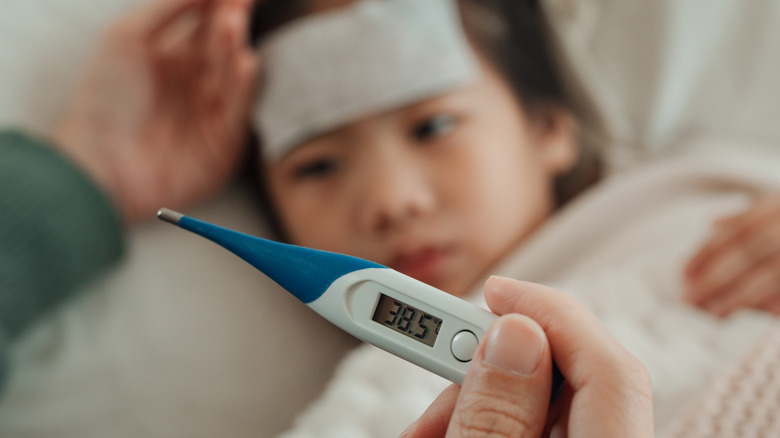
While Dr. Margaret Chan spoke at the 2013 Minamata Convention, which sought to phase out the production, import, and export of mercury-based medical instruments, as the then-director-general of the World Health Organization (WHO), she outlined the dangers of the chemical. "Mercury is one of the top ten chemicals of major public health concern and is a substance which disperses into and remains in ecosystems for generations, causing severe ill health and intellectual impairment to exposed populations," Dr. Chan said.
In 2024, the WHO reported that Albania, Burkina Faso, India, Montenegro, and Uganda had all joined a $134 million project to put an end to mercury use in medical devices. Meanwhile, Europe banned the production and distribution of mercury-based thermometers in 2009. These days, the best way to take your temperature is with a digital thermometer, which obviously comes without the risk of mercury exposure. For decades, mercury thermometers were considered the most accurate method for temperature-taking. However, a 1986 study in the Journal of Advanced Nursing found that mercury and digital thermometers were neck-and-neck in accuracy on average.
In some ways, a digital thermometer might give a slightly more accurate reading because it provides a precise number and eliminates the need for guesswork that a mercury thermometer requires. Moreover, a digital thermometer can provide more ease of use since it doesn't require the user to shake it to move the mercury in place. Of course, a digital thermometer generally also provides results in under 60 seconds, while its age-old counterpart can take a few minutes to tell if your temperature is high enough to be a fever. Still, it's important to know how and when to use the numerous other types of thermometers.