

Why Bathing Wasn't Considered Good Hygiene For Cowboys In The Wild West

Cowboys apparently weren't all too concerned with bathing. However, their lack of concern wasn't due to ignorance or laziness, but on account of an incorrect belief that was popularized in the 1800s. In a Medium post by Regina Clarke, who has a PhD in English Literature and a deeply rooted interest in the Wild West, she wrote that people strongly subscribed to the belief that water had played a part in the spread of the bubonic plague.
An article published in The American Journal of Medicine in 2020 similarly stated that the idea that warm baths caused the plague to enter the human body through the pores had been cemented centuries back. So, it's only natural that cowboys would want to adhere to such a long-held belief. However, due to advancements in science, we now know that the bubonic plague didn't spread through water. According to the CDC, the plague bacteria can enter the human system through infected flea bites, touching the fluids or tissue of an infected animal, and inhaling droplets that have been spread in the air by an infected person or animal.
Still, hygiene has looked different throughout history due to the plague and other outbreaks from the decades. However, supposed health risks aren't the only thing that kept cowboys from bathing often. According to Distinctly Montana, cowboys also faced practical concerns, since clean water was limited in those days due to a lack of rainfall and water pollution. So, people who lived in the Old West had no choice but to decide how to spend their limited water supply, and personal hygiene wasn't always a priority.
Cowboy bathing practices may have done more harm than good
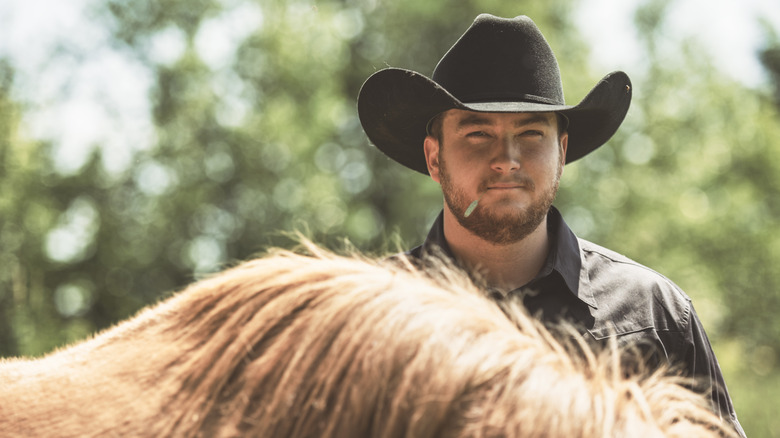
According to Way Out West, cowboys usually cleaned themselves up only when it became an absolute necessity. Even then, they wouldn't treat themselves to a bath and instead resorted to dipping a rag in water to conserve it. Some people preferred using soap made of lye and animal fat for their clothes, utensils, and bodies.
Poison Control notes that lye is commonly found in products like drain cleaners and toilet bowl cleaners. Thus, it's unsurprisingly not the best choice for human skin and can trigger skin irritation and chemical burns, or even cause blindness. Lye can also cause irritation in the nose and the throat. Moreover, using a washcloth to clean yourself didn't do much for the cause either. In a chat with Marie Claire, board-certified dermatologist Dr. Hadley King explained why washcloths weren't the most hygienic option for cleaning, saying, "When used, germs [on a dirty washcloth] are then spread or reintroduced to the skin, which can cause irritation and even infection."
These days, we know that the germs on washcloths can be reduced by leaving them out to dry. Back then, a dirty washcloth was the least of a cowboy's concern, so they likely didn't bother with the practice. Way Out West notes that since water was so scarce, washing hair wasn't a priority, even on days when people cleaned themselves with a washcloth. As a result, it wasn't uncommon for people to deal with lice and other parasites. Considering what happens when you stop washing your hair as well as what happens to you when you stop showering, it's safe to say that cowboys dealt with their fair share of hygiene-related issues.