

The Dental Hygiene Habit Cowboys Used In The Wild West That Would Disgust People Today

To say that cowboys didn't care about dental hygiene would be a massive understatement. According to True West Magazine, people hardly ever brushed their teeth in the Old West. If they felt the need to freshen up when they were at an eatery or at a stagecoach station, they could use the communal "toothbrush," which, as the name suggests, was open to use for everybody.
Speaking with Good Housekeeping, Dr. Nigel Carter OBE, Chief Executive of the British Dental Health Foundation, explained that when you use somebody else's toothbrush, you don't just come into contact with their saliva. You're potentially also exposed to their blood since bleeding gums are a common problem. With that exchange, you open yourself up to contracting bloodborne illnesses. "We all have unique bacteria in our mouth," Carter added. "Adding extra bacteria to this mix by sharing a toothbrush can have unintended consequences by changing this mix of bacteria (and adding new ones). This can cause dental decay, gum disease and even tooth loss."
Additionally, in a chat with the Oral Health Foundation, Dr. Ben Atkins, dentist and trustee of the organization, said that sharing toothbrushes could also lead to the transmission of viruses and bacteria that cause common colds and cold sores. These days, everybody knows why you should never use someone else's toothbrush. However, since dental hygiene wasn't a priority in those days, it's unsurprising that people went ahead and brushed their teeth with a communal toothbrush, which was nothing like its modern-day counterpart we use daily. In fact, even the toothpaste that cowboys used was quite different from the ones we use these days.
Cowboys had to get creative for toothbrushes and toothpastes
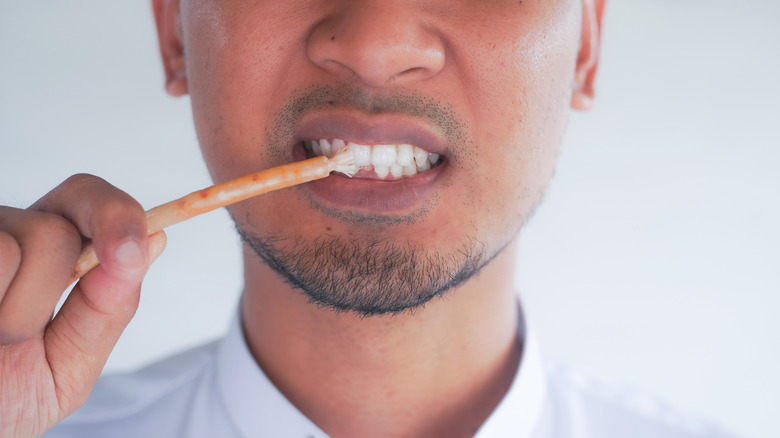
According to True West Magazine, people in the Old West frequently used a "chew stick," a twig that had a frayed edge in lieu of bristles. Although it's unclear what type of twig was used by cowboys, studies have shown mixed benefits to cleaning your teeth with miswak, a chew stick crafted using a twig from the Salvadora persica tree. A 2024 study published in Healthcare compared how miswak fared against toothbrushes in reducing plaque and gingivitis over two weeks. The study concluded that while miswak did help in combating dental plaque, it exacerbated gingivitis, potentially because participants used it too aggressively.
True West Magazine notes that the mass production of toothbrushes in the U.S. only began in 1885. It wasn't until the 1940s that the masses fully learned what happens to your teeth when you brush them and started incorporating the practice into their daily lives. Additionally, people in the Old West had to get creative since toothpaste wasn't a thing in those days.
Way Out West writes that cowboys frequently relied on tooth powders, baking soda, or salt to give their teeth what they perceived as a thorough cleaning. Over the years, many have sought to determine whether it's fact or fiction that baking soda will whiten your teeth. Speaking to CNN, Dr. Matt Messina, an Ohio-based dentist and assistant professor at the Ohio State University College of Dentistry, said that while the mildly abrasive properties of baking soda could temporarily whiten teeth, they could also damage the enamel. Messina said that salt didn't offer any teeth whitening benefits, but could also damage the enamel.