

What Is The Lifespan Of A Toothbrush?
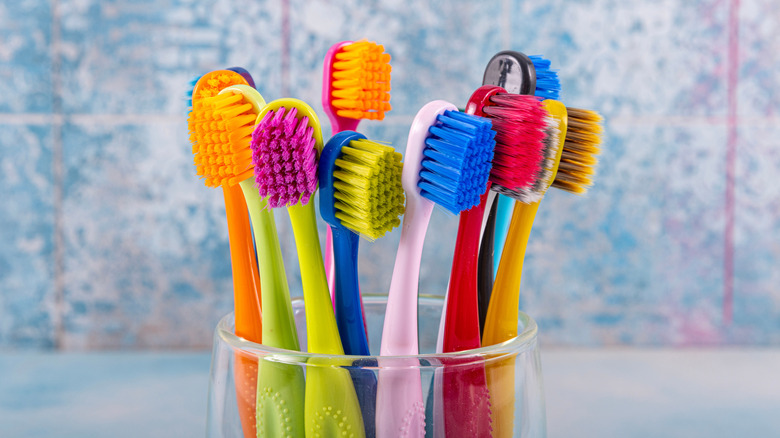
Personal question here. When's the last time you changed your toothbrush? If it's been more than three or four months, you're actually guilty of a mistake you probably didn't even realize you were making with oral health. According to the American Dental Association (ADA), toothbrushes should be replaced every three to four months, or if they're starting to look worse for wear. And the same goes for how often you should be changing your electric toothbrush head, too.
"The bristles just wear out. The more we use it, especially if people are brushing too hard, those bristles are going to become frayed or bent or splayed," Iwonka T. Eagle, director of the graduate dental hygiene program and a clinical associate professor in the department of periodontics and oral medicine at the University of Michigan School of Dentistry, told Time in June 2026 about one of the most common mistakes everyone makes when brushing their teeth. "As they become worn out, they become less effective at removing plaque from tooth surfaces, especially at the gum line. Worn bristles are just not going to contact the tooth surfaces as predictably or as accurately." Eagle's advice: In the event you don't even know when you last replaced your toothbrush, treat it as a sign that it's absolutely time.
How to get the maximum lifespan out of a toothbrush

How and where you store your toothbrush is equally important to maximize its three- to four-month lifespan. The ADA advises that toothbrushes should be stored in an upright position to ensure that they dry adequately.
Unfortunately, that means no toothbrush covers. Not only are covers bad for the bristles, but they also trap moisture, which makes them breeding grounds for bacteria. "Using a toothbrush cover doesn't protect a toothbrush from bacterial growth, but actually creates an environment where bacteria are better suited to grow by keeping the bristles moist and not allowing the head of the toothbrush to dry out between uses," said Lauren Aber, MHS (Graduate Student, Quinnipiac University), lead author of a study about toothbrush contamination in communal bathrooms that was presented at a 2015 conference (per Science Daily).
This should also probably go without saying, but storing a toothbrush right above the toilet is a no-go. "The bacteria from the toilet will land on your toothbrush," Dr. Ellie Phillips, DDS, and an oral health educator stressed to Fox News in 2024. "And your toothbrush picks up all the bacteria in your mouth in a single use." In the event you've been storing your toothbrush anywhere near your commode, it's time to throw it out and find a new home for its replacement — far, far away from where nature calls.