

Is Dementia Hereditary? Bruce Willis' Daughter Has Been Open About Her Genetic Testing
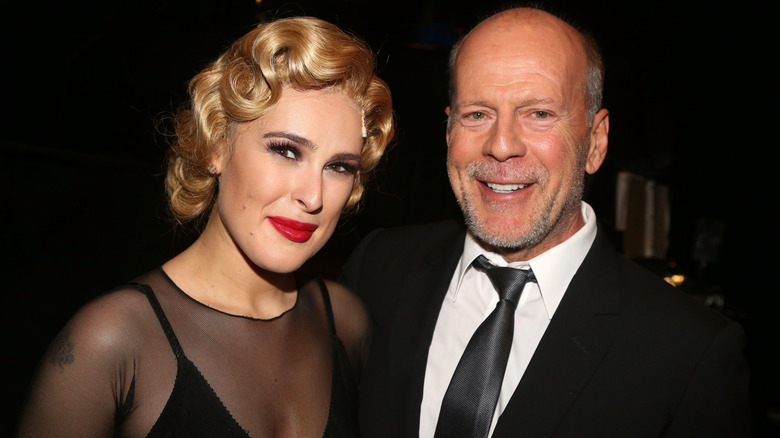
While Bruce Willis' daughter, Rumer Willis, adjusted to her dad's aphasia and frontotemporal dementia diagnoses in 2022 and 2023, respectively, she understandably became more serious about her own health. Speaking to People in August 2026, Rumer shared that she had undergone APOE genetic testing, which searches for the apolipoprotein-E protein that has been associated with higher risks of developing Alzheimer's disease. "It's terrifying to get answers sometimes," the "Wild Cherry" actor said.
Rumer was admittedly afraid of what genetic testing might reveal, but she also noted that she'd been making positive lifestyle changes even before her testing to help her live a long, healthy life. Ultimately, Rumer believed that the results would help her better advocate for herself before medical professionals. In an Instagram post, Rumer shared that the results of her genetic testing put her at a "pretty average" risk of developing Alzheimer's disease. Rumer, who Bruce shares with ex-wife Demi Moore, further elaborated, "It also just means that there is some risk, but it's not crazy."
Now, there's no denying that Rumer took the right step by getting tested since it helped clear some of her doubts. However, it's also important to remember that most cases of dementia seemingly don't have strong genetic ties. Over 99 out of 100 cases of Alzheimer's disease, the most common form of dementia, can't be chalked up to genetics. That doesn't mean that there's absolutely no genetic link, though. Over the years, researchers have identified more than 75 genes that can affect the odds of developing late-onset Alzheimer's disease, and each form of dementia has its own relationship with genetics.
Some forms of dementia have stronger genetic links than others
Although some causes of Alzheimer's disease remain unclear, research suggests that a small percentage of cases can be linked to alterations in hereditary genes. Among the genes that have been linked to the condition, the aforementioned apolipoprotein-E (APOE) stands out as the strongest link. According to a 2025 article in Stanford Medicine, one-fifth of the world's population carries the gene's APOE4 variant.
However, the majority of these people will not develop Alzheimer's disease. The risk of developing the condition depends on factors like the APOE gene variant and how many copies of it a person is carrying. Additionally, different types of dementia come with varied genetic risks. For instance, Bruce Willis' condition, frontotemporal dementia (FTD), can be inherited from parental genes. Around 40% of people who have FTD have one close relative who has been diagnosed with some form of dementia.
Huntington's disease and familial prion disease also have a higher risk of being genetically inherited. Having a parent with either of these two rare conditions brings the risk of developing dementia to 50%. Another rare condition, early-onset Alzheimer's disease, which is when symptoms set in before the age of 65, is also highly likely to be the result of parental genes. While genes can apparently play a part in rarer forms of the condition, it's important to remember that there are plenty of things you can do to decrease your risk of Alzheimer's disease, which is one of the top 10 causes of death in the world.