

Scarlet Fever Or Something Else? Re-Examining The Medical Case Of Mary Ingalls
We may receive a commission on purchases made from links.
For many years, avid readers of Laura Ingalls Wilder's "Little House" series were under the impression that her older sister, Mary Ingalls, lost her eyesight at 14 years old after a bout of scarlet fever. "Mary and Carrie and baby Grace and Ma had all had scarlet fever. Far worst of all, the fever had settled in Mary's eyes and Mary was blind," Laura famously penned in her fifth book, "By the Shores of Silver Lake." Interestingly enough, however, in an unpublished draft of "Pioneer Girl," Laura attributed Mary's blindness to a subsequent stroke after "a severe case of measles" (via Jezebel).
It wasn't until March 2013 that researchers published an in-depth study in Pediatrics — "Blindness in Walnut Grove: How Did Mary Ingalls Lose Her Sight?" — ultimately concluding that it was not complications of scarlet fever or measles but rather viral meningoencephalitis that caused Mary to go blind. "It was like a lot of like if then, if then, if then, so ... that part was really just to bring us up to, yeah, I don't think it's scarlet fever," Dr. Beth Tarini, the study's lead author and assistant professor of pediatrics at the University of Michigan, recalled during a joint appearance on the "Land of Laura" podcast about how they eventually nixed the scarlet fever theory. Then, they dug further to hopefully find what it really was.
Meningoencephalitis is a serious medical condition wherein the patient experiences inflammation of the protective layers of the brain and the tissues of the brain concurrently. It can be spread through the air or from person to person, or manifest as the result of an autoimmune reaction.
Laura Ingalls Wilder claimed that Mary Ingalls suffered from 'some sort of spinal sickness'
Ultimately, Dr. Beth Tarini and the rest of her research team were first pointed toward the viral meningoencephalitis diagnosis after obtaining past correspondence between Laura Ingalls Wilder and her daughter and editor, Rose Wilder Lane. In the research paper published in Pediatrics, the authors cited a letter that Laura wrote in 1937. "Mary had spinal meningitis [sic] some sort of spinal sickness. I am not sure if the Dr. named it. We learned later when Pa took her from De Smet, South Dakota to Chicago, Illinois to a specialist that the nerves of her eyes were paralyzed and there was no hope," the letter read.
Additionally, Mary's registration records from the Iowa College for the Blind (via Pediatrics) noted that her cause of blindness was "brain fever," a term people used to use to describe meningitis. And during an interview with the University of Michigan's The University Record in 2013, Tarini cited Mary's symptoms — as reported in The Redwood Gazette on April 24 and May 15, 1879 — to support the viral meningoencephalitis diagnosis as well. "Meningoencephalitis could explain Mary's symptoms, including the inflammation of the facial nerve that left the side of her face temporarily paralyzed," Tarini explained, "and it could also lead to inflammation of the optic nerve that would result in a slow and progressive loss of sight."
Scarlet fever is unlikely to cause blindness
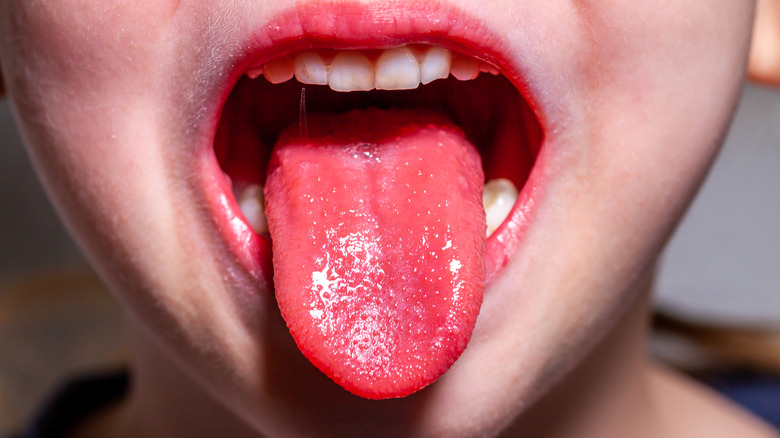
Contrary to popular belief, the authors of "Blindness in Walnut Grove: How Did Mary Ingalls Lose Her Sight?" discounted scarlet fever as the reason for Mary Ingalls' sight loss. "Scarlet fever is unlikely because there isn't eye involvement with that disease," Dr. Sarah Allexan, co-author of the study, explained to HealthDay in 2013 about the longstanding myth surrounding the infectious bacterial illness that can cause a rash as well as strep throat, which is different than a sore throat.
Alas, many are still under the false impression that scarlet fever and blindness go hand in hand — and Dr. Beth Tarini believes that Laura Ingalls Wilder's popular books may have a little something to do with that. "Familiar literary references like these are powerful — especially when there is some historical truth to them," Tarini explained in a press release (via CBS News). During an interview with The New York Times, Tarini also noted that when diagnosing a child with scarlet fever, she has to work overtime in order to quell the parents' misguided fears. "In my mind, it's no different than a strep throat with a rash, but the specter of history colors their reaction," Tarini said.
Tarini believes that Laura and her daughter, Rose Wilder Lane, may have opted to attribute Mary's blindness to scarlet fever simply to help the reader better understand, as they were already familiarized with the disease from other literary works, including Mary Shelley's "Frankenstein," Louisa May Alcott's "Little Women," and the children's classic "The Velveteen Rabbit," written by Margery Williams.
The appearance of Mary Ingalls' eyes and her report card also helped narrow things down

In their study, Dr. Beth Tarini and her co-authors were also able to rule out the theory that Mary Ingalls lost her eyesight to measles, an illness caused by a virus and that presents with a rash, simply due to the way Laura Ingalls Wilder referred to Mary's eyes in "By the Shores of Silver Lake," recalling that her "blue eyes were still beautiful." Allexan explained one of the side effects of losing your eyesight from this disease during a joint appearance on the "Land of Laura" podcast, saying, "If she had had measles, then that would cause a pan-sclerosing type of feature which would show scarring essentially of the eyes."
But that's not all. During the same podcast episode, they also cited a report card that Mary received from the Iowa School of the Blind wherein she received straight A's, to determine that she was "neurologically intact in terms of her intellect," thus distinguishing their diagnosis of viral meningoencephalitis as opposed to bacterial meningitis. "That really wasn't something that was affected by the disease," Allexan concluded, referring to the symptoms of meningitis, including a rapid onset of cognitive and neurological changes.