

Barbara Palvin's 6-Week Postpartum Victoria's Secret Walk Shouldn't Be The Universal Standard

Hungarian supermodel and actor Barbara Palvin turned heads everywhere when she strutted down the runway on October 18 at the 2026 Victoria's Secret Fashion Show merely weeks after having her first child, a daughter named Sylvie. "I tell everyone: This is normal. Maternity leave is six to eight weeks; I'm six weeks tomorrow, so I'm just doing what everyone [else] is doing. And I only need to walk down a runway!" Palvin told Page Six ahead of her big catwalk debut as a freshly postpartum mother. And, honestly, kudos to her! She looked great!
We would be absolutely remiss, however, not to add a disclaimer that while six weeks of maternity leave may work for Palvin and her family, it should in no way be considered "normal," as she noted, or the universal standard for women everywhere — let alone a job that requires shimmying your freshly postpartum body into beautiful, albeit barely there, lingerie and catwalking down a runway in sky-high stiletto heels. In fact, Palvin's husband and father of her child, actor, businessman, and podcast host Dylan Sprouse, said as much when he praised her ahead of her big day back at work. "Proud of my missus, jumping right into the vs fashion show post birth. Built different," he gushed on his Instagram stories on October 16, along with sharing a photo of Palvin walking their dog and simultaneously wearing baby Sylvie on her chest (via People). "I don't know where you find the energy but d***!"
Barbara Palvin credits luck, eating clean, light exercises, and familial support
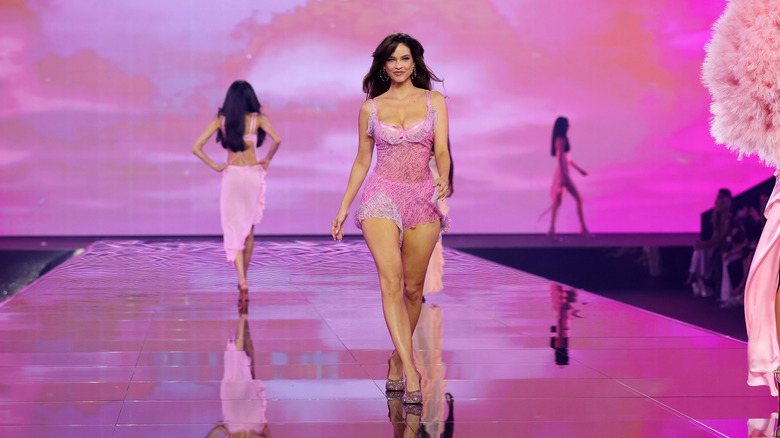
While getting ready backstage for the 2026 Victoria's Secret Fashion Show, Barbara Palvin chalked her postpartum body up to luck and a healthy diet, both during pregnancy and postpartum. She also maintained that she had never felt healthier as a result. "So that's how I prepped: I just let my body heal on its own and did some light exercises, but nothing crazy," she told Page Six. Still, other women who are freshly postpartum should not play the comparison game, as in many circumstances the specifics surrounding one woman's postpartum recovery can be very different from another. Palvin, herself, was open and honest during the backstage interview about having a great support team surrounding her, including her parents, who flew in for the first three weeks after giving birth, and other friends and family who delivered food — most likely healthy and all organic — to her door. No doubt, many other women would consider that alone to be very lucky.
There's also the big genetics argument to contend with. Every postpartum body is different, and just because someone else appeared to recover quickly doesn't mean everyone else will or should too. And that's okay! You should not exert yourself or rush to get your body back in an attempt to keep up with someone else's postpartum journey, even someone like Palvin. In fact, that's actually big on the list of things you shouldn't do after giving birth.
An investigative report found that nearly 1 in 4 women return to work within 2 weeks of giving birth

Unfortunately, no matter how well-intentioned Barbara Palvin's sentiments were, her comments about the supposed "normal" amount of maternity leave only fan the flames of the ongoing discourse surrounding paid maternity leave in the United States, or, in this particular case, the lack thereof. As it turns out, according to the Institute for Women's Policy Research (IWPR), the United States is the only Organisation for Economic Cooperation and Development (OECD) country without a federally mandated paid parental leave policy.
A 2015 investigative report by In These Times titled "The Real War on Families: Why the U.S. Needs Paid Leave Now" concluded that due to the lack of federally mandated paid leave, women, families, and children are suffering "devastating effects." According to the data from the report, nearly 1 in 4 women actually go back to work within two weeks of giving birth — namely those "without adequate options or support, low-income workers, who are more likely to live paycheck to paycheck and less likely to have access to any type of leave." The report also noted that going back to work too early could exacerbate postpartum depression in mothers — a mood disorder that can occur along with all of the other things that happen to your body after giving birth.