

100 Years Ago Today, This Legendary Daredevil Died After Ignoring Medical Red Flags

Harry Houdini, the legendary daredevil born Erik Weisz in Budapest, Hungary, on March 24, 1874, is best known for his work as a magician, escapist, illusionist, and stunt performer, earning nicknames like "the handcuff king" and "king of handcuffs." Perhaps, however, the only thing more mysterious than the performer's escapes and illusions was the circumstances surrounding his tragic death on October 31, 1926, when he was only 52 years old. It appears the escape artist ignored some major medical red flags that ultimately led to his demise, including abdominal pain and a fever of 104 degrees Fahrenheit (via PBS) — both warning signs from your appendix that you shouldn't ignore.
As reported by The New York Times on November 1, 1926, Houdini succumbed to peritonitis following a bout of appendicitis and a subsequent appendectomy performed way too late. Peritonitis is inflammation of the tissue lining the inside of your abdomen, which can occur after your appendix bursts. "If you've got symptoms of appendicitis, it's critical that you seek medical attention immediately," Dr. James O'Donovan, a physician and health educator, stressed on his YouTube channel, where he offers general health advice.
Harry Houdini's appendicitis symptoms started days before his death
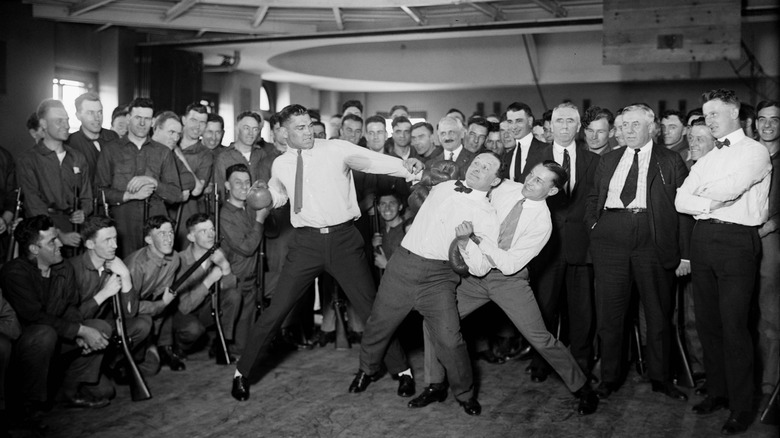
It appears that Harry Houdini first started ignoring his serious health symptoms following a matinee show he performed on October 22, 1926, at the Princess Theatre in Montreal, Quebec. As a famous stunt performer, one of Houdini's claims to fame was that his abdominal muscles were so strong that he could withstand even the most forceful of punches. As such, he often allowed fans to punch him in the stomach. According to PBS, a group of medical students visited Houdini in his dressing room for a meet-and-greet. At one point, one of the students, Joselyn Gordon Whitehead, asked Houdini if he could take a shot. The story goes that Whitehead landed two strong hits before Houdini even had a chance to "tighten his abdominal muscles and brace himself," per PBS. Houdini appeared to be in serious discomfort and ended the exercise by preventing the third hit from making contact.
It's reported that, afterward, Houdini took a train to his next show in Detroit, where he was still in severe pain. Once he arrived in Detroit, a physician visited him at the Garrick Theatre and diagnosed him with acute appendicitis. Ever the professional, however, Houdini continued on with the show. After the show, he continued to refuse medical treatment until his wife demanded he be taken to Grace Hospital, wherein the medical team promptly removed his appendix on October 24, but not before it had already ruptured.
The jury is still out on what caused Harry Houdini's appendicitis

There's still much debate, however, on what actually caused Harry Houdini's fatal appendicitis turned peritonitis. Per PBS, Houdini's doctors initially believed that the blunt force trauma from the punches he sustained nine days before his death triggered the appendicitis. Still, others argue that Houdini probably thought the pain in his abdomen was from the punches, as opposed to realizing appendicitis was the culprit for his severe pain. This particular theory could explain why Houdini kept ignoring the very important medical warning signs.
The authors of a 2023 article titled "Traumatic appendicitis is probably not real: an illustrative analysis of coincidental occurrences in nature," published in Trauma Surgery & Acute Care Open, concluded that the theory that the punch caused the appendicitis was nothing more than a "post hoc fallacy." Additionally, a 2013 literature review published in the World Journal of Emergency Surgery determined that "blunt abdominal trauma is rare and, occasionally, appendicitis and trauma exist together, which causes an interesting debate whether trauma has led to appendicitis."
Conversely, in a 2010 paper titled "Systematic review of blunt abdominal trauma as a cause of acute appendicitis," published in The Annals of The Royal College of Surgeons of England, researchers noted that, while rare, acute appendicitis should be considered following trauma to the abdomen if the patient is experiencing right lower quadrant pain and nausea. With all of this said, the red flags were there for Houdini, and his death will forever be tragic, regardless of how his appendicitis occurred.