

5 Common Myths About Tick Bites That Put You At Risk

Tick bites are becoming a more prevalent reason for emergency room and doctor visits, according to the Centers for Disease Control and Prevention (CDC), which tracks seasonal tick bite occurrences. As epidemiologist Dr. Alison Hinckley put it, "these tiny biters can make you seriously sick."
Some ticks can spread Lyme disease, a condition that can lead to many symptoms, including fever, headaches, and even localized paralysis. In fact, it's estimated that around a half-million people contract Lyme disease every year, although many don't realize it. However, Lyme disease isn't the only disease you can get from ticks. The CDC notes that you can get numerous kinds of viruses, some fevers, and at least one syndrome.
Thus, it pays to protect yourself against the nasty stuff that ticks can share. A good place to start is to understand the most common myths that people believe about tick bites; doing so may help you avoid getting bitten or get treatment as soon as possible.
Myth: You'll know when you've been bitten
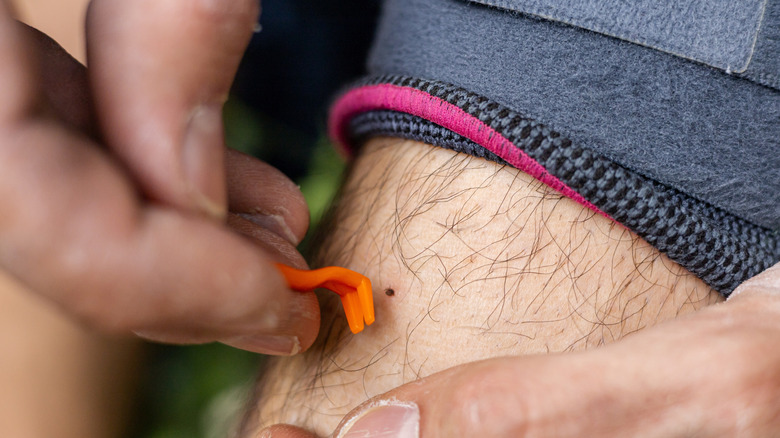
It seems logical to think that you'll know it if a tick sees you as a tasty snack. However, nurse practitioner Janine Rupert told Atlantic Health otherwise. "You usually won't feel when a tick bites," Rupert noted.
Ticks are rather sneaky, as they inject a numbing fluid when they bite. Therefore, you could have been bitten by a tick without realizing it for a long time, even after the tick is gone. The only way to conclusively know if you've been bitten is to look for either ticks that are still on your body or to spot their bite marks.
Ticks are small, so they may not be obvious at first. But a tick that's feeding will become engorged, meaning it may be more visible. If it's in a spot that's covered by hair, you may feel it as a small bump. A tick bite can look like a small, pin-sized puncture wound that may or may not be raised. Around the wound, you may see a bullseye rash, bruises, or other signs of topical irritation (via GoodRx).
Myth: Lyme disease always causes a telltale rash
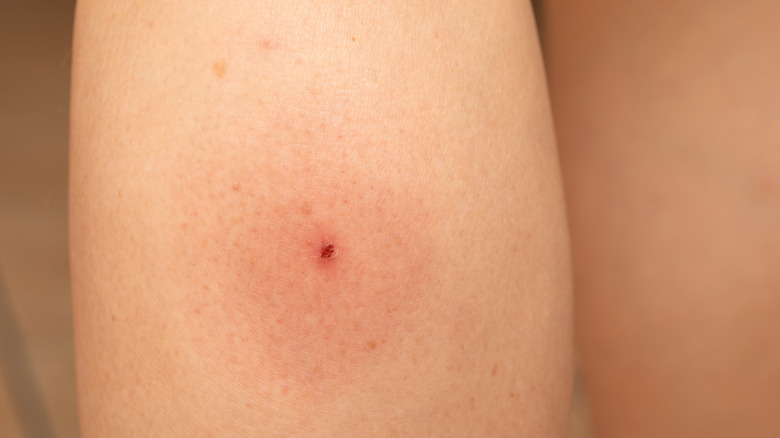
The CDC notes that approximately seven out of 10 people diagnosed with Lyme disease have a classic "bullseye" rash. However, a bullseye rash on your body isn't a surefire sign that you've been bitten by a tick or that you are at risk of developing Lyme disease. Other medical conditions can cause a bullseye rash, including ringworm and certain rashes. Plus, some kinds of tick bites don't end up leaving any physical traces.
So, what should you do if a bullseye rash appears on your body? The Bay Area Lyme Foundation recommends taking a picture of it, possibly next to a measuring tape or ruler to show the scale. Afterward, visit a medical professional who can examine you and possibly administer a Lyme disease test.
Know that the test isn't foolproof, though: It can take weeks for your body to create enough Lyme disease antibodies to give you a positive test result (via CDC). Nonetheless, testing allows you and your provider to know if you might benefit from taking antibiotics, the main treatment protocol for Lyme disease. Fortunately, Lyme disease can be cured.
Myth: You have to be in the woods to get bitten by a tick

People tend to believe that if they're not in wooded areas, they're free from tick exposure. While certain types of woods definitely have more ticks than the suburbs (especially forests with a mix of vegetation, according to a 2023 article in Forest Ecology and Management), any place with tall grass and shrubs can have ticks. That's because ticks live on the ground and hitch a ride on their hosts: They can't jump or fly, but they can effectively latch onto your clothing or skin as you're walking by them.
So even if you're just going to your neighborhood park for the day, wear preventative gear. This can include long socks, shirts with full-length sleeves, long pants, and possibly even clothing that's been treated with a special anti-tick repellent. When you get home, conduct a thorough tick check to make sure none of the little critters get past you.
Can you safely remove a tick? Yes: If a tick is attached to you, use tweezers to carefully remove it and flush it down the toilet or place it in a plastic bag in case your doctor wants to test it later. If ticks are walking on your clothing, tick illness expert Dr. Daniel Cameron suggests placing the clothing in a dryer at high heat for 10 minutes to kill them.
Myth: You'll be able to get a Lyme disease diagnosis right away

The CDC says that it can take as little as three days for you to start experiencing symptoms due to a tick bite. On the other hand, you might go weeks or months before having any signs at all. In fact, many people aren't diagnosed with Lyme disease and other tickborne illnesses immediately because their symptoms can mimic those of other diseases. Alternatively, they may have less obvious signs of Lyme disease that are hard to spot, such as nerve pain.
What's the best way to approach a personalized and pragmatic diagnosis journey if you suspect you might have been bitten by a tick carrying Lyme disease? First, anticipate that it may take time to figure out what's wrong with you if you go to the doctor with common symptoms like fatigue or an elevated temperature.
In an interview for Johns Hopkins Rheumatology, Dr. John Aucott lays out what patients should expect when working with a doctor. "Lyme disease is diagnosed by a combination of features," he notes, adding that multiple rounds of testing may be required before Lyme disease makes itself known. That said, Dr. Aucott does admit that patients with "early summer flu-like illness that is not typical, that lacks typical viral symptoms like runny nose or prominent cough or prominent diarrhea" should be seen as a red flag.
Myth: Ticks are just a summer problem

Although tick bites tend to become more prevalent in the summer months, they're not just a seasonal issue. In an interview with TODAY, entomologist Dr. Matt Frye noted that it's important to be vigilant year-round: "It's getting warmer, it's getting wetter and we're getting longer summers. So the ticks are moving all over the place." Additionally, ticks aren't creatures that disappear until it gets really cold. "If the temperatures are above freezing, you have a chance of encountering a tick," Dr. Frye asserted.
An NPR report from 2026 suggests that climate change may be one of the reasons that more tick bites are being reported outside the summer months. The year has seen the greatest trips to the emergency department for tick bites across the United States in the past 10 years (via Axios). Therefore, it's wise to take precautionary measures (like wearing proper clothing and checking for ticks and bites) all the time, not just in the summer.