

5 Unspoken Plane Hygiene Rules Flight Attendants Absolutely Can't Stand You Breaking
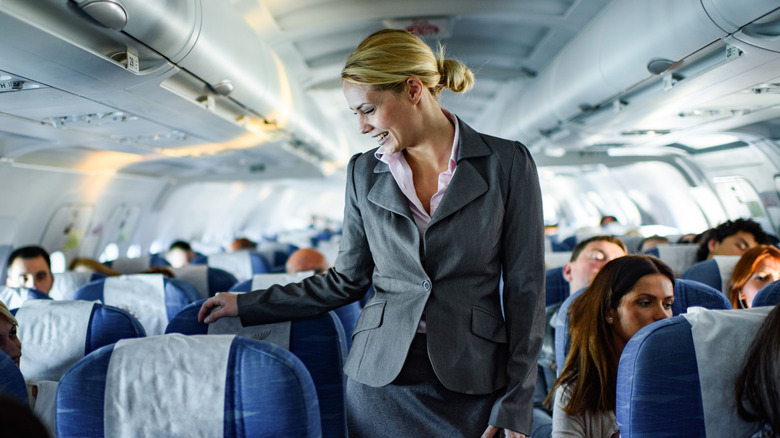
Sometimes, the "friendly skies" aren't so friendly after all, especially for flight attendants. In addition to all their other duties, they have to deal with the less-than-hygienic practices of travelers.
Certainly, flight attendants understand that not everything related to your airplane hygiene or what happens to your body when you fly is completely under your control. Take vomiting, for instance; airsickness happens to about 0.5% of passengers, according to a 2000 study in Aviation, Space, and Environmental Medicine. Fortunately, that makes actual vomiting rare. Flight attendants understand this, and do their best to mitigate those kinds of unpleasant occurrences, even if they don't particularly like the results. As one flight attendant recalled to Thrillist, a flight she worked on included a passenger whose vomiting caused a domino effect. "The entire last two rows of passengers were puking," she noted.
With that said, here are five unspoken plane hygiene rules that you can (and should) follow on your next flight.
Rule #1: Cleaning up after yourself
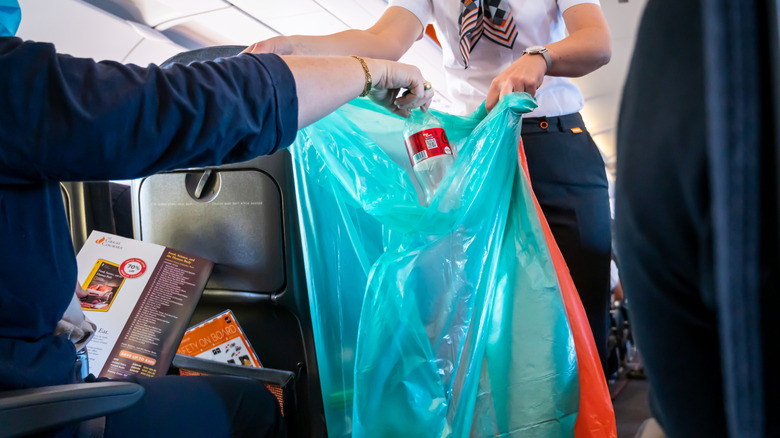
It's great when you get freebies like packages of nuts and pretzels during your flight. However, be sure to discard all of your trash properly. Sure, crumbs will happen. But turning your seat into a landfill? Bad choice — and one that could likely make someone else get sick.
For instance, a flight attendant shared a reel on Instagram admonishing people to stop leaving behind their dirty, used facial tissues. As she explained, "Every single day we find tissues stuffed into seat pockets, left on seats, and tucked into places they definitely don't belong." Likewise, an airplane cleaning staff member ranted on a now-unavailable TikTok (via New York Post): "Why did I find a diaper under a seat?"
Exposing other people to dirty tissues and diapers could put them in harm's way. For example, viruses can spread through filthy surfaces that contain bodily fluids, like nasal drainage. The same holds with the potential spread of viruses or bacteria on a dirty diaper, particularly if people don't wash their hands after touching it. Basically, when in doubt, take your garbage with you and dispose of it appropriately in the terminal.
Rule #2: Saving grooming habits for when you're not on the plane
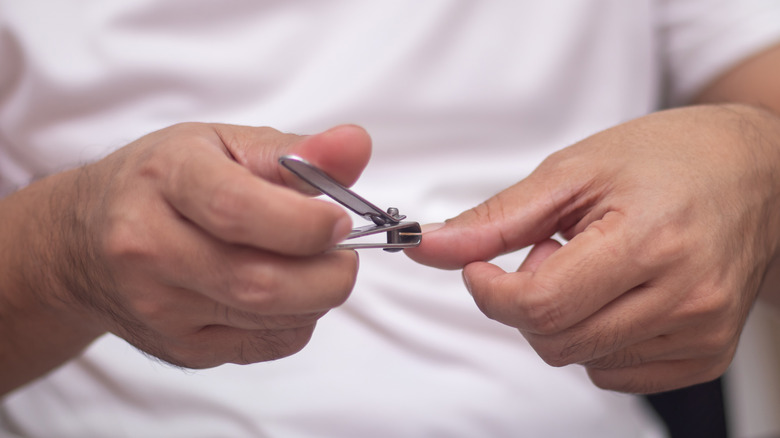
Personal hygiene practices like clipping your fingernails, tweezing your eyebrows, and flossing your teeth shouldn't be happening on a plane. Yes, you're bored because you're sitting for hours. But your boredom doesn't give you the right to expose others to your grooming habits.
Unbelievably, this type of occurrence happens more frequently than you might imagine, according to flight attendants online. One flight attendant took to TikTok to complain in a now-unavailable video that showed bits of toenails scattered across the floor. According to Vice, the video creator explained, "The passenger clipped their toenails mid-flight and left them."
Is it ever okay to groom in your plane seat? Etiquette expert Diane Gottsman told The Points Guy that grooming usually isn't critical, so you shouldn't do it during your flight. As she explains, "Do not clean your ears, use your battery-operated razor or apply sunless tanner in the cabin of an airplane. You are not at home." Perhaps one flight attendant said it best: "The aircraft is not a beauty salon."
Rule #3: Using the bathroom in an efficient manner
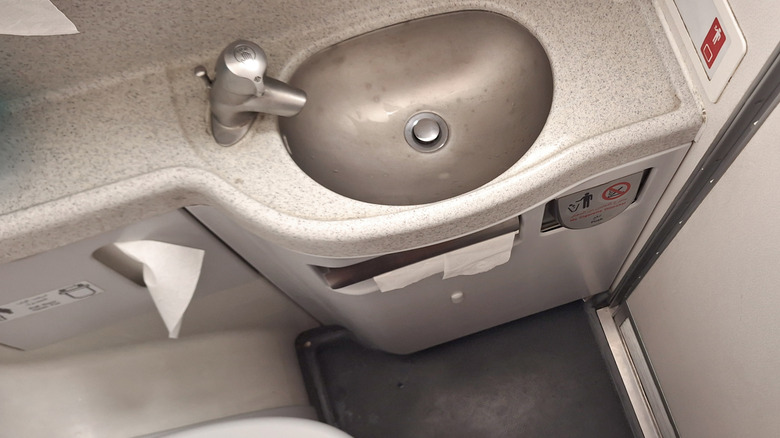
Unless you're having urinary or bowel troubles, staying in the airplane bathroom for tons of time isn't acceptable. In fact, you might cause the cabin crew to wonder if you're still alert.
How long is too long? A former flight attendant told Time that you should aim for 10 minutes maximum — and ask for a packet of coffee grounds to absorb odors if you know you're going to stink up the cramped restroom. While you're at it, avoid slipping off your shoes in the lavatory. A flight attendant on Instagram explains, "The floor in an airplane lavatory is not a place your bare feet should be touching," adding that "the liquid you see on that floor is not always water." In general, you shouldn't be walking barefoot inside a plane or even at the airport (which, as you might be aware, was revealed to be Robert F. Kennedy, Jr.'s gross hygiene habit).
Overall, when you gotta go, get in, do your business, and leave. And rather than brushing your teeth on the plane, wait until you disembark. Otherwise, you could end up splashing water all over, as well as leaving toothpaste splatter on the mirror.
Rule #4: Not spraying perfumes while you're on the plane
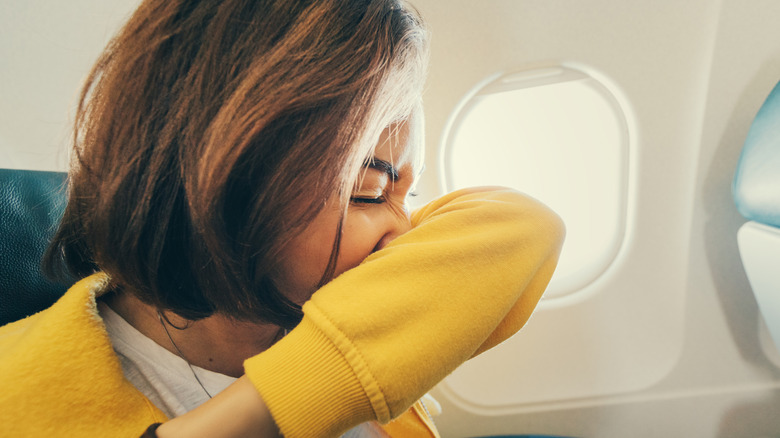
One travel journalist said perfumes and planes don't mix. In an Instagram reel, she commented, "At 30,000 feet in recycled cabin air it [your perfume] becomes a cloud nobody can escape." Many followers agreed, with one remarking that she'd endured a two-hour flight that left her with a headache afterward due to someone's fragrance. Indeed, nearly one-third of the population may experience fragrance sensitivity issues, according to a 2019 article in Air Quality, Atmosphere and Health. When their sensitivity or allergy is triggered, they may experience uncomfortable health responses, including headaches and respiratory problems.
A flight attendant who spoke with Newsweek took the whole "spraying with perfume" to a more philosophical level. Specifically, she felt that dousing yourself in perfume in an enclosed area anywhere — not just on a plane — shows a terrible lack of consideration. Said the attendant, "I strongly believe that whenever you do something, you should put yourself in someone else's shoes and see if that's the way you'd like to be treated."
What can flight attendants do when passengers slather on fragranced moisturizers or spritz perfume? According to one flight attendant who talked to Fodor's Travel, their options may be limited. That said, flight attendants may be able to move a passenger away from one who has a strong smell, especially before the flight leaves. But in general, they can mainly act as mediators.
Rule #5: Showing discretion when changing a diaper in flight
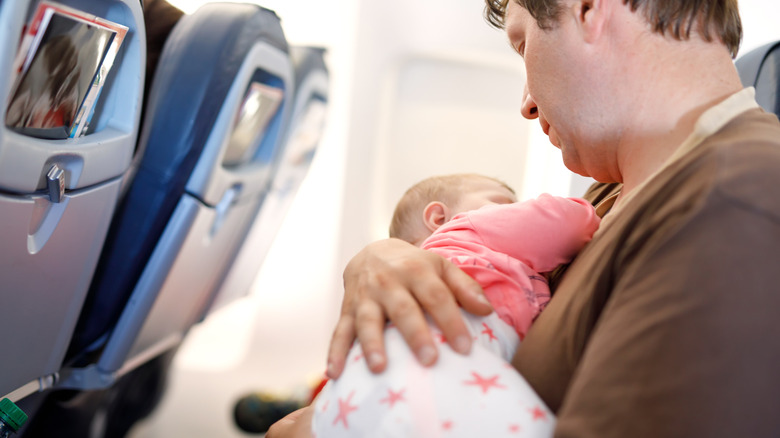
Parents know that they sometimes will have to change their baby's diaper during a flight. However, flight attendants hope they'll be discreet. Regrettably, at least one flight attendant has dealt with moms and dads who treat the pull-down tray as a diaper change area. "I don't appreciate what is happening at the moment," she recalls. She also reminds everyone that there is a baby changing table in the bathroom and, in her experience, elsewhere on the plane (via Matador Network).
This is probably one of the more unhygienic of all airplane passenger behaviors, because the pull-down tray is a surface that people use for holding their food. That surface also happens to be one of the filthiest on the plane. A study commissioned by Travelmath found that pull-down seat trays contain more bacteria than you'll find in plane toilet flusher buttons, air vents, and seatbelts. (Yet more reason to make sure you don't wash your hands for less than 20 seconds after exposure to any surface.)
Speaking of changing diapers, always be considerate when disposing of soiled ones. Handing it to a flight attendant probably isn't the best solution, especially if you haven't even tried to wrap it up in a bag.