

What Are Red Flag Signs Of Bad Hygiene?
There are plenty of reasons to care about having good hygiene that go beyond wanting to leave a good impression on others. For starters, experts have repeatedly cautioned that poor personal hygiene can give rise to numerous illnesses and infections. This includes include athlete's foot, body and head lice, scabies, swimmer's ear, and ringworm. Even skipping a basic practice like washing your hands can lead to problems like food poisoning, gastroenteritis, cold and flu, and hepatitis A.
Even worse, poor hygiene has also been shown to affect mental health. A 2025 study in PLoS One noted that people with mental health issues who neglected personal hygiene were at a higher risk of experiencing more social isolation as well as decreased self-esteem. Hygiene could also factor into employment decisions. Per Dentistry, a 2013 online survey by Axa PPP found that 44% of senior decision-makers in small and medium-sized enterprises admitted they would have hesitations about promoting an employee with bad breath and unpleasant teeth, irrespective of their professional capabilities.
With that said, poor hygiene isn't always the result of laziness. Mental health conditions (e.g., depression, PTSD) and socioeconomic status can also influence one's access to products that enable one to engage in safe hygiene practices. According to The Hygiene Bank, 69% of adults who are unable to afford basic hygiene products have to choose between spending their financial resources on essentials and hygiene products. However, with the rise of lifestyle movements that discourage regular showering, it's important to be mindful of when something crosses the line from personal choice into straight-up bad hygiene.
Body odor is among the most obvious signs of poor hygiene

There are plenty of sneaky causes of body odor that might surprise you. However, on a basic level, it can also be a sign that a person is not practicing good hygiene. People don't get body odor because they sweat a lot, since sweat itself doesn't have a smell. Instead, body odor occurs when bacteria come into contact with sweat. For the most part, body odor occurs when sweat containing fat and compounds produced by the apocrine glands, which are present in the armpit, groins, and hair follicles, comes in contact with the bacteria.
So, body odor is naturally a hygiene red flag that shows what happens to your body when you stop showering. One of the best antidotes to body odor is to take regular showers with antibacterial soap and focus on areas where the apocrine glands are present. It can also be beneficial to hit the shower shortly after you exercise. After reading all this, some may find themselves asking if shaving their armpits helps reduce smell.
Shaving your armpits regularly could prevent the area from becoming a breeding ground for bacteria and also reduce sweat. Additionally, a 2015 study in the Journal of Cosmetic Dermatology found that waxing and shaving armpits reduced odor levels in men. Armpit odor could be further reduced by using an antiperspirant since they prevented the sweat glands from producing sweat in the first place. Even small changes like wearing loosely fitted clothing made of breathable materials could help reduce odor.
Poor hygiene practices may result in skin infections

One of the tell-tale signs of poor hygiene is skin issues. A 2024 study in the European Journal of Cardiovascular Medicine found that children who engaged in poor hygiene practices such as irregular bathing, infrequent nail trimming, sharing towels and clothes, and not changing their clothes daily were more likely to have skin and fungal infections. The most common skin infections that these children dealt with were tinea and other fungal infections, followed by impetigo and bacterial infections, and finally scabies.
However, those aren't the only skin infections triggered by poor hygiene practices. Regularly failing to shower can lead to a condition called dermatitis neglecta. When we wash ourselves regularly, we eliminate the dead skin cells that have formed on our bodies. However, when we forgo the daily hygiene ritual, we make way for a buildup of dead skin cells, which eventually leads to the skin condition. Dermatitis neglecta shows up as scales that look like cornflakes and cling to the skin, as well as hyperpigmentation. Although the condition may look concerning, milder cases can be treated by simple things such as regular bathing and scrubbing the affected areas with a clean washcloth.
Additionally, cellulitis is another skin condition caused by infrequent bathing. The condition occurs when bacteria from the Streptococcus and Staphylococcus groups break past the skin barrier through a cut or a scratch. Once the bacteria break through an area, it can make it warm to the touch, cause swelling, discoloration, tenderness, and pain. In some cases, people may also develop blisters and experience flu-like symptoms. However, regularly showering can help clear bacteria from the skin and reduce the chances of infection.
Dirty, untrimmed fingernails could harbor bacteria
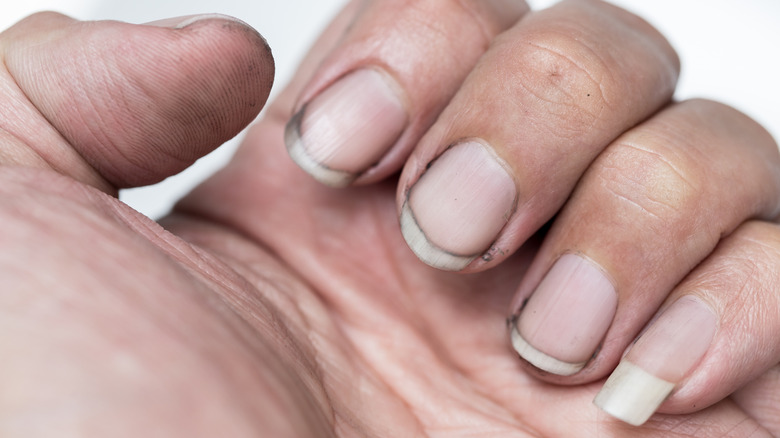
Over time, many have found themselves asking, "What's really under dirty fingernails?" In an interview with Women's Health Magazine, dermatologist Dr. Dana Stern, explained that it was "keratin debris from the underside of the nail, as well as skin cells from the nail bed." Stern also noted that dirt, lint, and the remainder of personal care products could also be present under the nails.
Dr. Stern also cautioned that bacteria were prone to setting up camp under the fingernails. One of these bacteria is Pseudomonas, which gives the underside of the nails a greenish tint and can cause an infection. People who wear artificial nails were at greater risk of harboring Pseudomonas under their nails since the longer nails were "perfect havens for bacteria," according to Dr. Stern. Additionally, a 2017 study in the International Journal of Current Microbiology and Applied Sciences analyzing nail bed samples from 20 college students found that all 20 had bacteria like Staphylococcus and Pseudomonas under their nails.
During Dr. Stern's chat with Women's Health Magazine, she recommended digging your nails into a bar of soap to clear the gunk. She also cautioned against using a nail brush to keep your nails clean since the tool could be a breeding ground for bacteria. Instead, it's ideal to keep your nails short to give bacteria less room to thrive in. Even simple steps like getting soap and water under your nails when you're washing your hands, drying your hands, and regularly moisturizing nails and cuticles could make the area more hygienic.
Bad breath is typically the result of poor dental hygiene practices
Research has notably indicated that what happens to your teeth when you don't brush, and it doesn't look — or smell pretty. According to a 2023 study in Cureus, over 85% of cases of halitosis or bad breath are due to poor oral hygiene, tongue coating, and other intraoral conditions. Chatting with UNC Health Talk, Ram Neelagiri, MD, MPH, said, "If you don't floss or brush your teeth properly, bacteria will break down the leftover food particles and produce an odorous sulfur compound."
Additionally, when we forgo brushing, we let a sticky film of bacteria called plaque reside on our teeth. Left untreated, this can cause irritation and form pockets between the gums and teeth. When that happens, you enter the first stage of gingivitis, a gum disease that causes bad breath that can't be eliminated with brushing. What's more, some studies have hinted that teeth are connected to the health of your organs.
A 2023 study presented at the American Stroke Association International Stroke Conference found that people who practiced good oral hygiene were less likely to deal with the symptoms of cognitive decline. By the same token, tackling oral hygiene issues early on has been linked to potentially improving brain health. Meanwhile, a 2019 study in the European Journal of Preventive Cardiology concluded that brushing your teeth at least three times a day lowered the risk of developing atrial fibrillation and experiencing heart failure. Ultimately, the simple solution to the problem lies in brushing your teeth multiple times per day with a fluoride toothpaste for around two minutes, flossing, and keeping up with your dentist appointments.
Greasy hair could be a warning sign of poor hygiene

Sometimes, the real reason hair gets greasy is that it's not washed enough. Chatting with Mane, Kate Holden, consultant trichologist, explained the simple reason for hair greasiness, saying, "Our hair gets greasy when there is a build up of a natural oil on the scalp called sebum." Holden made sure to note that sebum isn't inherently bad, since it helps provide essential natural hydration to the scalp.
However, too much sebum can be a bad thing for your scalp health. As time passes without a hair wash, it triggers buildup by mixing with dead skin, dirt, sweat, and product residue. This oil accumulation can invite microbes to the scalp and make it harder to curb issues like ringworm, head lice, and seborrheic dermatitis.
This buildup could lead to hair odor. Some may even develop dandruff if they went about a week or two without washing. However, it's worth remembering that over-washing your hair can also make it greasy. During Dr. Holden's chat with Mane, she explained that going overboard with hair washing can trigger your scalp to overproduce sebum. Meanwhile, dermatologist Dr. Shilpi Khetarpal told Cleveland Clinic that a person's hair-washing frequency should depend on their hair type and length as well as their age, ethnic background, and activity levels.