

What Was Life Expectancy Like On The 19th-Century Prairie?
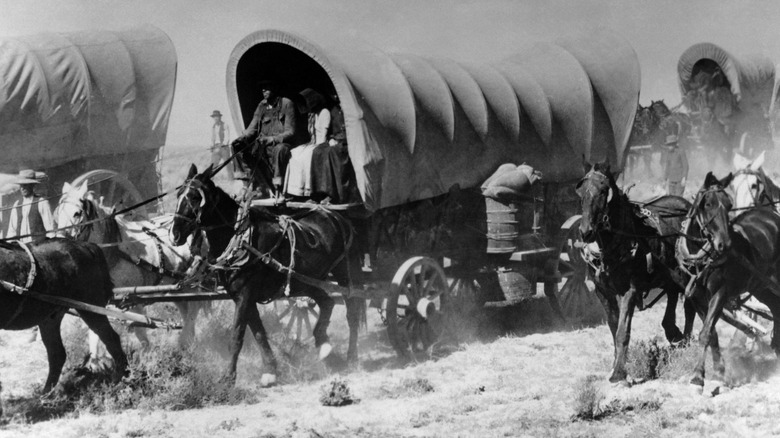
Life was challenging for the people in the Americas who sought their fortunes by moving westward in the second half of the 19th century. From the 1800s to the 1900s, the average life expectancy for people in the Americas was between 34.8 and 41 years (via Our World in Data) and intrepid folks who went westward put themselves at even greater risk, facing life-threatening violence and various health and environmental hazards.
Is it any wonder that many women were less than enthusiastic about moving to the West? As Stephen Aron, professor emeritus of history at the University of California, Los Angeles, shared with History: "Often, in private diaries women lament, 'Why are we going on this foolhardy errand, separating ourselves from these networks we have at home that undergird our lives?'"
According to the National Park Service, up to 10% of people who traveled westward to live on the prairie died of diseases, including malaria (which, up to the present day, remains a reason you might want to worry about a mosquito bite), typhoid fever, diphtheria, and the dreaded cholera. Unfortunately, diseases weren't the only issues that faced them, either.
Folks quickly learned that cholera is a devastating disease that can take lives overnight
Cholera can spread when people drink food or water that's been contaminated by human or animal waste. Cholera causes such intense diarrhea and vomiting that in the mid-1800s, many people died within hours of contracting the bacterial illness, turning the famous 2,000-mile Oregon Trail into a highway filled with graves. Since it wasn't exactly a top priority for people to stay consistent with what we now know as proper hygiene practices, cholera could sweep through groups in very little time.
Writing in 1852 to her family, one settler noted how they "lost 7 persons in a few short days" due to cholera (via the Oregon-California Trails Association). To make matters worse, settlers didn't know about food safety. Sociology professor Samuel Preston told History that the "boiling of water and milk was a practice that was unknown until the 1890s." And that's not even to mention what hygiene looked like during this part of history. Hint: It was equally as rough.
Although cholera still exists, it can be treated with medicines and rehydration therapy. Unfortunately, prairie settlers had woefully few dependable medical remedies, so they just didn't have the capability to combat the disease. As one female settler wrote, it was seen as a necessity for all families to have "physicing pills" and castor oil, as well as rum and peppermint essence, in their medical kits (per Historic Oregon City). However, none of those items could actually address serious diseases.
Many deadly mistakes were made on the prairie, too
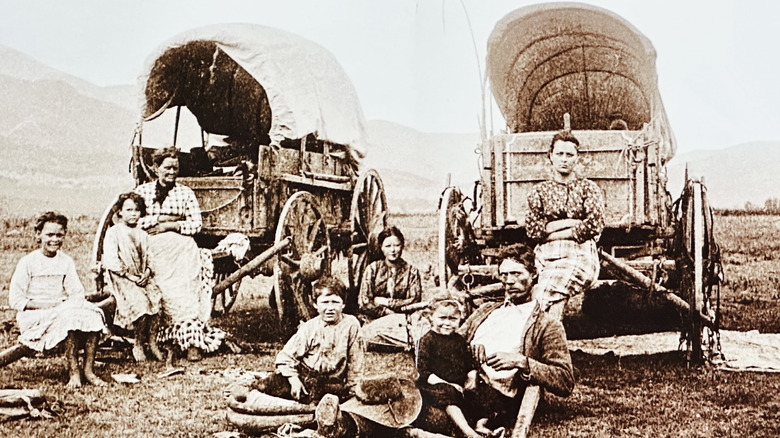
In addition to diseases, accidents accounted for countless deaths on the prairie. For example, drowning wasn't unusual, especially when people tried to cross flooded rivers and waterways. Animal attacks were also a real concern, which isn't entirely surprising; would you know, for instance, the first thing to do after experiencing a raccoon bite?
Accidental gunshots were another major cause of mortality in midwestern prairie areas. In fact, many emigrants weren't familiar with how to use guns, which led to some tragic shootings, including self-inflicted gunshot wounds. Per Notes From the Frontier, one of the biggest problems for many settlers was their lack of survival knowledge, spurring a rise in popular pamphlets like "The Emigrants' Guide to Oregon and California" and "What I Saw in California," both of which were filled with questionable information that led to some documented deaths.
Meanwhile, encounters with Indigenous folks on the trail were friendly most of the time, despite what's shown in so many Hollywood Westerns. In fact, accidents related to wagons, such as being crushed under the wheels of a moving covered wagon, were more common than deaths that resulted from conflict.