

Tim Curry's 2012 Stroke Changed His Life Forever But He Kept A Healthy Sense Of Humor
We may receive a commission on purchases made from links.
Tim Curry admittedly didn't have to work very hard to keep his sense of humor intact while he recovered from a near-fatal stroke in 2012. Speaking to Los Angeles Magazine in 2015, the "IT" star deemed his sense of humor crucial to his recovery, before stressing, "It's not tough to maintain. It is just part of my DNA." Over the years, we saw several examples of Curry's wit after surviving one of the top 10 causes of death in the world.
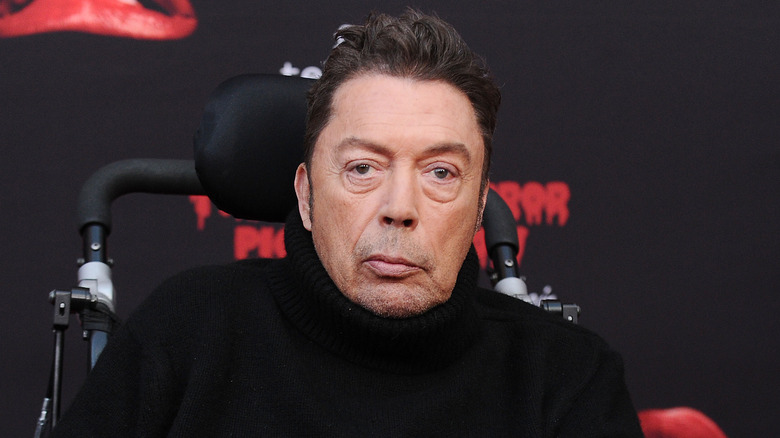
According to The Hollywood Reporter, while the iconic comedian gave a speech at the Academy Museum for a 4K remaster screening of "The Rocky Horror Picture Show" in 2025, he joked, "I'm so excited by this and very honored by the Academy to do this presentation of our movie, which has dragged on for 50 years." His jokes didn't just extend to his most beloved movies; he also managed to make light of his health conditions.
When The Guardian asked Curry how the stroke had altered his perception of life during a 2025 interview, he replied that it had taught him to never smoke three packs of cigarettes a day since that's what he had done the day before the stroke. While he was kidding around, it's important to remember that quitting smoking is something you can do to decrease your risk of a stroke. Meanwhile, when Curry spoke to CBS News in 2025, he said that he might actually embrace death when it came knocking on his door, jokingly clarifying, "I think it may be very comforting to go bye-bye – and I want to earn it!"
Tim Curry's stroke affected his life in numerous major ways
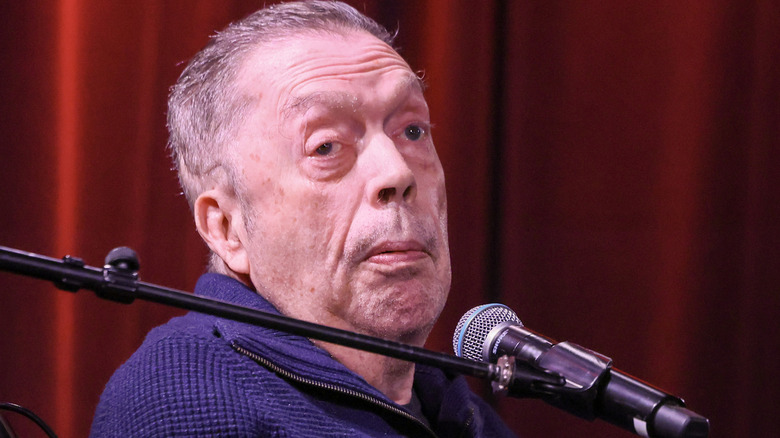
During Tim Curry's speech at the Academy Museum in 2025, he recalled how he thought he had been having a perfectly normal massage in 2012 when his masseur suddenly insisted on calling an ambulance, likely because he saw that he was having symptoms of a stroke. In the iconic comedian's 2025 memoir "Vagabond," he wrote that after arriving at the hospital, he underwent an emergency craniectomy, a procedure in which a surgeon removes a part of the skull and doesn't immediately put it back into place.
It was only when he woke up from the procedure that he finally learned that doctors had removed the two blood clots from his brain. Around the same time, he discovered that one side of his body was paralyzed. In the following days, he realized he also had trouble with comprehension, walking, and talking. Soon, Curry began going to a rehabilitation center to improve his mobility, speech, and facial expressions, among other things.
For a conversationalist like Curry, being unable to communicate clearly was especially difficult. "That part was exceptionally frustrating, because thoughts were forming again, but articulating them was such a monumental stretch," he shared in his memoir. "I felt like there was a massive gulf between my mind and what emerged from my mouth." However, in a 2025 New York Times interview, Curry said that speech therapy didn't do much to improve his condition, and that his voice had come back naturally for the most part. Despite all his health struggles, Curry continued working as a voice actor for several years.