

The Bad Cowboy Hygiene Habit That Fueled Disease — And Led To Public Bans
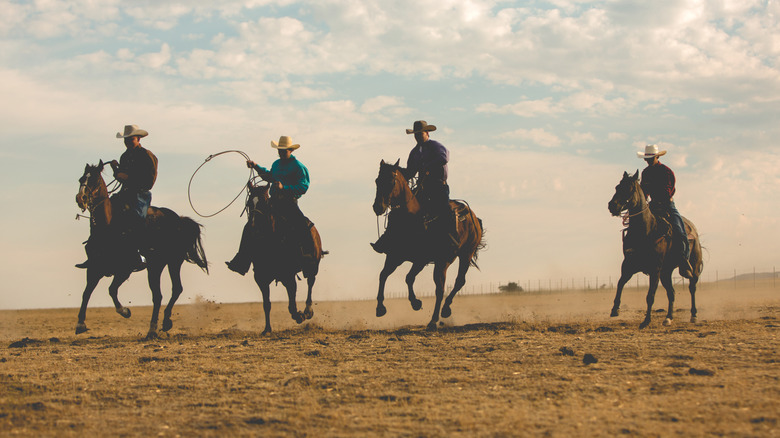
Watch any documentary about cowboys, and you might come to the conclusion that they were pretty dirty. Bathing wasn't considered good hygiene by cowboys; instead, they basically lived each day covered in a mixture of sweat and dust. However, they did their best to wipe off as much of the trail grime as they could with a damp rag (via Way Out West). Despite these occasional "sponge baths," these denizens of the Wild West were nowhere near becoming hygiene freaks. In fact, cowboys actually exhibited one nasty habit that led to public bans: spitting.
Cowboys were known to spit any substances that were in their mouths, from tobacco-laden saliva to nasal drainage. When a proper spittoon (a vessel to catch spit) wasn't available, the ground or a sawdust-laden saloon floor did the trick. That's where the problem started, because spitting can lead to the quick spread of disease. Plenty of viruses and bacterial infections can spread through saliva. That said, perhaps the most feared of the infectious diseases back in the day was tuberculosis.
Banning cowboys spitting to stop consumption's spread

Called "consumption" in the 1800s, tuberculosis is a contagious illness that still exists in the United States, albeit relatively rare, according to the Centers for Disease Control and Prevention (CDC). Today, tuberculosis is treated with various medications. But folks in the Wild West didn't have modern-day medicine, and relied heavily on homeopathic remedies like eating cod liver oil or sniffing hemlock (via the CDC). Around one-seventh of people were diagnosed with tuberculosis in the later 1800s, making the illness the leading cause of cowboy deaths.
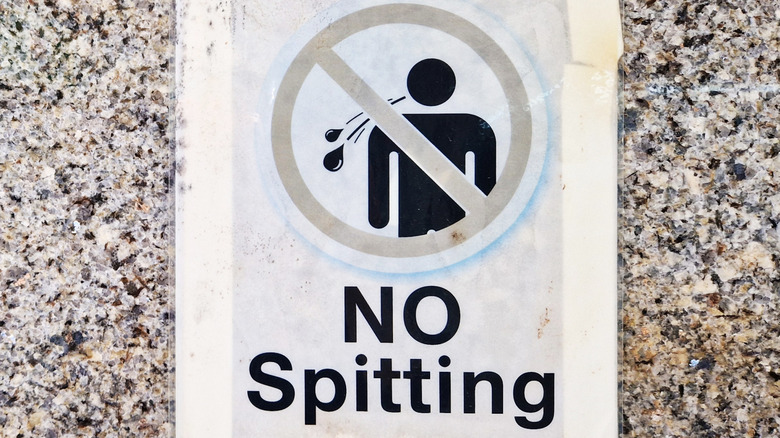
If you contract tuberculosis, you may experience a slew of cold- and flu-like symptoms, including a chronic cough and fever. Tuberculosis can also make you cough up small amounts of blood, which a cowboy would likely spit out, potentially infecting others. Consequently, public signs banning spitting began to pop up around the west as reminders for cowboys to keep their saliva to themselves.
Though it's hard to say exactly when cowboys were first warned about the disease-spreading potential of their spitting habits, a 2015 paper in the University of Montana Scholarworks gives a clue. The paper discussed an 1889 leaflet from a public health entity that connected spitting with the spread of tuberculosis, thereby establishing a general timeframe.
Research-backed reasons for curbing the spitting habit
According to a 2022 study in Scientific Reports, a single droplet of contagious saliva might be able to infect someone who encountered the droplet in an enclosed area of two meters. In an interview with Campusa, study co-author Ainara Ugarte-Anero noted that increased air moisture could make matters worse. "In a humid environment, evaporation takes place more slowly, so the risk of contagion is greater because the particles remain airborne longer," she explained. This might mean that a damp day in the Wild West could be an even more dangerous one for spreading disease than an arid one, although the West tended and tends to be dry.
Were all those anti-spitting campaigns of the 19th century successful? Did cowboys respond by spitting more discreetly or making sure they always had spittoons? They may have had some minor effect, although fines for spitting anywhere other than in a spittoon weren't really enforced (per Nebraskaland Magazine). In fact, an early 20th-century Nebraska newspaper printed an article on the downsides of spitting that admitted "the practice has become as common as before the passage of the ordinance."