

Because We All Have To Do It: How 19th-Century Pioneers Handled Bathroom Hygiene
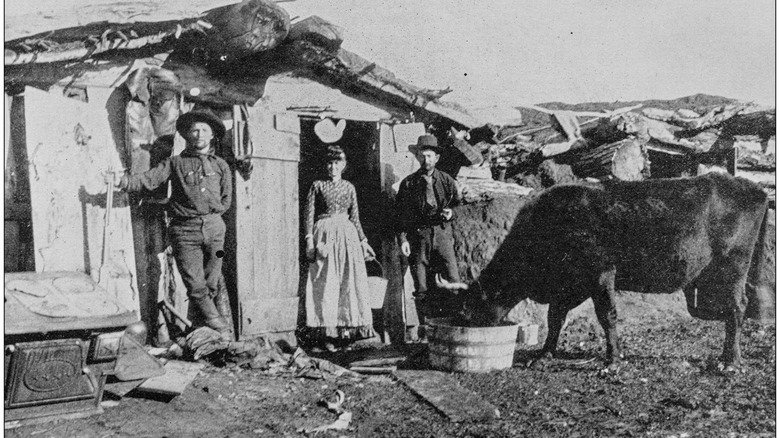
Everyday 19th-century frontier bathroom hygiene practices bear little resemblance to how we take care of our basic toileting and grooming needs today. In fact, most prairie- and forest-dwelling families didn't have a bathroom at all. Back then, pioneers who built homes didn't include a space indoors for a bathroom. Instead, they crafted a small structure called an outhouse (or privy) within close distance of their house.
Thanks to a door that shut, the outhouse offered privacy but zero other bragging rights. Inside was a board with a hole cut in it — and you can probably figure out what they did from there. Believe it or not, outhouses stuck around for a long time as the main places where people relieved themselves. According to Wake Up Wyoming, indoor bathrooms didn't start being routinely constructed until at least the 1880s. And in Nebraska, lots of rural homes still had working outhouses in the 1930s (via Wessels Living History Farm). To be fair, even more sophisticated people out east were slow to bring their bathrooms inside their homes.
Of course, you might not want to trudge to the outhouse, especially at night. That's why you kept a chamber pot handy indoors. You could just do your business in it and then dispose of the waste in the morning. It might have made your bedroom smelly (one Facebook user recalled the smell of her grandmother's half-full chamber pot vividly), but it sure beat navigating your way to an unlit, un-climate-controlled outhouse.
Staying as clean as possible after visiting the privy

At this point, you finally know where pioneer kids and adults answered the call of nature. But how did they wipe themselves, especially after having a bowel movement? Many used devices like dried corn cobs (without the kernels) to scrape fecal matter off their nether regions. And those cobs would stay in the outhouse for everyone to share – a practice of 19th-century frontier hygiene you probably wouldn't enjoy. (Sometimes, tree bark, corn husks, or grass were used instead.)
If you were a little luckier, your outhouse might have a copy of the annual Farmers' Almanac rather than a corn cob: The book's pages were frequently ripped out and used like toilet paper. In fact, the Almanac's publishers started printing the Almanac with a pre-made hole in the corner beginning in 1919 so it could be hung more easily in outhouses (via Farmers' Almanac). The move shows the ingenuity of the company but also illustrates just how long many people in the United States were using outhouses regularly even after the "Old West" and pioneer eras of the 19th century.
Wait, though: What about the benefits of wiping up after peeing? It might not have been as necessary. Men don't always wipe after a "number one" anyway, and pioneer women frequently wore what one journalist called "crotchless" underwear if they wore any underwear at all (via True West Magazine). This made it easier to just let her private parts dry naturally.
Dealing with a medical condition possibly due to germy bathroom conditions

From a contemporary lens, the average outhouse wasn't even close to being sanitary. Yet an article from Outhouses argues that it still provided some degree of sanitization since it kept all human waste in one location. Likewise, Capper's Farmer mentions that outhouses were typically built a distance from wells and water sources, which certainly helped avoid the deadly frontier hygiene mistake of contaminating drinking water with bacteria. Those are fair points. But pioneers still faced tons of germs when they used the privy or the chamber pot, not to mention exposure to the bugs and critters that are attracted to waste (like flies that swarmed people's exposed genitals and rumps).
Given the unhygienic bathroom conditions pioneers faced, genital-related medical issues, including urinary tract infections (UTIs), were common experiences on the 19th-century frontier. Perhaps one reason might be the way that wiping of fecal matter occurred (when a corn cob or grass clump was handy, that is).
As a 2024 study in Cureus showed, women who wiped from back to front were possibly at a higher risk of developing a UTI than those who wiped in the opposite direction away from their urethra opening. Unfortunately, someone on the frontier who experienced the symptoms of a UTI could only try to manage them because there weren't any cures for UTIs in the 19th century.