

Talc Dominated '70s Beauty. Now Gen Z Wants Powder Back — What Are The Safety Concerns?
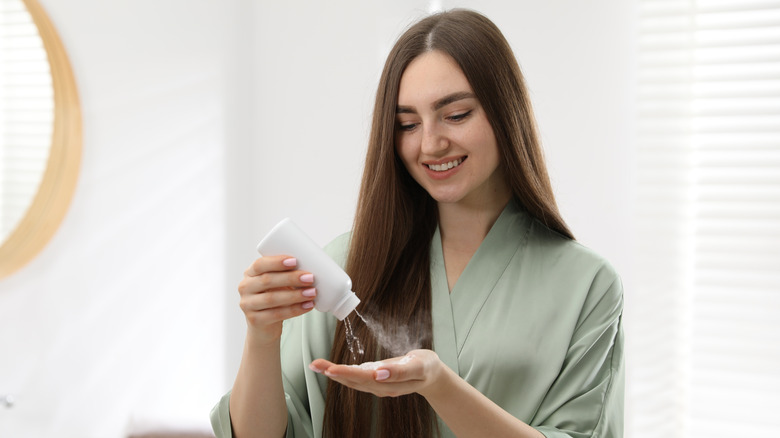
Back in the '70s, talcum powder was considered the epitome of femininity. Young girls and women applied the product, thinking that it would leave their skin feeling soft and smelling clean while ridding it of sweat. In the 2020s, the younger generation decided to put their own spin on the classic dusting powder. Many Gen Z influencers started to mix baby powder, or any other cosmetic powder, with perfumes and baby oil. Several creators touted it as a means to keep the skin soft, keep moisture at bay, create a signature scent, or even extend the lasting power of a favorite perfume.
Despite its past and present, applying talcum powder was a common hygiene habit that wasn't as healthy as people thought, on account of its main ingredient: talc. In a chat with Allure, cosmetic chemist Amanda Lam explained why the mineral was commonly found in cosmetics, saying, "Talc is a naturally occurring mineral that was [commonly] used as a sensory modifier and absorbent in powder products." Initially, the health concerns surrounding talcum powder were mainly focused on the asbestos contamination in talc rather than the mineral itself.
The American Cancer Society notes that some talc does contain asbestos in its raw state. Additionally, tests conducted on 19 talc-containing products in 1976 found that 10 contained asbestos (via The New York Times). WebMD writes that scientists have determined that inhaling talcum powder that contains asbestos can lead to cancer. Inhaling asbestos has been notably linked to a higher risk of lung cancer in numerous studies. With all this, it's unsurprising that talc was eventually widely regarded as an ingredient that you don't want to see in your makeup or cosmetics.
Talcum powder has had quite the transformation over the years
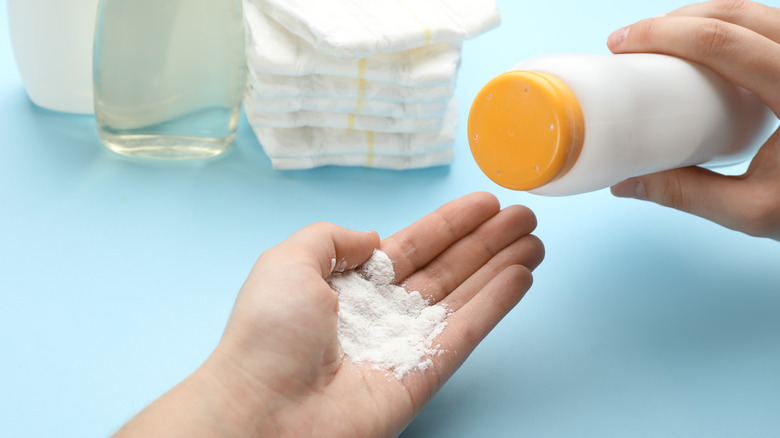
When we look at health concerns surrounding talcum powder in general, things get a little more complex. Over time, researchers have sought to determine whether there is a link between perineal/genital talcum powder use and ovarian cancer. According to the American Cancer Society, research has shown mixed results, with some studies showing a slightly higher risk of ovarian cancer and others showing no significant link.
However, after reviewing research on talc's potential carcinogenic effect on humans and animals, the WHO's International Agency for Research on Cancer categorized it in Group 2A, meaning the mineral is "probably carcinogenic to humans." To make this evaluation, the group notably focused on studies where asbestos contamination was unlikely. Unsurprisingly, all the discourse surrounding talc, and how it was partially responsible for one of the largest pharmaceutical recalls in U.S. history, compelled many people to stop buying talcum powder.
A good example of changing consumer attitudes surrounding talc can be seen in how Johnson & Johnson discontinued the sale of its talc-based baby powder in the U.S. and Canadian markets from May 2020 after facing a slew of lawsuits and a decline in demand. The company made sure to stress that it was "steadfastly confident in the safety" of its product, which it claimed had been backed by scientific studies. To keep in line with these consumer attitude shifts, many companies released talc-free versions of their baby and cosmetic powders. However, it appears that times have changed in more ways than one, as an FDA report from 2023 notably found that asbestos was not detected in 50 samples of cosmetic products containing talc.