

Why There's Simply No Need For Q-Tips Anymore
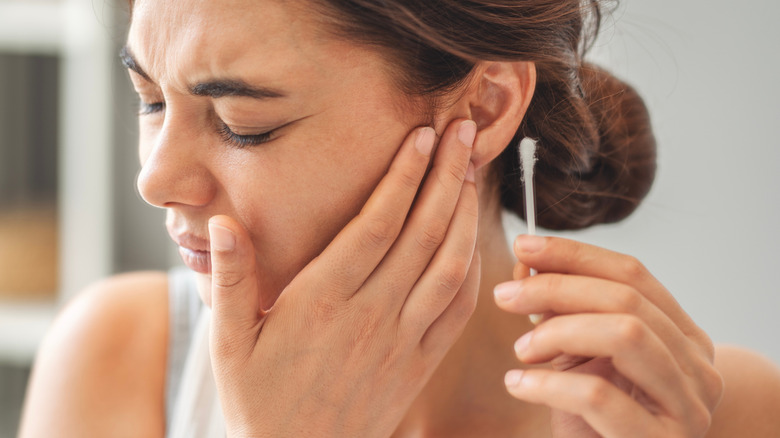
Unless you've been living under a rock, you're probably well aware that it's not actually safe to clean your ears with Q-tips. You should absolutely think twice before using Q-tips for ear hygiene, as you run the risk of damaging your eardrum, increasing earwax buildup, developing hearing loss, irritating the delicate skin inside your ear canals, and even developing an infection. Simply put, there really is no need for Q-tips anymore.
The truth of the matter is, most people don't actually need to clean their ears at all. "The ear cleans any debris, wax, or particulate matter and the outer ear is a pretty amazing self-cleaning system," otolaryngologist Dr. Bradley Kesser said in an interview for UVA Health's blog while discussing how often you should clean out your ears.
But on the off-chance you are someone who produces more earwax than normal, and it's causing pain, fullness, dizziness, or ringing in the ears, there are much safer alternatives, like over-the-counter drops that soften earwax or even just a regular old washcloth with soap and water. And for the love of it, leave the ear candles alone as well. "Candles are both ineffective and dangerous," Dr. Seth Schwartz, an ear, nose, and throat doctor at Virginia Mason Franciscan Health in Seattle, told the New York Times about the real danger behind ear candles.
How Q-tips became synonymous with ear cleaning in the first place
Considering all of the risks associated with using Q-tips in your ears, you might be wondering how they became the go-to for cleaning ears, anyway. As it turns out, in 1923, inventor Leo Gerstenzang became inspired after watching his wife clean their infant child's eyes, ears, and other delicate areas with cotton wrapped around a toothpick. Enter: Baby Betty Gays, which eventually became known as the popular Q-tip.
Fortunately, Q-tips are no longer marketed as a way to clean your ears. In the 1970s, the manufacturer started stamping a label on the box warning customers against the practice. Per the brand's official website, the tiny cotton swabs attached to a small, thin wooden stick are now very vaguely marketed as "the ultimate home and beauty companions." Sure, Jan.
Unfortunately, most people still can't seem to put down the Q-tip. Per a 2025 study in Cureus, 95.6% of surveyed adults admitted to using cotton swabs in their ears. Doctors are seeing much of the same in their practices. "People come in with cotton-swab-related problems all the time," otolaryngologist Dr. Dennis Fitzgerald told The Washington Post. "People say they only use them to put makeup on, but we know what else they're using them for. They're putting them inside their ears."