

We Finally Know Why Donald Trump Got An MRI (And The Results Are Classic)

Following persistent social media speculation, as well as a November 30, 2025, call from Minnesota Governor Tim Walz to release Donald Trump's MRI results from his October visit to Walter Reed National Military Medical Center (via Twitter), reporters aboard Air Force One pressed the president to clarify the reason for the advanced imaging. Trump said he didn't know which part of his body was scanned, but insisted, "It wasn't the brain, because I took a cognitive test and I aced it" (via CNN). However, despite his apparent lack of knowledge about the details, Trump indicated he was willing to release the results. "If they want to release it, it's OK with me," he said. "It's perfect. If you want to have it released, I'll release it."
The next day, White House press secretary Karoline Leavitt followed through with the president's promise, revealing at a press conference that his imaging had been performed "because men in his age group benefit from a thorough evaluation of cardiovascular and abdominal health." Leavitt went on to state that the imaging was done as a preventative measure, and his cardiovascular imaging was normal. "No evidence of arterial narrowing impairing blood flow or abnormalities in the heart or major vessels," Leavitt said. "The heart chambers are normal in size, the vessel walls appear smooth and healthy, and there are no signs of inflammation or clotting," she added. "Overall, his cardiovascular system shows excellent health" (via Fox News).
Still, some have questioned whether it is typical to undergo this type of imaging without being fully aware of the reasons for it. Experts say it's actually very unlikely that you wouldn't understand why the procedure was being performed. Here's why.
Why it's unlikely you'd be unaware of why you're having an MRI
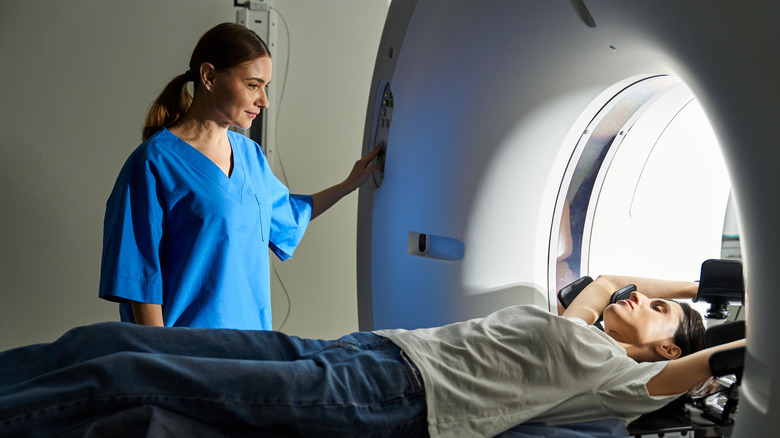
As noted in a 2017 article in the Indian Journal of Radiology and Imaging, cardiovascular and abdominal MRI is not the kind of test a patient typically undergoes without knowing why it was ordered. Even though written consent isn't always required for routine diagnostic imaging, radiology standards emphasize that informed consent is still a communication process, not simply a signature. The patient must be told what body areas are being examined, what the scan is looking for, and what to expect during the procedure.
As the authors explain, patients are routinely screened before an MRI, especially when contrast might be used. Gadolinium-based contrast carries a small but real risk of allergic reactions and contrast-induced nephropathy. Because of that, institutions commonly use patient information sheets that explain the scan, outline its purpose, describe potential risks, and invite questions. When contrast is administered for vascular or abdominal evaluation, the threshold for providing clear information is even higher. The review notes that international guidelines expect patients to receive this information in simple, understandable terms, and many practices require a patient signature to document that the material was reviewed.
In other words, a cardiovascular and abdominal MRI would not be done casually or without some level of discussion. Whether the consent was implied or written, Trump would almost certainly have been told why the imaging was being performed.