

Kim Kardashian's On-Air Brain Scan Predicted Her Risk For Alzheimer's Disease

Kim Kardashian, perhaps one of the most popular celebrities in the 21st century, shared a recent medical revelation through her reality TV show "The Kardashians." In a 2025 episode, the second-eldest Kardashian daughter sat down with celebrity psychologist Dr. Daniel Amen to discuss a scan done on the reality star's brain. In the images from the scan, apparent "holes" freckle her frontal lobe — a sign of low brain activity (via USA Today).
According to Dr. Amen's evaluation, the low activity could mean things — like managing stress — could become more difficult for Kardashian as she gets older. Ironically, the celebrity doctor placed the blame for these holes on Kardashian's sudden uptick in anxiety and stress in her personal life, citing her tumultuous divorce and bar exam as incredible stressors in the Skims owner's life.
The star had undergone a brain scan following an undiagnosed brain aneurysm. A previous scan that Kardashian had done showed the small aneurysm in her brain, which she has sought out additional evaluation on, eventually leading her to Dr. Amen, who specializes in brain disorders. Her medical scare came with a powerful message from the reality star (via E!News): "It's just a good measure to go make sure that you always check everything. And health is wealth, and you have to be careful with everything that you do." The scan did more as well, according to Amen, by showing a lower risk of Alzheimer's disease in the Skims owner (via USA Today).
How could Kardashian's brain activity predict Alzheimer's?
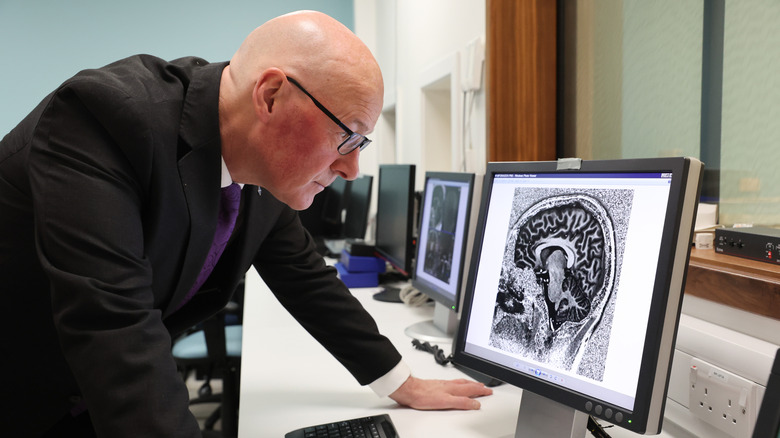
Kim Kardashian's low brain activity scan results do more than simply visualize the aftermath of her aneurysm diagnosis. Low brain activity when caught early, like in the reality star's case, can predict the likelihood of developing Alzheimer's. The degenerative brain disease — characterized by its attack on memory and cognitive abilities — has been linked to low brain cell activity. Though not a necessary marker in every Alzheimer's patient, it is a typical diagnosis along with the disease. Kardashian's aneurysm itself also holds a key to her predicting her probability of developing the brain condition.
An aneurysm, caused by blood adding pressure to a vessel wall, can cause headaches, blurred vision, and even seizures. The increase in pressure can lead to a vessel rupture, causing a bleed in the brain. As Kardashian shares in the "Keeping Up with the Kardashians" episode, her small aneurysm was caught prior to a rupture. Thanks to the identification of this bulged vessel, the Skims owner's likelihood of being diagnosed with Alzheimer's can be further evaluated. Ruptured aneurysms are linked to a decrease in cognitive abilities and thus encourage Alzheimer's to develop. Thankfully, the reality TV star was able to identify her aneurysm early enough to have it treated and hopefully lower her probability of developing a degenerative brain disease.
Kardashian is doing what she can to prevent further complications

Coming face-to-face with a diagnosis, especially something like a brain aneurysm, can be intimidating. Kardashian was candid in her feelings about this diagnosis and shared that it was her children who spurred her decision to continue forward with medical intervention and seek out answers. As she said in the "Keeping Up with the Kardashians" episode (via E!News), "I have four kids that depend on me. I have to be sane. It's stressful out there, but this aneurysm can't be stressed." Her overall choice to get a brain scan, speak with a doctor, and discuss medical plans is encouraged for individuals with Kardashian's same condition.
But there are plenty of other tactics and practices that can be integrated into everyday life to decrease your probability of being diagnosed with Alzheimer's. Like many other conditions, opting for a healthy lifestyle filled with a good balance between exercise and diet can aid in strengthening your body. Additionally, avoiding head injury is a huge step in protecting your brain. Though accidents happen, wearing a helmet when riding a bike, snapping your seatbelt when in a car, can mean the difference between dangerous brain trauma and protected health (per Alzheimer's Association).