

Donald Trump's Claims About Childhood Vaccine Schedules Are Completely False - Here's The Truth

President Donald Trump shared some misinformation at a roundtable on December 8, 2025. When asked if he would support ending federal mandates for vaccines, the president made the claim that infants are required to receive 88 vaccinations in one doctor's visit. "I think we take like 88 different shots all wrapped up in one," he declared to the room full of White House Press Corps, "And we're going to be reducing it very substantially" (via YouTube).
In reality, according to an August 2025 update from the Centers for Disease Control and Prevention (CDC), babies under 2 years old are advised to receive 27 vaccine doses over the course of 15 months. Before the age of 18 years old, children should receive an additional 14 vaccine doses. In total, minors are strongly recommended to receive around 40 doses, which is less than half of President Trump's claim. It's also important to keep in mind that this number includes annual shots that are recommended to people of all ages, like COVID boosters and flu shots.
This isn't the first time that the president has stated such a large number when discussing immunization recommendations from the CDC. In October 2025, Trump made the claim that 82 vaccines were being injected into infants when attending one doctor's appointment, saying, "When you give 82 vaccines in a shot to a baby that hasn't even formed yet, it's a lot of vaccines" (via Live Fox Now).
RFK Jr. has echoed much of Trump's rhetoric
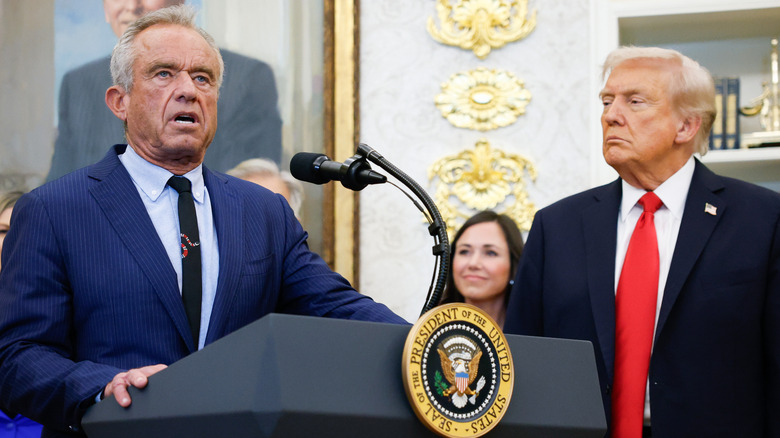
The CDC has long been considered a pillar of medical advice and public health guidance for Americans across the country. For decades, the organization has considered vaccinations as a safe measure to protect citizens in the U.S. and around the globe from dangerous and contagious diseases. Vaccines have been rigorously tested and widely used during this period, with roots in medical practice dating back more than 200 years. However, during President Donald Trump's second term, with Robert F. Kennedy Jr. as the Secretary of Health and Human Services (HHS), misinformation has caused widespread speculation towards the tried-and-true immunization method (per BBC). Among Kennedy's controversial claims is that non-white children might be especially susceptible to harm from vaccinations (via NPR), which has encouraged anti-vaccination rhetoric and led to a proposed rollback on childhood immunization schedules (via Rep. John B. Larson).
Doctors have spoken out in opposition to vaccine hesitancy, preaching the safety and importance of vaccination. Dr. Swathi Mannava Gowtham, an infectious disease pediatrician, explained this crucial role of vaccines to the American Medical Association: "One of the triumphs of 20th century medicine is that vaccines have significantly reduced infant and childhood mortality, along with other public health measures, and immunization is one of the strongest public health measures we have," said Gowtham. This is a sentiment that Dr. Kristen Walsh echoed in a Sabin Vaccine Institute article: "Vaccines are among the safest medical interventions that can make a real impact in terms of preventing disease and death," she wrote. "Vaccinating your child is very low-risk, and is proven to help protect them from deadly diseases."
We have already seen a rise in measles cases
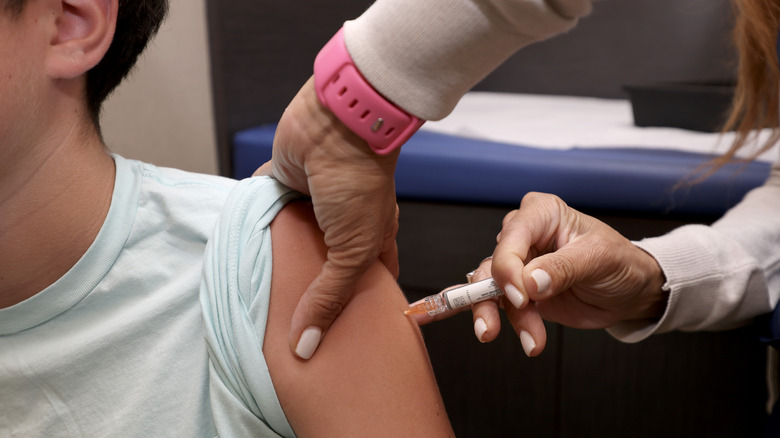
As of December 2025, there were almost 2,000 measles cases in the United States, most of them children, per the CDC. According to Harvard Health, the last time that measles cases were this high in the United States was 25 years prior, in the year 2000. At the time, measles had been established as an eliminated disease in the U.S. Unfortunately, the same cannot be said now. So why is this happening?
In a conversation on the UChicago News podcast presented by the University of Chicago, the director of the Division of Pediatric Infectious Diseases at NYU, Dr. Adam Ratner, explained that the rise in vaccine hesitancy and anti-vaccination conversations has given rise to the disease. Before vaccines, measles was responsible for a high childhood mortality rate for those diagnosed with the disease. But vaccines have worked to prevent this, according to Ratner. "Death in childhood is much less common now than it used to be, and that's in large part, but not exclusively, due to vaccination," he said.
In the face of this outbreak, UNICEF USA has preached the importance of vaccinations, saying, "Measles vaccines are safe. Two doses of a measles-containing vaccine provide 99 percent protection from measles for life. No child should risk serious health complications or death by contracting measles."