

Where Did Male Chest Hair Go? Hollywood's Trend Speaks To How Men's Bodies May Be Changing
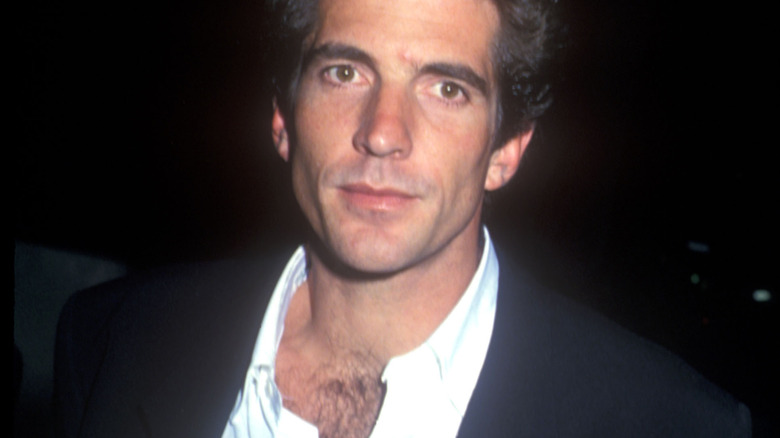
The powers that be in charge of making FX's limited series "Love Story: John F. Kennedy Jr. & Carolyn Bessette" really had their work cut out for them when it was time to cast the actor who would portray John F. Kennedy Jr., the late, legendary, iconic heartthrob. As one can imagine, not just anyone would do. "We had casting agents in Australia, in England. We read male models. We read random people off the street — any sort of white guy between 25 and 40," one of the series' executive producers, Brad Simpson, recalled to Variety about their casting plight. However, perhaps what proved to be most excruciating about the manhunt for a JFK Jr. lookalike was the seemingly worldwide shortage of men with the same thick, bountiful chest hair Kennedy was known and loved for. "We live in a world where chest hair has somehow disappeared," Simpson lamented.
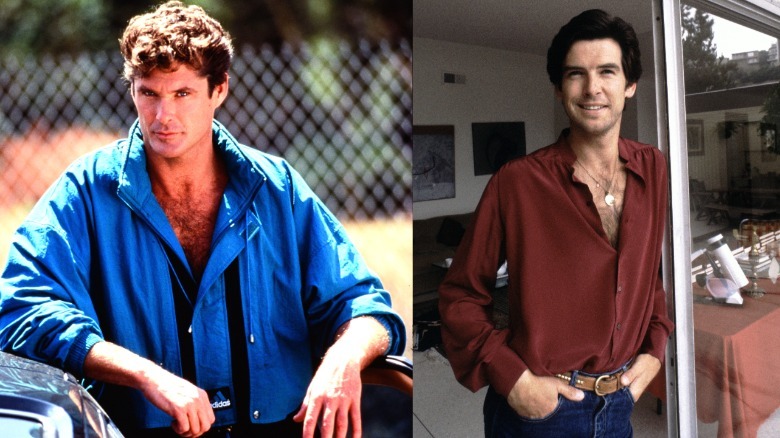 Paul Harris & Bob Riha Jr/Getty
But why exactly is it suddenly so hard to find men in Hollywood with chest hair? As it turns out, there are a lot of factors at play when it comes to the shrinking pool of men sporting a full chest of hair, including genetics, environmental and lifestyle factors, social trends, and even the effects testosterone has on your body.
Evolution and declining hormone levels at play

According to Pavol Prokop, an associate professor of biology at the University of Trnava in Russia, the reason males are growing less and less chest hair comes down to one thing: evolution. "Perhaps the most commonly held explanation for the evolution of the nakedness in humans is that it evolved as a cooling device," he told MEL Magazine, citing the way in which hunting apes moved from cool, covered forests to areas with higher temperatures. "Thus, it's been assumed that the hunting ape took off his hairy coat to avoid becoming overheated in the hot savannah," Prokop concluded.
Another, perhaps even more plausible, theory about the sudden lack of chest hair in Hollywood and the rest of the country, for that matter, involves widespread dwindling testosterone levels — a known problem in the United States. A study done by Yale School of Medicine and published in Urology Times found that from 1999-2016, testosterone levels continued to drop in adolescent and young adult men. Unfortunately, according to Harvard Medical School urologist Abraham Morgentaler, M.D, being unable to grow as much chest hair is only the tip of the iceberg when it comes to the many warning signs that you may have low testosterone. "The primary hallmark of low testosterone is low sexual desire or libido, but another can be erectile dysfunction, and any man who complains of erectile dysfunction should get his testosterone level checked," Morgentaler told Harvard Health in 2007 (via Advancing Longevity Medicine).
There's also the ever-growing hairless trend to contend with. While men do have more body hair than women, according to a 2018 study by Mintel, 46% of British males confessed to simply removing the hair from their bodies.