

Can Falling Asleep In Public Be A Sign Of A Dementia? Donald Trump Can't Escape The Speculation
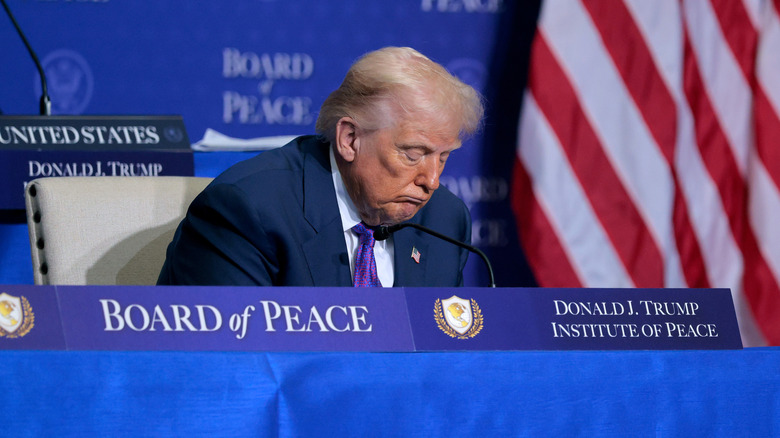
President Donald Trump got people talking on February 19, 2026, when he was caught seemingly dozing off during his very own Board of Peace event — a notion White House spokesperson Anna Kelly later refuted. "President Trump is the sharpest, most accessible, and energetic president in American history," she told The Independent. "While the deranged and failing Independent has their 'reporters' push baseless conspiracy theories — President Trump is securing world peace."
BREAKING 🚨🚨: USA President Donald Trump fall in sleep during meeting of 'Board of Peace' 😂😂 pic.twitter.com/qeP25vM7Qm
— Galactus (@Galactusq) February 19, 2026
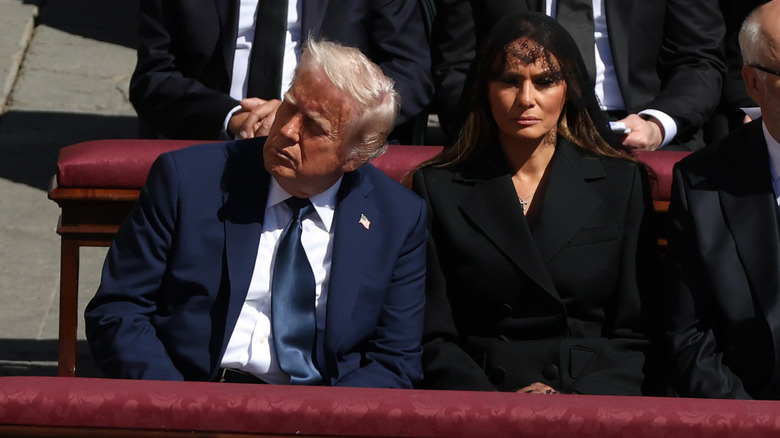
Unfortunately, this is not the president's first rodeo when it comes to being accused of catching some z's in public. On April 26, 2025, Trump appeared to take a catnap while attending the funeral of Pope Francis. And in December 2025, Trump also looked like he was enjoying a little rest and relaxation during his own cabinet meeting, though he was adamant he was only resting his eyes. "It was a little bit on the boring side," Trump later told a gaggle of reporters. "I didn't sleep. I just closed them because I wanted to get the hell out of there," he declared. In fact, according to Trump, he can get by on very little sleep. "I've never been a big sleeper," he famously told The Wall Street Journal in January 2026, citing his ability to work well into the wee hours of the morning.
Alas, Trump's tendency to fall asleep in public — or at least appear to be falling asleep in public — has garnered some serious public concern about his health and cognitive status, prompting many to raise the question: can falling asleep in public be a sign of dementia? As it turns out, according to a 2025 study published in Neurology, researchers found that the risk of developing dementia doubled for women who napped excessively or experienced big moments of sleepiness — like, say, suddenly falling asleep at a meeting with representatives from all over the world.
Sleep problems may serve as an 'early marker' for dementia
Yue Leng, Ph.D., the author of the study published in Neurology, said in a press release that a good night's rest is "essential for cognitive health, as it allows the brain to rest and rejuvenate, enhancing our ability to think clearly and remember information." However, she was careful to point out that there's still a lot of uncertainty about how changes in sleep patterns affect cognition over time. "Our study found that sleep problems may be intertwined with cognitive aging and may serve as an early marker or risk factor for dementia in women in their 80s," she said. (Basically, your risk of dementia goes up if you don't 'flush' your brain while sleeping.)
Meanwhile, neurologist Clifford Segil, D.O., echoed those same sentiments in a September 2025 interview with Women's Health. "If you ask two different neurologists, you may get two different answers as we still don't know the reason we sleep," Segil explained. "Getting a good night's sleep is more important for octogenarians — people in their 80s — than a good daytime nap," he added, bolstering the idea that older people — like Trump — should absolutely get more shut-eye. Still, he maintained that there is a connection between not enough sleep and memory. "Memory retrieval is likely affected by poor sleep in elderly patients," he said.