

Outdated Boomer Exercise Cliches That Millennials Absolutely Can't Stand
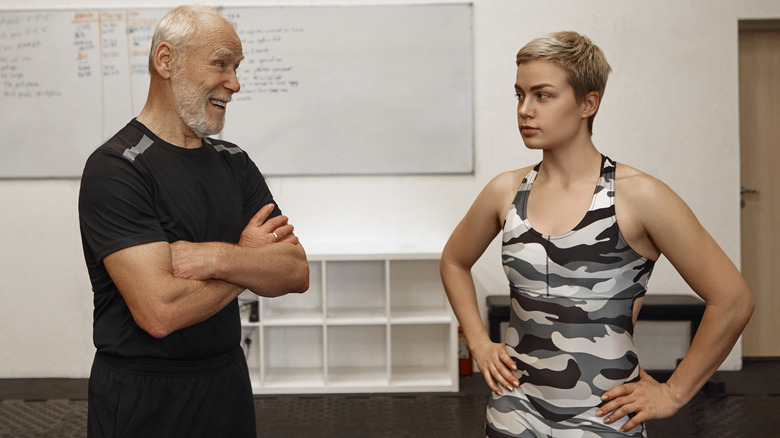
Considering how little millennials and baby boomers agree on, it probably comes as no surprise that they have vastly different perspectives on fitness, too. A survey conducted by Garage Gym Reviews in 2024 found that only 27% of baby boomers preferred resistance training in comparison to a whopping 51% of millennials. However, the results showed that the primary reason for exercising across Gen Z, millennials, Gen X, and baby boomers was physical health.
It also revealed that millennials were most likely to exercise to reap the mental health benefits, while baby boomers were the least likely. The eldest generation polled was also notably the least likely to train for muscle gain and the most likely to rely on friends and family for fitness advice. Interestingly, 90% of millennials reported being physically active, the most out of the generations polled. Although baby boomers came in last, they weren't too far behind, with an impressive 84% reporting they were exercising regularly.
In a chat with ACE Fitness, Bolling Richards, a fitness instructor with several baby boomer clients, noted that the two groups also tended to approach their workouts quite differently. "Baby Boomers tend to be pretty structured in what they want to do in their workouts," she said. Richards then stated that millennials were more likely to want to turn up the fun quotient in their workouts by switching out of their routines to try things they saw on social media. Hence, it seems only natural that the two generations would butt heads about their views on fitness.
Their obsession with cardio irks the younger generation

Baby boomers grew up in an era where running, jogging, and other forms of cardio like aerobics were believed to be the most effective exercises. Many people from that generation carried that belief forward and discouraged their millennial family members from undertaking strength training in favor of cardio. Now, there's no denying that cardio really changes your body in many ways, and for the better. Cardio can not only help improve heart, lung, cognitive, and joint health but also help improve sleep, increase energy levels, and aid in weight management.
However, when you only do cardio, a lot of things happen to your body, and some of them aren't necessarily ideal. During a 2017 chat with Women's Health Magazine, Michele Gordon, creator of Cardio Sweat Party, professed that when someone only did cardio workouts, they stood to lose the metabolism boost that could be achieved by strengthening muscles through a variety of workouts. On a similar note, she believed that a combination of strength training and cardio was far more effective for fat loss than the latter alone.
Jericho McMatthews, a N.A.S.M. and A.C.E. personal trainer, also noted that only doing cardio might not be ideal for overall health, either, as she noted, "Cardio-only workouts will put you at higher risk for joint pain, breakdown, and injury since strength training is necessary for increasing and maintaining bone density as well as strong tendons and ligaments." Additionally, a 2012 study in Mayo Clinic Proceedings found that doing cardio excessively over a long period could negatively affect heart health.
Millennial women are tired of hearing that strength training can make them look 'masculine'
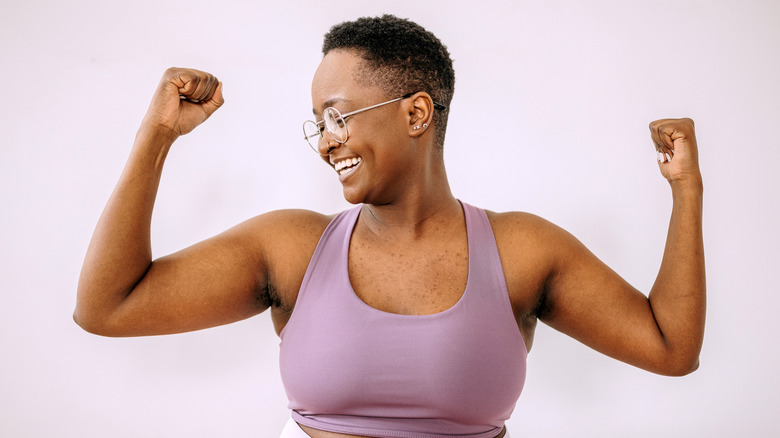
For several years, baby boomer women watched advertisements showing bulky male bodybuilders promoting strength training. During that era, ads promoting women's fitness mostly showed women with lean figures doing dance exercises. Notably, in a chat with Tonal, Stacy Sims, Ph.D., a female physiology expert, said that even simple strength training was associated with female bodybuilders in the '80s. Subsequently, many baby boomer women internalized the idea that they would end up looking bulky if they picked up a dumbbell. When they had daughters, they urged them against weight lifting, cautioning that it would negatively impact their physiques.
However, many millennial women grew up in an age where information about exercise was more accessible, so they naturally pushed back against the strength training myth. Sims stated that the idea that many boomer women had of strength training stemmed from watching women who were specifically training to gain significant amounts of muscle mass for bodybuilding competitions.
The average gym-going woman would likely find it much harder to put on that kind of muscle mass due to the hormonal fluctuations their body underwent throughout their monthly menstrual cycle. In a 2024 chat with Vogue, Christiane Mensching, a specialist in general medicine, geriatrics, preventive medicine, and public health, said that strength training could have numerous benefits for women. Mensching said that women were more prone to falls because they had reduced muscle mass and stability compared to men, and training could prevent fractures from these falls by improving bone density. It could also improve immune system functioning, reduce water retention, prevent illnesses, and promote mental well-being.
The 'no pain, no gain' mindset feels backwards for millennials
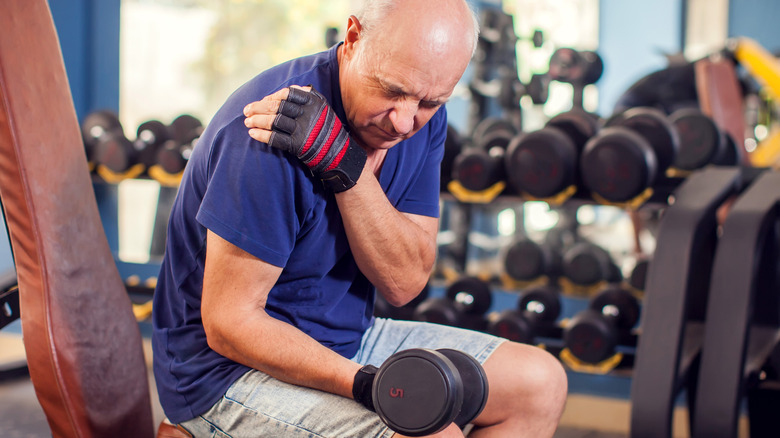
In the '80s, Jane Fonda would often encourage her video workout followers to push themselves harder by saying, "No pain, no gain" (via The Idioms). Although the exercise icon had good intentions behind the phrase, many of her boomer fans took it to an extreme and started believing they needed to push themselves beyond their natural capabilities to achieve their fitness goals.
While some members of the younger generation also absorbed that belief, others rebelled against it. In a YouTube video, Keith Baar, Ph.D., a professor of molecular exercise physiology at UC Davis, noted that the "no pain, no gain" mentality wasn't exactly backed by science. He began by stating that it was normal for people to experience soreness a day or two after trying a new exercise and it was a sign that the body was trying to repair the muscle damage caused by the workout.
Baar then said that as the body started growing accustomed to the load it was put under, the pain would reduce as it was no longer trying to mend the damage, but grow due to it. Moreover, there are several reasons why you should never push through pain during a workout. During a 2025 chat with Self, Dave Pavao, PT, DPT, noted that sharp, stabbing pain in a small area could be a sign of a stress injury. Meanwhile, shooting pain, numbness, and tingling could signal a condition like peripheral artery disease. Other experts agreed that it was a good idea to pause a workout when you felt joint pain, prolonged shortness of breath, and chest pains.
Millennials have argued that a sweaty workout isn't always a good workout

Through years of fitness messaging, baby boomers gained the idea that a workout could only be considered good if you left it drenched in sweat. During the '60s and '70s, some boomers might have even walked into a workout wearing a sauna suit, which was designed to increase sweat production by retaining body heat. While sauna suits may have joined the long list of fitness trends that completely disappeared, boomers continued to carry the belief that sweating a lot during a workout meant you were burning fat.
However, millennials naturally believed that the answer to the question, "Does sweating really burn calories?" was a resounding no. In a chat with Healthline, physical therapist John Gallucci Jr., DPT, ATC, explained the physiological reason for sweating during a workout. "Sweat is released through glands on your skin and is then evaporated into the air, which provides the effect of cooling down your skin and therefore your body," he said. When sport scientist Harry Aitken spoke to Women's Health Magazine, he similarly said that the level of sweat during a workout wasn't a testament to the amount of effort the body was being put through.
As an example, he described how people don't sweat after deadlifting, despite the tremendous physical exertion, but are drenched after an easy Soul Cycle class. Moreover, Karen Austin, founder of Topaz Academy, said that when people saw the number on the scale go down after a sweaty workout session, they were only seeing the amount of water weight they had lost. Austin stated that the number would go right back up after water consumption was resumed.
The younger generation no longer believes in spot reduction
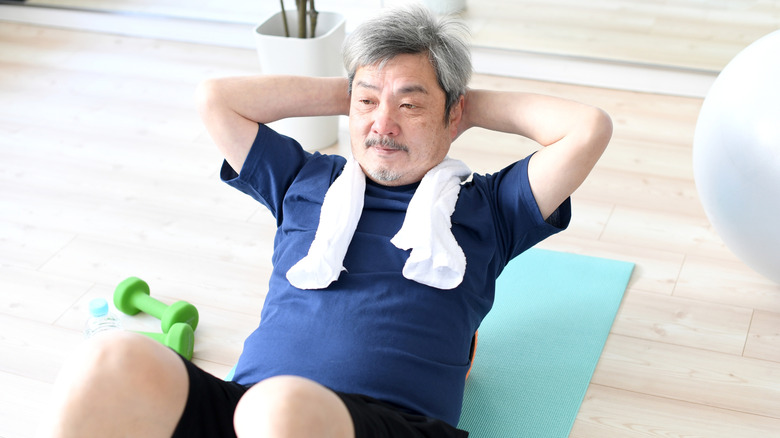
During the baby boomer era, there was an abundance of strange exercise equipment promising to tone a certain body part or sometimes even multiple unrelated body parts. While the actual machines may not be available on the market anymore, their impact remains, as many boomers continue to carry the belief that spot reduction is possible through exercise. Although this philosophy bled into numerous aspects of fitness for boomers, it hit particularly hard in the core area, cementing the idea that abs could be solely achieved through exercise.
The general idea has led to several clashes with gym-going millennials who have argued the contrary. In a chat with Women's Health Magazine, Kara Liotta, CPT, stated that solely doing core exercises wouldn't go a long way in getting defined abs. Instead, the best path to getting defined abs includes being in a calorie deficit, focusing on hydration, and incorporating core training into every gym session. Liotta also cautioned that genetics played a part in whether the plan was effective in achieving abs, since they determined where the body's fat stores were.
Chatting with GoodRx, Cedrina Calder, MD, a board-certified preventive medicine physician, health expert, and fitness professional, stated that spot reduction did not really work for weight loss either. "It's not possible to target fat in specific areas," Dr. Calder professed. "When you lose weight, you lose fat from different parts of your body — [and] the body parts that lose fat first are mostly based on genetics." However, she noted that gaining muscle definition and tone in a specific body area was possible by focusing on it during strength training.