

Olivia De Havilland Lived To 104. The Gone With The Wind Star Credited These Three Things

Olivia de Havilland, who passed away in 2020, refused to overcomplicate longevity and managed to live to 104. When Vanity Fair asked the "Gone With The Wind" star for the secret to her good health in April 2016, she simply replied: "The three *L'*s—love, laughter, and light." As a consummate optimist, de Havilland didn't let her physical problems or mental stresses consume her completely and instead approached them from a place of curiosity to see how she could solve them. Her attitude is also notably backed by science, as a study revealed that optimists may actually live longer.
According to a 2022 study published in the Journal of the American Geriatrics Society that analyzed a diverse group of people, the most optimistic women lived 4.4 years longer than the least optimistic women. Additionally, the women who adopted the most positive perspective on life were also more likely to live to their 90s. Researchers also sought to confirm whether optimistic women lived longer because they were more likely to naturally adopt healthier habits. However, after analyzing information related to the group's body mass index, exercise and dieting habits, alcohol consumption, and smoking history, scientists found that only 25% of the link between optimism and longevity could be chalked up to lifestyle habits.
The National Institute on Aging further notes that it funded a study published in The Journals of Gerontology, which found that optimistic men were less prone to experiencing negative emotions. Over 50% of this link could be connected to how this group dealt with daily stressors by either avoiding them or rethinking their perspective on them. Unsurprisingly, prolonged exposure to stress has been associated with a shorter lifespan.
Olivia de Havilland tended to her mind by doing crossword puzzles daily
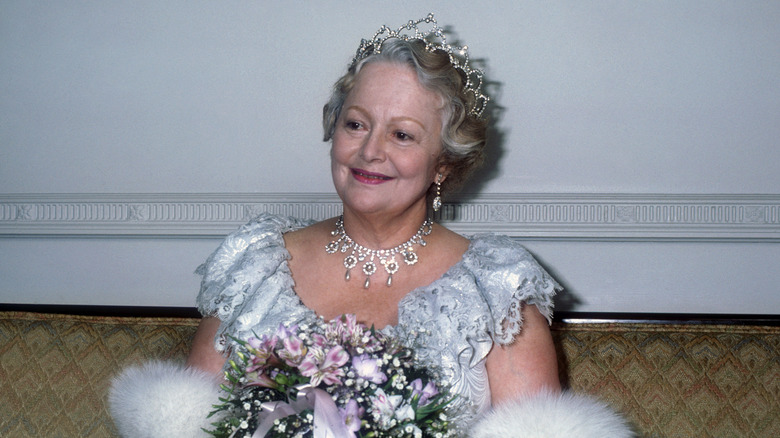
During Olivia de Havilland's 2016 interview with Vanity Fair, she shared that she also did the New York Times crossword daily to help maintain her cognitive health. Numerous studies from over the years have shown that solving puzzles can go a long way in keeping the mind sharp as we age. As part of a 2022 study published in NEJM Evidence, 107 adults with mild cognitive impairment regularly solved crossword puzzles or played other cognitive games for 12 weeks and then participated in booster sessions for an additional 78 weeks.
At the end of the study, 37% of people who did the crossword moved two points down on the Alzheimer's scale. Speaking to The New York Times, Dr. Joe Verghese, the chair of the neurology department at the Stony Brook University Renaissance School of Medicine, explained that the "mental muscle" gained from solving crossword puzzles and other cognitive games could make it harder for a person to get dementia. Verghese said that solving puzzles likely wouldn't be enough to fully stave off the brain damage that led to dementia. However, for someone with Alzheimer's, having a greater degree of cognitive reserve could "mask the effect and delay the onset of symptoms for a few years."
Of course, it's not just crosswords that can positively affect cognitive health and help slow down aging. Even games like Wordle can boost your brain power in a surprising way.