

5 Hygiene Public Restroom No-Nos People Are Guilty Of In The First 5 Minutes
Do you avoid public restrooms? According to a 2020 study in the Journal of Urology, 26% of adult female respondents admitted they do. But ignoring the call of nature is tough; after all, you don't want to accidentally mess up your pants. Therefore, chances are good that you probably encounter and use communal restrooms on a regular basis. And when you do, it's best to keep some hygiene practices in mind — and, perhaps more importantly, what you should avoid doing.
When you use a public bathroom, you typically do it in a rush. This may cause you to let down your guard, making mistakes that put your health at risk. Worse, if you're the one who's sick with a communicable disease like norovirus, you might wind up transferring your own germs or a virus to another person unintentionally. Being a bit more careful could spare someone else from a nasty stomach bug or norovirus symptoms like vomiting and loose stools.
With that said, these are five serious (though understandable) bathroom blunders made by men and women across the United States. Read them before you make your way to the only stall you should be using in a public bathroom.
Touching flushers and sink tops
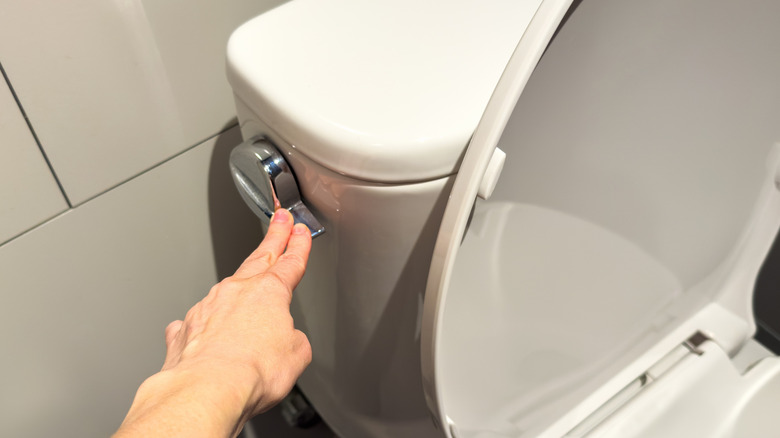
If you polled your BFFs about the nastiest place in a public restroom, they might say the toilet seat. After all, it seems like a no-brainer. Ironically, they'd be wrong. According to a 2025 study in Hygiene, the filthiest places in a bathroom were the countertops and flush handles. It's because they're coming into contact with a lot of grime, as infectious disease expert Dr. Nidhi Ghildayal explained to The Healthy. Specifically, Dr. Ghildayal pointed to the phenomenon of "individuals using their feet rather than their hands to flush," since "the floor and the bottom of your shoes are generally some of the dirtiest parts of a bathroom."
In terms of countertops, they're a high-touch area that collects germs that persist, according to microbial ecologist Jack Gilbert (via NPR). Gilbert notes that the Staphylococcus bacteria (which can cause infections in some people) are "true survivors" and will stay alive on bathroom surfaces for longer than other types of bacteria strains.
How can you avoid touching all those hotspots? You could use napkins, paper towels, and facial tissues to cover your hand when navigating your way through a public toilet. Thinking of using your sleeve? Health expert Jessica Pettit warned The Healthy that "the moment your hands brush against the clothing, they will become contaminated."
Resting personal belongings on the floor
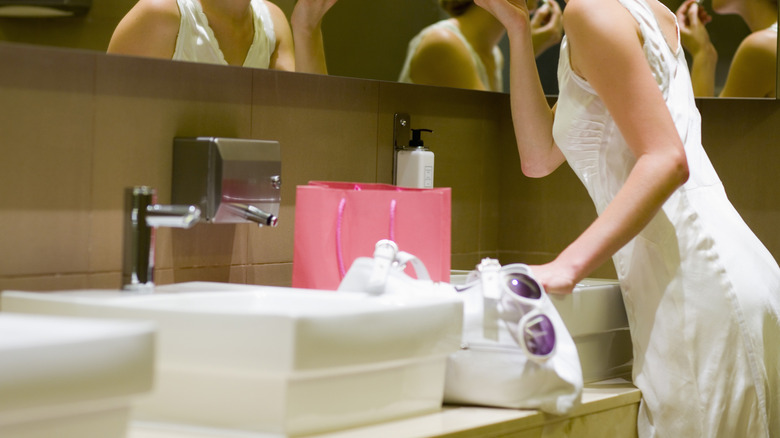
The same 2025 study in Hygiene that revealed how flushing devices and countertops were so packed with E. coli also found that the bathroom floor was covered in bacteria and germs. And that matters if you're someone who tends to put your bag, purse, or even cell phone and keys on the floor.
Are there really a lot of folks resting their purses and bags on the bathroom floor? Yes. In a thread on the /AskWomen subreddit, Redditors cite using the floor for a multitude of reasons (e.g., "Not a germaphobe [sic]," "no hook on the door," "people can easily steal your purse over the top of the door from that hook"). Consequently, is it surprising that microbiologist Charles Gerba explained to USA Today that he found the cleanliness of handbags to be questionable? "About a third of them [purses] have fecal bacteria on them," he noted.
Remember that you'll later be touching your purse and bags, as well as placing them on the various surfaces within your workplace, car, or home. Therefore, use the hooks in public restrooms whenever you can. If you don't see a hook, figure out if you can hold onto your personal belongings rather than rest them on the floor.
Handwashing too quickly (or forgetting to wash at all)
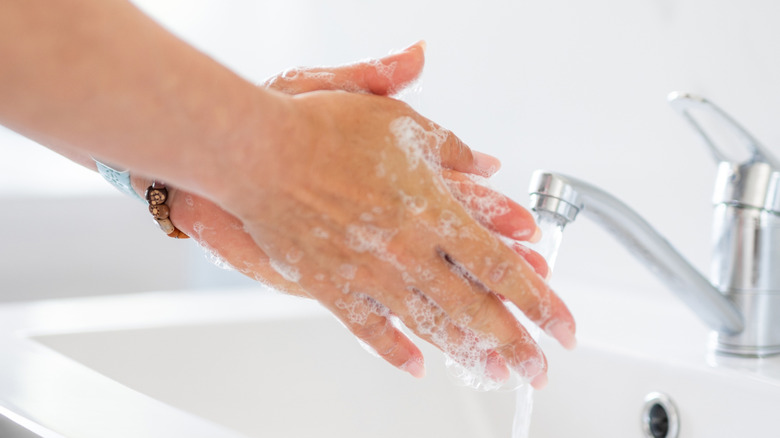
Twenty seconds. That's the recommended minimum for you to wash your hands when they're dirty, according to the U.S. Centers for Disease Control and Prevention (CDC). Here's why: It takes the full 20 seconds for the soap to remove unwanted dirt, germs, and other contaminants from your hands (via the CDC). Essentially, the grime gets trapped in micelles, which are pockets that form in the suds and help clean off your skin. If you only wash your hands under running water for five seconds, you'll still remove 90% of the dirt, according to a 2021 review in the International Journal of Environmental Research and Public Health. However, the review recommended 20 seconds as the best handwashing practice.
Regrettably, many public restroom users fall way short of the 20-second handwashing rule — or just don't bother to wash their hands in the first place. A 2000 survey conducted by the American Society for Microbiology showed that although nearly all people profess that they wash their hands after going to the bathroom in public, only about two-thirds actually do it. This can be a risky decision, says Dr. Robert H. Hopkins, Jr., the medical director for the National Foundation for Infectious Diseases. "Given the importance of handwashing in infectious disease prevention, the stakes are high—improving hand hygiene can help improve health for all," he noted.
Flushing before you're ready to leave the stall
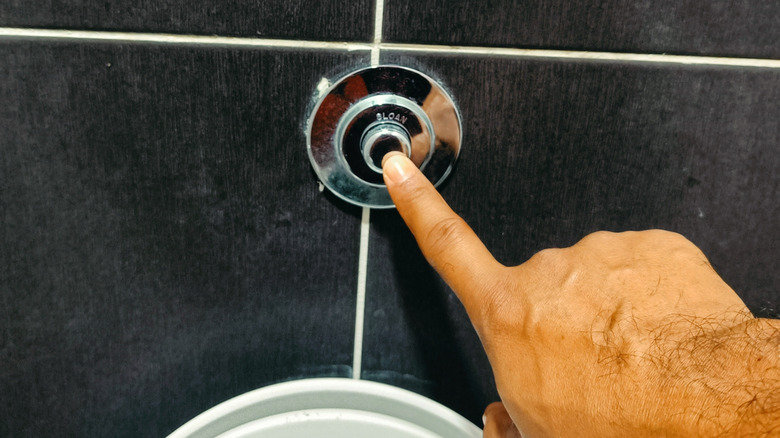
You may think it's wise to flush as soon as you've finished in a public restroom, even if you're not buttoned and zipped yet. But it's one of those habits that are spreading more germs than you realize. Here's why: A 2022 study in Scientific Reports found that the spray from a flushed toilet can spatter bacteria. "We had expected these aerosol particles would just sort of float up, but they came out like a rocket," stated lead author John Crimaldi from the University of Colorado Boulder. Consequently, you might end up covered with germs if you're not careful to make a fast getaway.
It's worth noting that even if there's a seat you can put down, the splatter can still make it into the small toilet area by moving sideways. With that in mind, get yourself buttoned, zipped, and straightened before flushing so you're not hanging around for the after-flush experience. Oh, and one more reason to get lost: A 2017 study in the Journal of Environmental Health discovered that bacterial residue persists in toilet bowls for up to 24 flushes. In other words, you could be contaminated with other people's germs long after they've vacated the stall.
Using your smartphone in the restroom
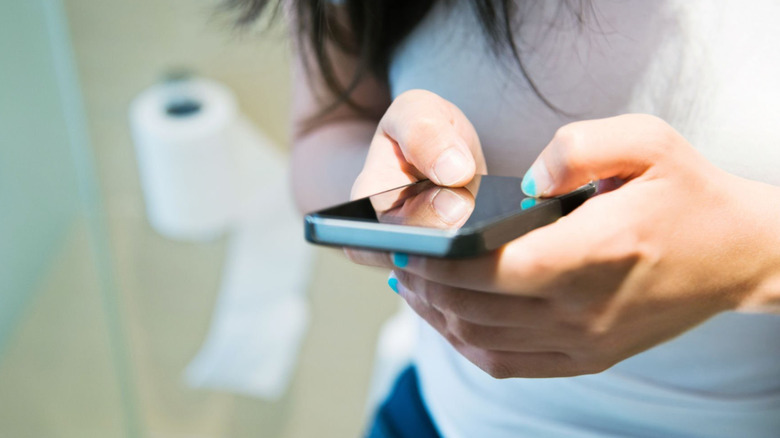
Using your phone in a restroom sets you up to acquire new germs on your device, which is already fairly gross unless you're cleaning it regularly. As public health expert Emily Martin explained in an interview for the University of Michigan Institute for Healthcare Policy and Innovation: "Taking a cell phone into the bathroom and then leaving with it is kind of like going in, not washing your hands and then coming back out."
The problem is that if you touch your cellphone with unwashed hands or set it down on any surface, you're just introducing more grime to it. Of course, some people just don't care: A survey from QS Supplies revealed that 88% of people in the U.S. use their phones in the bathroom, and just a quarter of them clean their screens off regularly. Perhaps it's no wonder that one out of every six phones has fecal matter on it.