

Is Gray Hair Reversible? A New Study Finds It May Be Possible
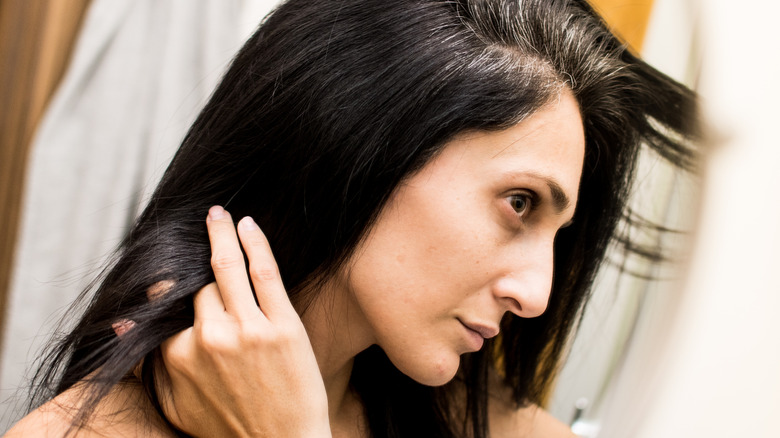
Some people aren't happy when they spot gray hairs; many take measures to hide them. Based on a Garnier-commissioned 2021 survey of 2,000 women (via Salon Today), 33% used at-home hair color kits in 2020. Of those women, 85% were motivated by the opportunity to send away the gray. But banishing gray hairs with chemical products may not always be necessary, according to a 2023 study in Nature.
After examining melanocyte stem cells (the ones involved in hair pigmentation and growth) in mice, the authors observed cases in which the stem cells causing gray hair were getting interrupted and skipping a hair follicle development step. When they were modified to return to their regular routine, pigmentation reappeared. Lead author Dr. Qi Sun told Earth that the conclusions present "a potential pathway for reversing or preventing the graying of human hair by helping jammed cells to move again between developing hair follicle compartments."
Although the study was conducted on animals, its conclusions show promise for humans who would like to limit their gray hairs. Interestingly, this isn't the first study that indicates that gray hair may be a temporary phenomenon under specific conditions.
More ways to postpone the grays

A 2021 research article in eLife investigated the possibility that stressful occurrences could cause hair pigmentation to go gray or white for a limited time before returning to normal. To test the hypothesis, a series of hair samples that included a section of pigment interruption (white or gray) were gathered from participants. The samples were measured to determine the approximate time period when the pigmentation stopped and started.
After identifying the likely months when stress occurred, the investigative team looked at the participants' self-reported stress logs to see if the loss of pigmentation in each hair corresponded with a stressful situation in the participant's life. In some instances, the white and gray areas of hair lined up with participant stressors, suggesting that stress-induced graying might be reversible.
As biogerontologist and study editor Matt Kaeberlein explained to Scientific American, "What was most remarkable was the fact that they were able to show convincingly that, at the individual hair level, graying is actually reversible." However, the authors noted that reversible grays might only work in younger adults.
Although neither of these experiments means an end to gray hair, they may indicate that gray isn't always here to stay. In the meantime, you can make everyday changes to potentially delay your graying, like eating certain foods to prevent gray hair, lowering your stress, and getting sufficient sleep.