

Sen. John Fetterman's Health Issues Throughout The Years, Explained
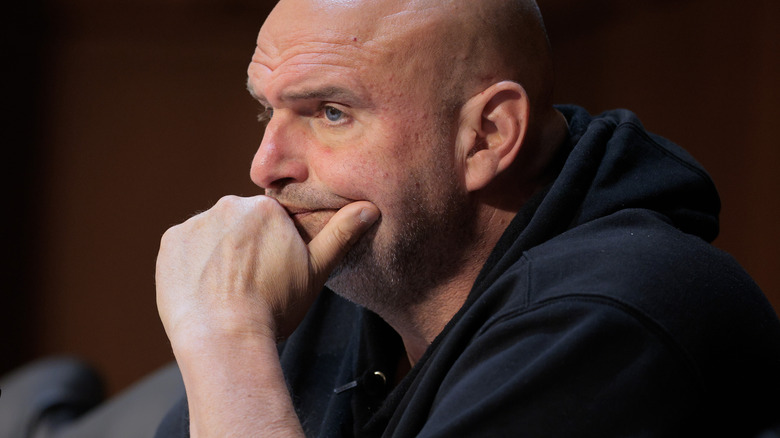
A constantly rotating wardrobe of hoodies and shorts earned senator John Fetterman a spot on The New York Times 2022 Most Stylish list. However, what's more fascinating about the politician than his laid-back personal aesthetic may be his harrowing health journey, beginning with a life-threatening stroke in May 2022.
There are two kinds of stroke: ischemic and hemorrhagic. Fetterman had the former, which occurs when blood (and the oxygen it carries) is interrupted on its way to the brain. In his case, the interruption was due to a blood clot.
Each year, more than three-quarters of a million individuals in the United States experience strokes, with ischemic strokes accounting for 83% of the occurrences (via the Centers for Disease Control and Prevention). For survivors, the side effects after a stroke can be pronounced and debilitating, such as paralysis and speech difficulties.
Fetterman now has a hearing deficit (which may have been due to different factors, including his stroke), as well as symptoms of aphasia, which is the inability to interpret spoken language effectively. As he explained in a CBS interview, "I can understand much of what you're saying. But my hearing has a deficiency that makes it difficult for me to fully understand 100% of it."
Senator John Fetterman's physical, emotional, and mental health struggles

As a result of his condition, Fetterman has had to rely on closed captioning to help him fully communicate. This was evident during a 2023 appearance on "The Late Show with Stephen Colbert," when he used a tablet to read the questions Colbert was asking. He won the 2022 Pennsylvania senatorial race by a significant percentage of the vote, even after speaking during a difficult debate that showcased his aphasia and produced doubt in some about his capabilities.
After his 2022 stroke, Fetterman suffered from episodes of clinical depression symptoms that steadily worsened. By early 2023, his mental health condition had deteriorated so much that he stopped eating. He was compelled to take action and admit himself to an inpatient treatment facility. He credits getting help with saving him from regular thoughts of taking his own life, which are common ideations among people who are diagnosed with major depressive disorder. "To anyone going through this right now, stay in this game," he advised in a CBS interview.
If you or someone you know is struggling or in crisis, help is available. Call or text 988 or chat 988lifeline.org
Sharing openly to help others heal
After undergoing intensive mental health treatment, Fetterman's condition improved, and he gave numerous interviews both while in treatment and out of treatment to highlight the positive strides he was making. But his health woes resurfaced more than two years later in November 2025, when he made headlines for his health once again after briefly losing consciousness and falling on the ground.
The fall reportedly caused what a spokesperson described on X as "minor injuries" to Fetterman's face. According to statements made to the press, Fetterman fell due to a "flare-up" of ventricular fibrillation, a condition that causes the heart to stop beating normally. Ventricular fibrillation can lead to death, which is why Fetterman previously underwent surgery to have a special heart pacemaker placed to detect irregular rhythms and attempt to restore the heart's normal beating pattern.
Fetterman's stroke and depression slowed him down but didn't sideline his political aspirations or his persistence in spreading knowledge and hope. He has used his senatorial status to promote a bill to support others like him who need assistive technologies to better understand what people are saying to them. He has also been an outspoken supporter of mental health care, and has supported legislation to add more guidelines to social media sites to reduce digital-related mental health problems.
If you or someone you know needs help with mental health, please contact the Crisis Text Line by texting HOME to 741741, call the National Alliance on Mental Illness helpline at 1-800-950-NAMI (6264), or visit the National Institute of Mental Health website.