

The Hair Loss Drug Donald Trump Used Has Some Serious Drawbacks
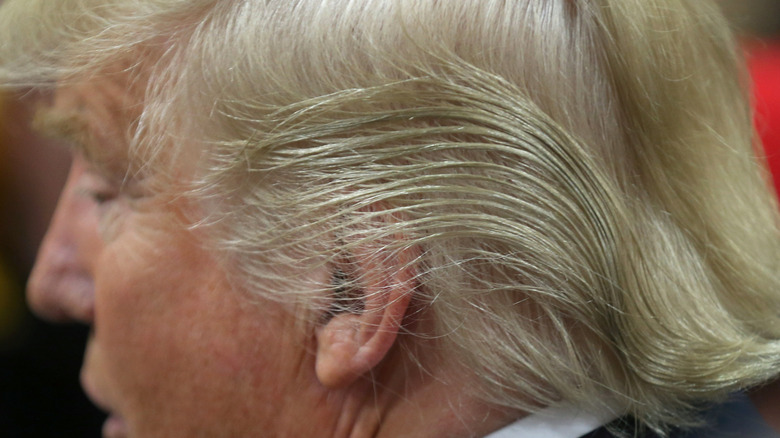
For Donald Trump, life in the political spotlight has meant revealing details about his health. For instance, Trump has bragged about passing a cognitive test after starting his second term. Similarly, it's common knowledge that he takes drugs for certain conditions including high cholesterol and eczema, according to a 2025 White House medical report.
However, one medication was glaringly absent from the document: finasteride, a hair loss treatment (sometimes better known by the brand name Propecia) that Donald Trump used to take in or around 2017. And that might be better for him, given the drug's potentially serious drawbacks.
Doctors typically prescribe finasteride to treat two different male-specific issues: male pattern baldness (since finasteride might help to combat a receding hairline) and benign prostatic hyperplasia (BPH).
Although finasteride is popular, it's known to cause some significant and lasting problems in a small percentage of men who take it. Specifically, those men experience what has become known as post-finasteride syndrome.
Understanding post-finasteride syndrome

Post-finasteride syndrome occurs when men stop taking finasteride but continue to present with a variety of side effects. Post-finasteride syndrome has been associated with cognitive, psychological, and sexual side effects.
For instance, some men who decide not to use finasteride feel mentally foggy, even months after they discontinue the drug. Or, they have mood swings and major depression that they trace back to using finasteride. And their claims that finasteride is to blame are being taken seriously by some members of the medical community: A 2025 review in the Journal of Clinical Psychology attributed finasteride to anxiety and thoughts of self-harm among some men, and called for more stringent regulation for emerging drugs.
One of the more persistent — and emotionally overwhelming — reported side effects of post-finasteride syndrome in some men is a loss of libido and sex organ concerns. As noted by NBC News, research showed that between 1% and 2% of men reported having this type of "persistent" dysfunction for years. Findings revealed that the men most likely to be affected by long-term post-finasteride syndrome were those who took the medication for at least seven months before they turned 42. (For the record, Trump was 42 in 1988, and finasteride didn't enter the market until the 1990s.)
Other options for regrowing hair

There haven't been any reports indicating that Trump has had a brush with any negative finasteride side effects. But a 2020 review in Neurobiology of Stress suggests other men likely haven't been as fortunate. The review determined that while post-finasteride syndrome was difficult to conclusively diagnose, it deserved to be studied further.
Trump and other men who want to keep their manes full without resorting to drugs have other options that aren't medical. For example, some men (and women) swear by all-natural methods to encourage abundant hair regrowth, such as partaking in "scalp oiling" (massaging oil into the scalp) or sticking to a properly nutritious diet. (If you want to grow your hair fast, take these vitamins.)
In a New York Magazine interview, scalp therapy expert Bridgette Hill explained why scalp oiling can stimulate hair growth: "Certain oils are vasodilators: that means they widen the blood vessels. Massage is also a vasodilator, but from a mechanical standpoint."