

How Strong Are Veneers? Chrissy Teigen's Tooth Mishap Hints They're Weaker Than You Think

You might not have been born with a straight, camera-ready smile, but that's okay: You may be able to get the illusion of one if you cover minor tooth imperfections like slight tooth rotations or unevenly sized or spaced teeth with porcelain veneers. However, you need to be cautious about how you take care of your new grin, as superstar Chrissy Teigen found out the hard way.
The one-time model apparently tried to rip open the wrapper of an oversized candy cane during the year-end holidays in 2025, snapping off one of her veneers, according to her Instagram. As a result, she was left with an incomplete smile, at least temporarily. (She had the veneer rebonded the next day.)
Teigen showed off her sense of humor as well as her veneer vacancy during the incident. (It's the same no-big-deal attitude she displayed when she admitted that she had cellulite.) But her experience illustrates the reality that veneers can't handle the same forces that a natural tooth might. Since a veneer is only bonded to the front surface of a tooth, it can break off under pressure. This is why dental providers recommend that people with veneers avoid biting down on ice or crunchy objects. (And it's never a good idea to use your teeth — with or without veneers — as a tool.)
Durable, but not infallible
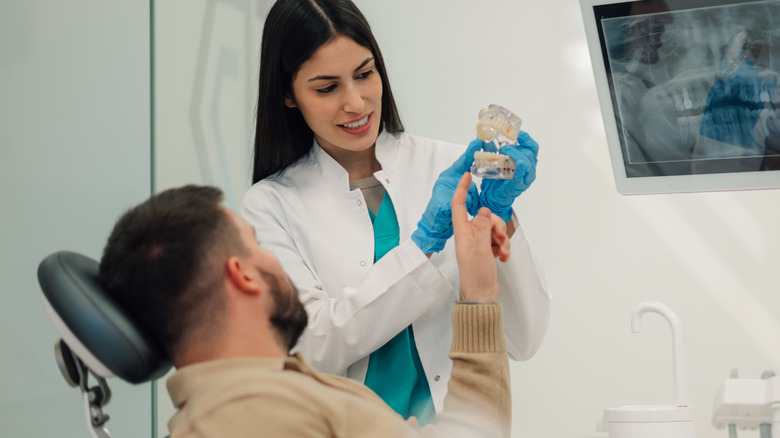
The problem is not the veneer itself, because veneers made of porcelain or composite substances aren't typically brittle or fragile. And they don't generally slide or come loose, because the enamel of the tooth they cover is roughened before placement to promote a tight bond. (Here's what really happens to your teeth when you get veneers.)
That said, even the most secure tooth-veneer bond has limits. Plus, veneers must be replaced after around 15 years, so the bond may begin to weaken over time. (Teigen didn't indicate how old her veneers were in 2025, although she discussed getting them with Refinery29 in 2016.)
If you want a winning smile but prefer a stronger alternative than a veneer, you might want to talk with your dentist about covering all your unattractive or damaged teeth with crowns rather than veneers. After all, crowns form a complete cap around a prepared tooth, which enables them to withstand a stronger force.
The only issue is that tooth crowns cost more than veneers (upwards of $3,500 per crown versus $1,500 per veneer, per Heathline). Therefore, you could wind up with a sizable dental bill in exchange for a stronger cosmetic dental product.