

5 Presidents Who Kept Health Issues Under Wraps While In Office
In 2025, President Donald Trump's health was a significant topic of conversation. A mysterious bruise on his hand was first photographed in February 2025, and when the press released the images to the public, immediate concerns arose. In response, Trump appeared to be applying makeup to cover the bruise. While we don't know whether the president has been concealing a more serious medical condition, hiding health problems wouldn't be anything new to the Oval Office.
Almost as deeply rooted as the history of the presidency itself is an archive of medical cover-ups that took place under the roof of the White House. For centuries, when administrations or presidents did not want to raise doubt or diminish status, a political plan to mask the commander-in-chief's illness was set in place. Often involving other members of the cabinet and even the press secretary, presidents have gone to outrageous means to maintain a face of health to the American public. In order to hide procedures, ailments, and fatal diagnoses, lives were put on the line, blatant lies were spread, and full walls of feigned transparency were erected, all in the name of maintaining political power.
Chester A. Arthur
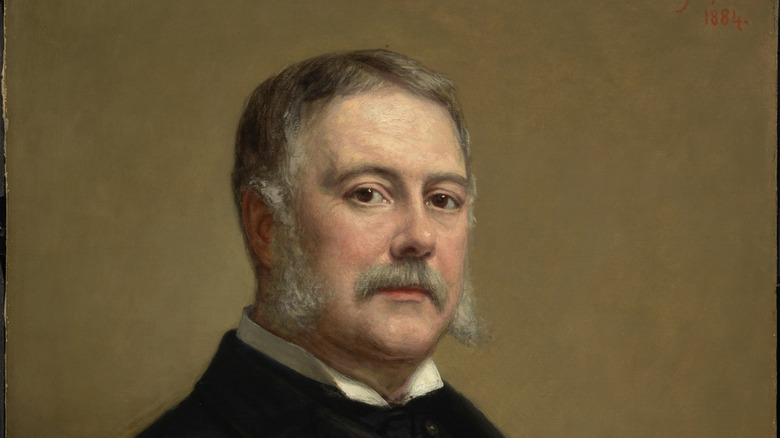
In 1881, Chester A. Arthur was thrust into the role of President of the United States when James Garfield was assassinated. His sudden position demanded behavioral change, a change that he wasn't quite up to. Arthur was known for his limited stamina during the presidency, starting meetings late, ending them early, being constantly fatigued, and making only weak attempts at rallying his Republican party. By 1882, the Virginia native's sleepy disposition was undeniable, with even his brother-in-law taking note of Arthur's condition, suggesting that an illness could be affecting him.
Soon, the public was aware of it too. He had lost weight, a lot of it, and his face showed great signs of age. No need to fret, his press secretary had told journalists, the president had a case of malaria — something he had caught from the recent mosquito outbreak in Washington — a treatable condition. The reality? Arthur had been diagnosed with Bright's disease, a kidney condition that causes organ shutdown. His administration worked to cover up the disease, pushing the president on national trips and boasting of his recovery. However, information leaked to the press. Papers published their findings before Arthur's press secretary stepped in again, insisting that the illness was malaria and squashing the idea of Bright's. With Arthur's failing condition, however, it was no use. The president was dying, and no amount of media redirect would stop that. In 1885, Arthur was voted out of office, and by November of the following year, he died.
Grover Cleveland
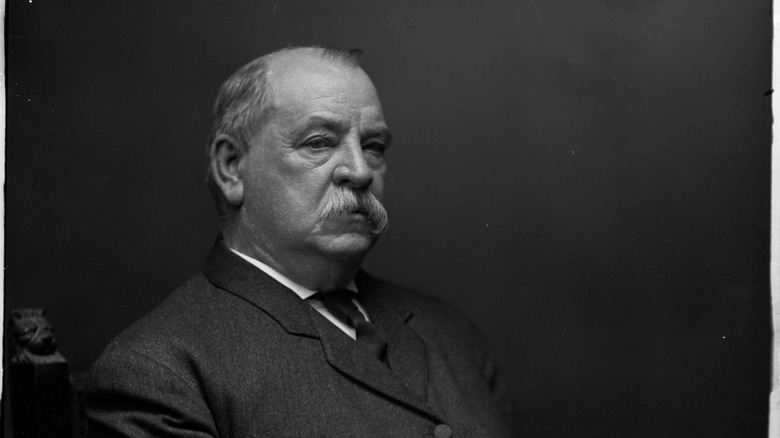
Grover Cleveland was elected president for the second time in 1893, but not long after returning to office, he noticed a large bulge on the roof of his mouth. Cleveland's practitioner took one look at it and determined the lump was cancer. The bulge had to be removed; there was no question about it. Cancer is a dangerous diagnosis, and he was the president of the United States after all. His title also meant inciting public fear and doubt should the diagnosis become public.
So, in the 19th century, the president and his doctors devised a plan. To keep his medical condition under wraps, Cleveland wouldn't be able to have the surgery in the state — there'd be too many eyes to see him go in and out of the hospital. Instead, Cleveland would fill a yacht with surgeons and sneak aboard under the guise of a vacation. Over the course of four days, the surgery would be performed, the president would be monitored during his recovery, then he'd miraculously come back to shore as though nothing had changed.
The surgery in the 21st century, on solid land, takes several hours, but Cleveland's doctors were able to extract the cancerous tumor in only 90 minutes... on a moving boat. Out with the tumor also came five of the president's teeth and a chunk of his upper jawbone, but the public would be none the wiser thanks to the surgery scar and missing teeth all expertly hidden under his large, bushy mustache.
Woodrow Wilson
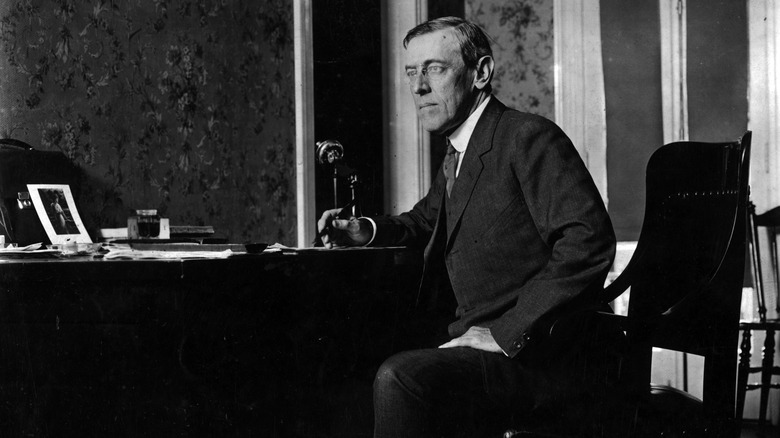
Woodrow Wilson was known to overwork himself; becoming president in 1913 did little to change this work ethic. Known to have traveled across the country for weeks on end to give speeches, visit land, and meet his constituents, Wilson was a seemingly tireless man who had taken up the prestigious mantle of presidency. That's not to say there weren't people who doubted him. Dr. Silas Weir Mitchell had made the personal declaration that Wilson would not make it through his first term alive. Despite the doubt, he completed his first term and was elected to a second. Wilson persevered, never slowing down... even when his body showed signs of failure.
During one of his long cross-country trips in 1919, the president had noted having symptoms typical of a stroke: severe headaches, a loss of appetite, nausea, and incessant facial muscle twitching. After his doctor made a public announcement that the president had been experiencing some drooping on the left side of his face, the national tour was cut short. Excuses were made, naming the need for rest and an upset stomach as the reason for the sudden cancellation. But once he was back home at the White House, the president awoke with partial paralysis. Not wanting to alarm the public or ruin her husband's administration, Edith Wilson took to running the country herself, while at Wilson's bedside. The American people weren't told about their president's condition until after his second term had come to an end in 1921.
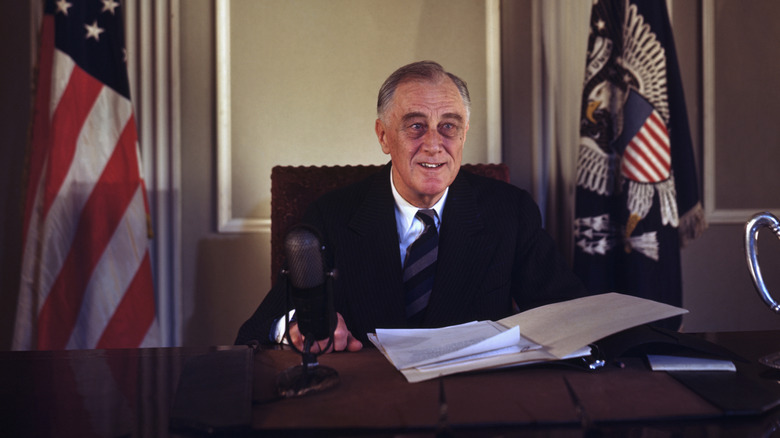
Franklin Delano Roosevelt
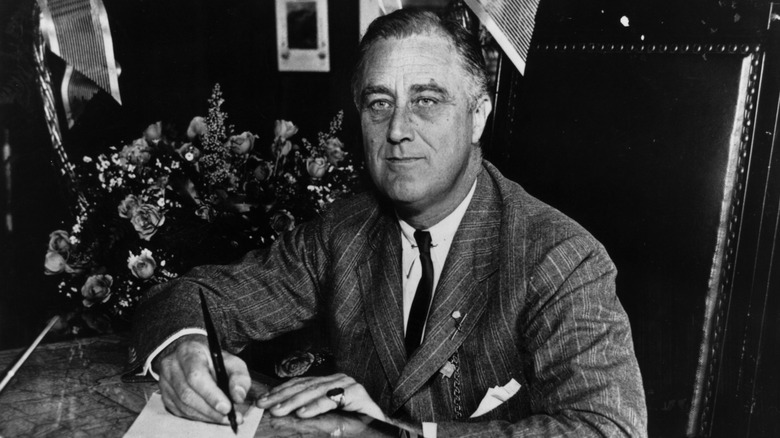
Franklin D. Roosevelt's time in office was much longer than a normal stay. Elected to four terms, the president was a well-loved and highly trusted political figure in the eyes of the American public. But, mostly unknown to the public (or greatly downplayed), Roosevelt was severely ill. Diagnosed with polio in 1921, Roosevelt was not immune to the paralyzing effects, and though he mostly recovered from the disease, his legs did not.
Elected president in the 1930s, he was required to use a wheelchair, which his political advisors warned him against. The image of the president wheelchair-bound could send the public into a panic over his fitness for office. Roosevelt made it work. In public, he used leg braces and a cane or crutches, and in the privacy of the White House, he used a personally designed wheelchair that would accommodate the inaccessibility of the office.
But his paralysis was not all that plagued him while in the Oval Office. When his election to his fourth term came in 1944, at the age of 62, Roosevelt had been diagnosed with partial heart failure, bronchitis, and melanoma. His long list of ailments was purposefully misrepresented to the public through White House statements that encouraged an image of the president that was healthier than Roosevelt actually was. During his last term, the cancer would spread to Roosevelt's brain and stomach, which eventually caused the president to have a fatal stroke only four months into his fourth term.
Dwight D. Eisenhower
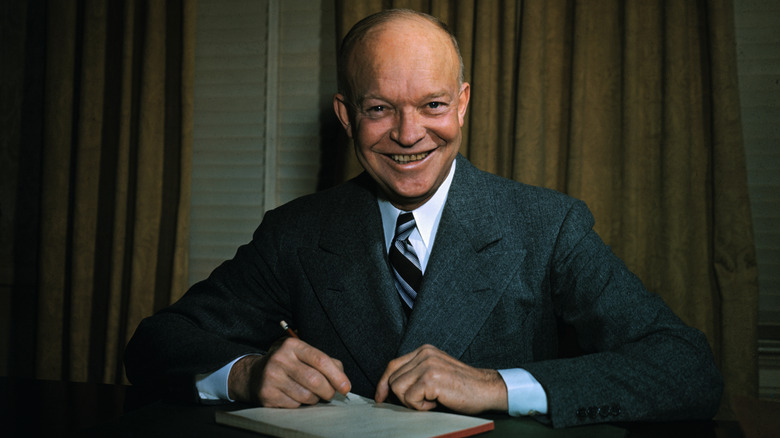
When Dwight D. Eisenhower was elected president in 1952, he wasn't in the healthiest of conditions. Eisenhower had had an appendectomy in the 1920s, which served as a trigger point for severe abdominal pains that he suffered from throughout his adult life. He had muscled through the chronic pain when another medical emergency rocked his world. Just two years into his first term, the Texas native had a heart attack while in Colorado. Unlike Grover Cleveland, the president didn't have the luxury of pre-planning his escape; he had no choice but to be rushed to the hospital. It was public, or very near to it, before the administration could do much to cover it up, so Eisenhower's press secretary went full swing into press mode.
He spoke to the press and even invited the president's doctor to answer questions. Crafting a lie on top of a lie, as predecessors had, or downright going into hiding, would not work in the modern age. Instead, Eisenhower's administration flooded the press with information about his health. Releasing medical records, checkup dates, and physicals, the administration carefully constructed an image of a transparent presidency, all while hiding the severity of his heart attack. This practice would continue throughout Eisenhower's term, when the president would be diagnosed with Crohn's disease, undergo surgery, and have a stroke. As Eisenhower healed, he was deemed a hero for his clarity in recovery despite obfuscating the real truths of his conditions.