

How Did Piers Morgan Break His Hip? The Commentator's Road To Recovery Is Brutally Long
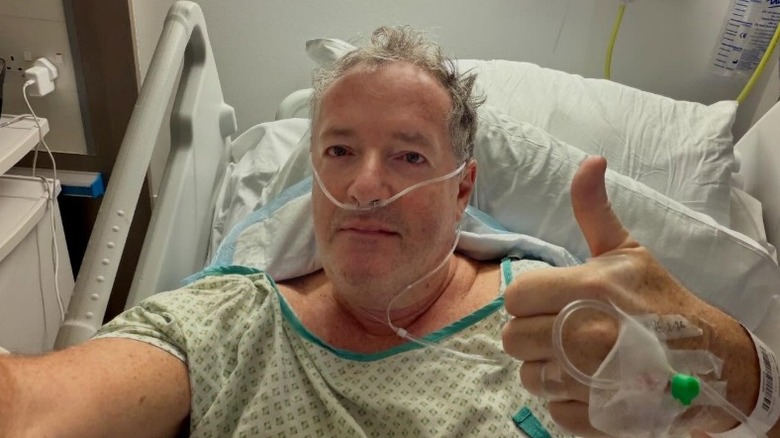
Piers Morgan kicked off 2026 with a press-earning medical emergency health situation that landed him in the hospital and will probably require a long recovery period. According to his Instagram, the 60-year-old broke his hip while at a London restaurant in mid-January. Morgan's post was brief but shared a few key details about the incident.
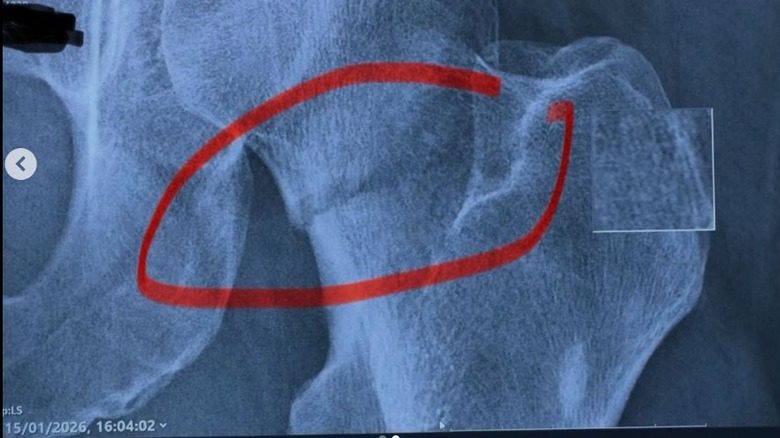
Morgan said that he "tripped on a small step," ultimately fracturing the top of his femur. (This means he has something in common with athlete Tony Hawk, who also broke his femur several years prior to Morgan's incident.) The break was extensive enough to warrant hip replacement surgery, a procedure that's common in both the United Kingdom and the United States. (Surgeons in the UK perform more than 100,000 hip replacements annually; in the U.S., the yearly figure soars to more than 500,000.)
The expected recovery period for hip replacements tends to be predictable, but can be lengthy and involved. That said, Morgan shouldn't be bed-bound for long if his case follows a typical pattern. In a Johns Hopkins Medicine interview, orthopedic surgeon Dr. Savya Thakkar explained that the majority of patients who undergo hip replacements are walking (and heading home) within about 24 hours, with and sometimes without the support of assistive devices. Morgan noted that he expects to walk with crutches for six weeks.
Recovering after hip replacement surgery
Dr. Thakkar added that hip replacement patients generally return to low-impact work in a couple of weeks. But Morgan won't be able to jet-set for his job as a broadcaster for longer than that, given that he's apparently restricted from flying long distances for 12 weeks. (Here are the things you should never do after having surgery.)
When can Morgan expect to go full throttle again? A complete return to normal daily life could take three months or even longer, depending on how the individual's body responds to the treatment (per Cleveland Clinic). Complicating matters further is the nature of Morgan's injury. The American Academy of Orthopaedic Surgeons notes that recovering from a femoral bone break could require up to six months.
Another snag for Morgan could be that his hip replacement surgery wasn't preplanned. Frequently, patients schedule pre-operative physical therapy sessions to strengthen the muscles and connective tissues around their hips before they have surgery. This speeds up recovery in most people, allowing them to move quickly through the recovery stages. In contrast, emergency hip replacements may require longer hospitalizations, according to a 2010 study in the Journal of Arthroplasty that evaluated the care needs of adults facing emergency versus elective hip surgeries.