

Donald Trump's Life Expectancy: What Is (And Isn't) In His Favor
It's tough to scroll through social media without hearing opinions (and dire predictions) about Donald Trump's health, but what are the clear facts? Will the twice-elected POTUS continue to receive "excellent" medical reports like the one released by the White House in April 2025, or is it more complicated than that? Are troubles looming?
To determine whether he's likely to have life-threatening health problems, we should first look at what he does right, and a good place to start is his decision to swear off drinking alcohol. Trump reportedly chose to be a teetotaler because his older brother died from alcoholism in his early 40s. He even admitted at a National Faith Summit (via The Independent), "I think I have the type of personality where I probably would have a problem."
Is having a little alcohol now and then really bad for you, though? A 2022 study in Scientific Reports looked at the health records of more than 400,000 adults and discovered that those who drank alcohol regularly could expect to shorten their lifespan by 6.9 years. Although people who drank just one alcoholic beverage a day seemed to gain one year of life, they were at higher risk of cancer, which negated the benefit. Consequently, Trump's refusal of alcohol may give him a win.
Favorable: Trump doesn't smoke and hasn't used illegal drugs
In addition to saying no to alcohol, Trump doesn't smoke or use illegal drugs, either. The reason? Again, it was watching his brother. During an appearance on "This Past Weekend w/Theo Von," Trump explained that his brother told him not to smoke, drink, or do drugs because of his own issues. Said Trump, "It was very important for him to convey to me not to have this problem."
Science shows a connection between lowered life expectancy and smoking and illegal drug use. For instance, a 2024 editorial in Addiction noted that smoking a single cigarette could reduce a person's life expectancy by 20 minutes, based on data regarding smoking and mortality. All those minutes add up: The Association of American Medical Colleges explains that smokers die approximately a decade before non-smokers from the same age group.
Drug use is equally bad for longevity. A calculator provided by the American Addiction Center estimates that one episode of taking cocaine shortens lifespan by 6.6 hours and methadone by 14.7 hours. As such, never starting a smoking or drug habit seems to be a wise way to extend one's days.
Favorable: Trump keeps an existing health condition under control
In a White House medical report from April 2025, Trump's list of medications included two cholesterol drugs: rosuvastatin and ezetimibe. While it might seem like a downside that Trump has to take these prescriptions, his full panel of triglycerides, "good" cholesterol, and "bad" cholesterol levels were all within normal parameters (56 milligrams per deciliter, 77 milligrams per deciliter, and 51 milligrams per deciliter, respectively).
In other words, the fact that Trump has what physician to the president Captain Sean Barbabella has called "well-controlled hypercholesterolemia" may be positive. Plus, rosuvastatin is, as its name implies, a statin, which may lower the likelihood of death by 44%, according to a 2024 study in the American Journal of Preventive Cardiology.
In the article, one of the study leaders, Dr. Jiapeng Lu, explained, "The combination of preventive medication use and adhering to multiple healthy lifestyles was significantly associated with a lower risk of all-cause and CVD mortality, as well as having remarkable benefits in life expectancy." This means that Trump's willingness to keep his cholesterol within desirable limits may be stretching his life span.
Unfavorable: Trump consumes a plethora of processed food
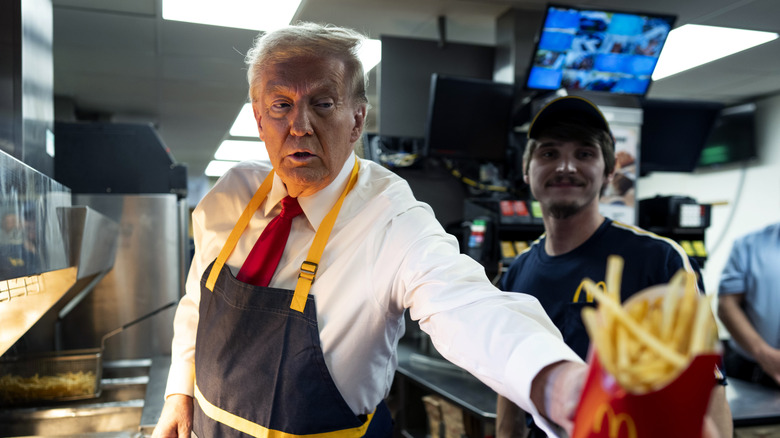
President Donald Trump's daily diet can easily include Big Macs, Filet-O-Fish sandwiches, and KFC, all washed down with Diet Cokes — up to 12 a day. (That's not hard when you have a button in the Oval Office to order a Diet Coke on demand.) Even the U.S. Secretary of Health and Human Services, Robert F. Kennedy Jr., has wondered how the Commander in Chief is still alive, given his ultraprocessed dietary preferences.
The problem with ultraprocessed fast food is that it's generally high in fat, sodium, calories, and often sugar, all while being low in nutrient-dense ingredients like vegetables and lean meats. A constant diet of ultraprocessed meals has been associated with more than 30 serious diseases, from obesity and respiratory problems to diabetes and cardiovascular disease.
In a 2024 piece for the American Medical Association, cardiologist Dr. Stephen Devries asserted, "Health consequences of ultraprocessed foods are dire." To back his claim, Dr. Devries cited a 2019 study in Public Health Nutrition that found that people who ate ultraprocessed foods the most (the top 25% of respondents to a survey) had a 31% greater chance of dying than those who didn't.
Drinking Diet Coke can also lead to diabetes and obesity. Diabetes can shorten men's lifespans by five years, according to a 2020 review in Frontiers Endocrinology. Obesity can do the same, even by more than 10 years in some cases.
Unfavorable: Trump doesn't exercise beyond golf
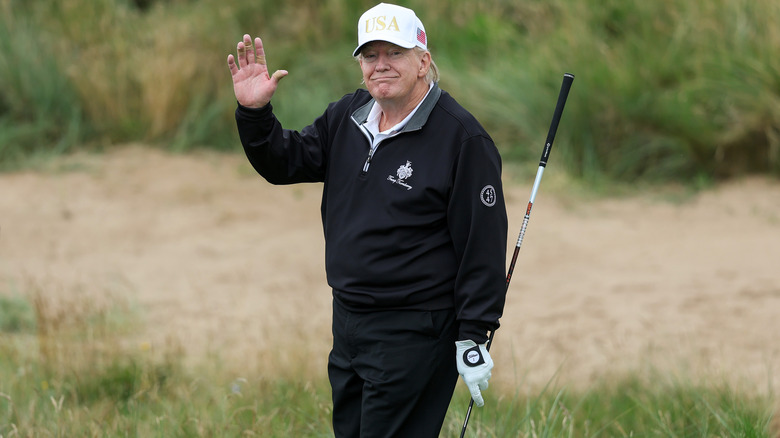
Exercising and staying fit can help extend your life, even if you're not an elite athlete (or prone to getting into fitness challenges like two of Donald Trump's colleagues.) Studies have found that it doesn't matter whether you exercise moderately or vigorously — either way will help to lower your risk of dying early. For instance, a 2023 study in JAMA Oncology concluded that exercising vigorously for just about four minutes daily could decrease a person's chances of getting cancer.
Aside from hitting the greens for some leisurely golf, Trump isn't a fan of working out in general. In fact, he has been actively against exercise for quite a long time. In their 2016 book, "Trump Revealed," authors Michael Kranish and Marc Fisher wrote that after college, Trump came to believe that exercise shaved years off your life. "Trump believed the human body was like a battery, with a finite amount of energy, which exercise only depleted," they wrote (via Vox), adding, "When he learned that John O'Donnell, one of his top casino executives, was training for an Ironman triathlon, he admonished him, 'You are going to die young because of this.'"
In 2015, Trump shared his thoughts on exercise with a reporter for The New York Times Magazine, noting that his type of exercise was spending an hour talking to a crowd. That said, he's seemed to be concerned enough to drop weight at times; he said he lost about 20 pounds in 2024, and in 2025, he was thought to be around 30 pounds lighter by Kennedy and talk show host Sean Hannity. However, there's no evidence that Trump hit the gym to trim down; Kennedy claimed it was because he began eating his burgers without the bun.
Unfavorable: Trump gets too little sleep
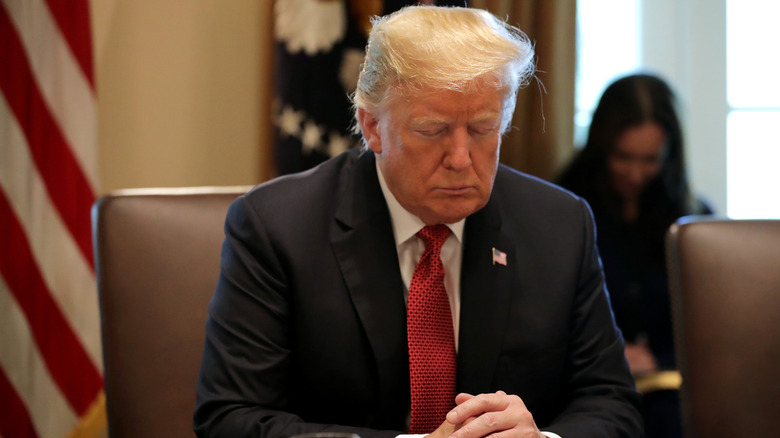
In an interview with The New Yorker in 2017, Donald Trump opened up about his poor circadian rhythm. "I like three hours, four hours," he said of his sleeping habits. The same year, he explained to political pundit Bill O'Reilly that he worked until midnight or later and got up at 5:00 a.m.
While some people can manage with so little sleep, most need more hours snoozing to remain healthy. That much is obvious from the results of a 2024 study in QJM, which looked at the cardiovascular effects of inadequate sleep in adults. Those who experienced sufficient, good-quality sleep improved their life expectancy by almost five years.
Many possibly life-threatening conditions have been linked to sleep deprivation, including weight gain around the abdomen, elevated blood sugar and blood pressure, and cognitive decline. The latter is especially important to consider for Trump, given that his father died from complications of Alzheimer's disease, the most commonly diagnosed of all age-related dementia types.
Indeed, lack of sleep may contribute to the development of Alzheimer's, as shown in a 2018 trial that was published in the Proceedings of the National Academy of Sciences of the United States of America. The trial discovered that a single night of sleep deprivation in subjects caused an uptick in a brain protein associated with Alzheimer's. Considering how many nights Trump has spent typing away on Twitter and then Truth Social, an Alzheimer's diagnosis is certainly within the realm of reason.