

Is Daryl Hannah Autistic? The Diagnosis Has Fans Slamming Her Controversial Portrayal In Love Story
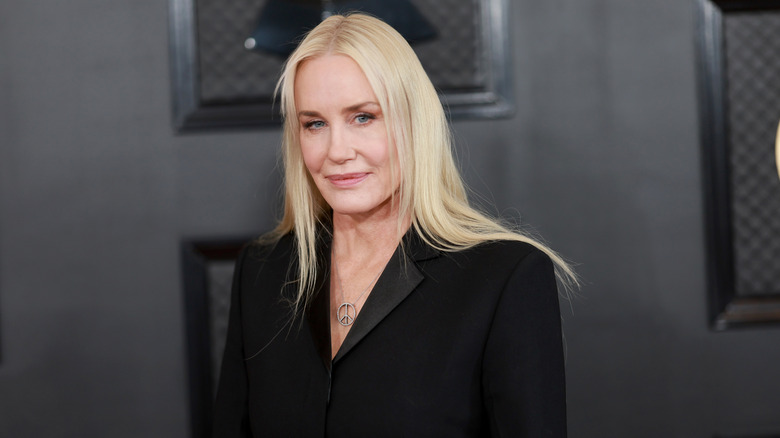
Adult women with autism can face many social challenges. For instance, they may find it difficult to read others' body and vocal cues, they may "stim" (e.g., repeating soothing activities like rocking back and forth), or they may try to fit in by overcompensating for their differences (via Psychology Today). Though the diagnosis can make life more difficult, many autistic women are successful professionals, including celebrity Daryl Hannah. (She's only one of several A-listers who have revealed their autism diagnoses.)
Now in her 60s, Hannah received her autism diagnosis during childhood. In a 2014 interview with Dan Rather available on YouTube, she told Rather that she wasn't "wasn't very communicative" as a youngster and typically rocked all the time. She credits her mother for helping her thrive, rather than institutionalizing her, and allowing her the space to explore acting.
Through film, Hannah says she has been able to live out her dreams. In one interview (via TODAY), she explained, "Acting for me was about going to the Land of Oz and meeting the Tin Man." However, viewers suspect that a new TV series may be grossly overplaying Hannah's autism in an effort to get ratings.
Created for ratings, not for autistic portrayal accuracy

The TV series is "Love Story", a streaming vehicle that elevates the 1990s romance between stars John F. Kennedy, Jr., and Carolyn Bessette. (The couple died in 1999 in a plane crash.)
Since Hannah dated Kennedy for several years, a character with her name surfaces in the show. But the writers of the character have been accused of taking liberties — and of "lazy writing" by Time Magazine — when it comes to Hannah's portrayal. Among those liberties may be a magnification of characteristics typically attributed to female autism.
Daryl Hannah and JFK Jr. in American Love Story! #LoveStoryFX pic.twitter.com/5ed0si5cou
— 𝒾𝓈𝓃𝓉𝒹𝒶𝓋𝑒𝑜𝓃𝑒 (@IsntDaveOne) February 14, 2026
As an example, the "Daryl Hannah" character appears in one scene at Kennedy's mother's wake. There, the character makes socially inappropriate and strangely cold remarks. In another scene, the character allows friends to do drugs in Kennedy's apartment while she engages in yoga-like poses. Both of these moments arguably make Hannah seem insensitive or incapable of forging strong relationships, two assumptions sometimes made about autistic women. (Both assumptions do have evidence-based underpinnings, but every autistic person is different, and assuming such characteristics is unjust for those with autism.)
Encouragement from around the Internet
Hannah hasn't accused the "Love Story" creators of mocking her autism, but she did call them out for being deceptive, as well as misogynistic. In an opinion piece for The New York Times, Hannah blasted those involved in creating "Love Story" for demeaning and villainizing her. "These are not creative embellishments of personality. They are assertions about conduct — and they are false," she wrote. "The actions and behaviors attributed to me are untrue."
Many watchers have noticed that the "Daryl Hannah" in "Love Story" seems contrived and fans of Hannah aren't keeping quiet about what they also perceive as an unfair spin on her autism. Said one on X, "The fact she has autism makes me wonder if they purposefully portrayed her in this ableist way to make fun of her." Even celebrity Rosanna Arquette has gone on Instagram to support Hannah by posting a throwback picture of the two of them with the comment, "The portrayal of her on the streaming thing is b*******. Her love with John F Kennedy Jr was real."
Whether or not "Love Story" took Hannah's autism into account when writing her fictional doppelganger's part isn't clear. (As a side note, the creators didn't consult with Hannah or with the Kennedy or Bessette family members, so the entire show has been filmed without any official backing.) That said, the "Daryl Hannah" character certainly seems to be overflowing with what look like autism symptom exaggerations.