

Photos Of Oprah Winfrey's Weight Loss Transformation Prove Wellness Is Not Always A Straight Line

Oprah Winfrey's stellar career trajectory has kept her in the spotlight for decades. However, the public has tended to talk just as much about her weight battles as about her phenomenal professional success.
Over the years, Winfrey has gained and lost roughly 60 to 70 pounds. Now in her 70s, Winfrey has finally found freedom from what she calls "food noise." But her path to a trim silhouette hasn't been simple. In fact, her journey proves that getting and staying fit doesn't necessarily follow a straight pattern. Many people take circuitous routes to attain their ideal shapes.
Dr. Marc Bessler explained to Columbia Surgery why some individuals (like Winfrey) end up putting on and taking off weight repeatedly. "There's a clear genetic component," he said. "Some people making those exact same [lifestyle] choices would not be overweight."
Indeed, heredity can play a role in whether a person will have difficulty managing their weight, according to a 2021 review in Obesity. The review determined that up to 80% of body weight variances can have an inherited component for people with obesity. (Winfrey has said that members of her family were also obese.)
What has Winfrey's path to wellness looked like? Let's take it by decades and work through her ups and downs in photos.
Going all-liquid in the 1980s
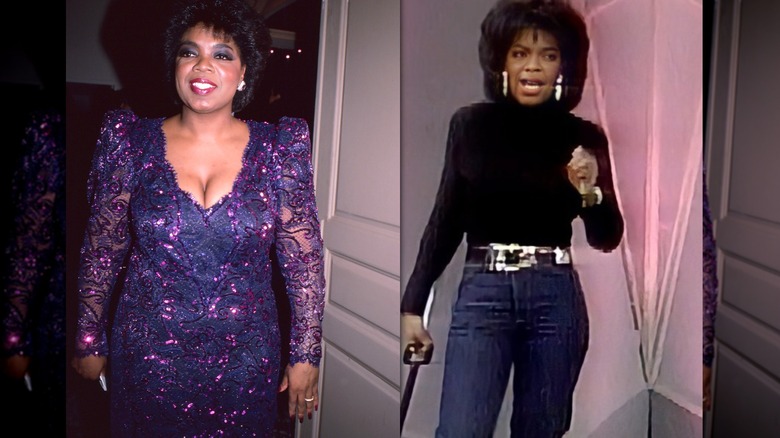
In the 1980s, Winfrey started her meteoric rise to global recognition and respect as a daytime talk show queen. But her weight always seemed to sneak into the picture. As she recalled to Jane Pauley of CBS News, "Tonight Show" comedian guest host Joan Rivers bluntly put Winfrey on the spot during a live broadcast with a: "So, tell me, you know, how'd you gain the weight?" (via YouTube). When Winfrey told her she "ate," Rivers chastised her and recommended that she lose weight.
That was 1985. By 1988, Winfrey was determined to look different, so she spent months on the liquid-only Optifast diet plan. Very rapidly, she lost enough weight to slip into a size 10 pair of jeans, which isn't surprising. As a 2018 study in Obesity showed, individuals on the Optifast meal replacement plan tended to lose weight nearly twice as quickly as those on a standard food diet plan.
To celebrate her transformation, Winfrey brought out 67 pounds of fat during her "unveiling" episode to give her audience a tangible illustration of the difference between 212 pounds (her starting weight) and 145 pounds (her stopping point). Viewers cheered, but Winfrey found the low weight hard to sustain and regained steadily over the following years. "Two weeks after I returned to real food, I was up 10 pounds," she wrote in an O op-ed, adding that the experience "shot" her metabolism.
A focus on fitness in the 1990s
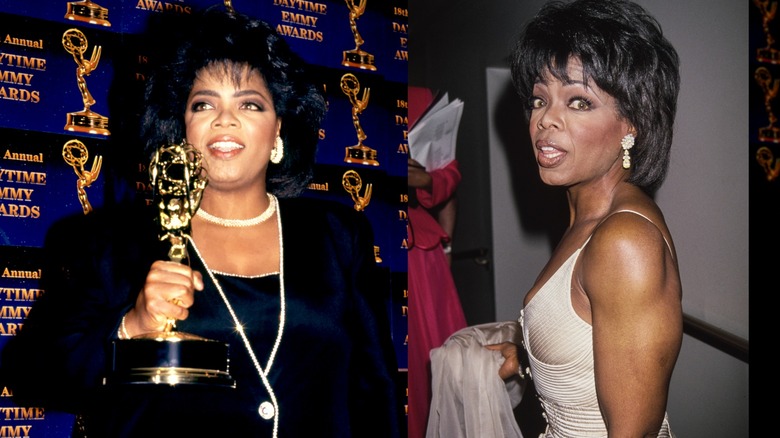
Winfrey started the 1990s overweight again, but took a different tactic to get back into better health and shape. Instead of starving herself, she began working with personal trainer Bob Greene to get stronger and leaner through physical fitness. She even co-wrote a book with Greene to help others (via The Root).
Winfrey lost 72 pounds after jumping into a full-scale training regimen, as noted by Women's Running. She even ran the Marine Corps Marathon in 1994 as a way of showcasing her new abilities. It was the only marathon Winfrey ever completed, but she made headlines for her dedication as well as her impressive completion time of just under four-and-a-half hours.
For the rest of the decade, Oprah stayed fairly trim. But her weight rose again in the coming years.
Adding pounds in the 2000s
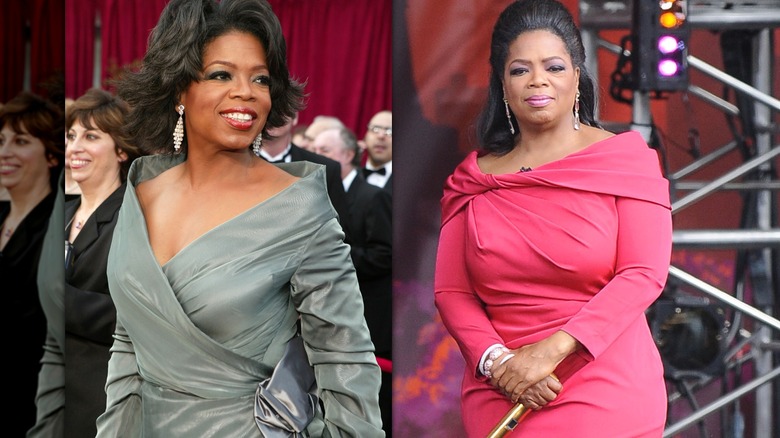
By the late part of the 2000s, Winfrey's weight crept back. Writing for O, she explained that although 2006 saw her at 160 pounds, she reached 200 pounds by the beginning of 2009. Yet it wasn't a sudden jump; as Winfrey noted, "It happened slowly."
What Winfrey discovered was that her thyroid was to blame. Specifically, she described it as being "sluggish" due to hypothyroidism, a medical condition that causes the metabolism to stop working correctly. Weight gain is often associated with hypothyroidism.
Although Winfrey tried medications for hypothyroidism, she discontinued using them by the late 2000s. At the time, she said that she was concentrating on "self-care" to help her get back to a healthier place.
Weight control remains uneven in the 2010s

Winfrey's weight stabilized above 200 pounds for a while in the 2010s. But eventually, Winfrey became involved in the Weight Watchers movement and lost 26 pounds by 2016, according to reporting by the LA Times. (Other celebrities have opted for Weight Watchers as well, including Kate Hudson and Tina Fey.) That year, she noted in an edition of her magazine, "With age comes the understanding and appreciation of your most important asset, your health" (via LA Times).
In 2017, she revealed that her weight loss had jumped to 42 pounds on the program (via ABC News). "I don't look at this as a diet; I see it as a plan for life," she said.
Embracing GLP-1s to jumpstart weight loss in the 2020s

The 2020s have been a time of renewed weight reduction for Winfrey. She's been vocal about trying Mounjaro (tirzepatide), which she says helps her stop worrying about food. Instead, the GLP-1 medication enables Winfrey to lose weight, enjoy eating, and not obsess over every bite (via People).
Winfrey went off the GLP-1 for a brief time but then realized that she needed it after her weight rose by 20 pounds despite a challenging exercise regimen. "'I was trying to eat more healthily and put the weight back on," she told the Daily Mail, according to MSN.
Winfrey has mentioned in the 2020s that she doesn't expect to stop taking the GLP-1 again because it's a "tool" that's allowing her to finally have the high quality of life — and a smaller physique — she wants. Plus, she feels differently about the science that governs the way her body responds to food, dieting, and exercise. That's why she's co-written a book with Dr. Ania M. Jastrebof, who avers that, "Obesity is not a choice; it's confused biology" (via Oprah Daily).