

Bill Clinton's History Of Health Issues, Explained

For most of the 1990s, Bill Clinton led the United States as a healthy president. Though he wasn't known for eating the most nutritious foods (his fondness for McDonald's became legendary), he didn't experience many medical problems until the very end of his second term. Clinton's first health scare occurred in 2001, just days before handing over the White House to George W. Bush. The outgoing president had surgery to remove a skin lesion from his back, which was later discovered to be cancerous.
Clinton was determined to have basal cell carcinoma, the most common form of skin cancer, one that's usually associated with being in the sun too often. While it's smart to be vigilant about identifying the symptoms of skin cancer and addressing every type of cancer, basal cell carcinoma is unlikely to grow quickly, making it easier to cure without fear of it spreading.
Chief White House spokesperson Jake Siewert said at the time (via The Guardian), "The lesion was removed, so while the president, it can be said, had skin cancer, that has been removed and he no longer has it." Siewert added, "Mr. Clinton elected to have the tissue around the lesion treated superficially with a technique called 'scraping and burning', in the event that the lesion was to be confirmed as skin cancer." Because Clinton got immediate treatment after an exam spotted the lesion early, he was able to have it cured without any recurrence.
Clinton's quadruple bypass surgery
During Bill Clinton's final medical exam as president, the one that spotted his skin lesion, his cholesterol levels were found to have increased pretty dramatically, something which would foreshadow his future cardiovascular issues. According to Clinton, cardiovascular disease runs in his maternal lineage (which is why you should pay attention to your mom's health history), a fact he admittedly didn't take seriously. Additionally, he confessed to being reckless with his eating habits. All of these elements ultimately led to Clinton having symptoms of heart disease, such as sudden shortness of breath.
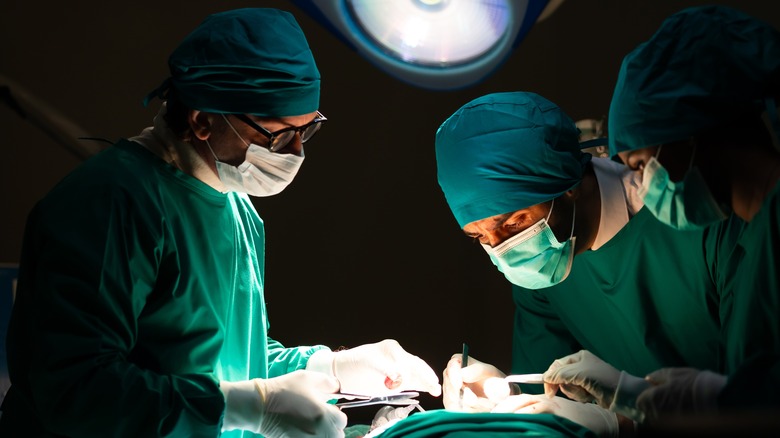
After a 2004 examination, his doctors found almost complete blockages in several of his arteries. To prevent further serious heart symptoms, they performed a quadruple bypass surgery on his heart. Clinton was 58 at the time, making him eight years younger than the average heart bypass patient age of 66.
The open-heart surgical procedure that Clinton underwent involved replacing the blocked arteries with blood vessels from his torso and his lower body, according to The New York Times. Cardiologist Dr. Allan Schwartz told the Times that if the former president hadn't gone through the treatment, "There was a substantial likelihood that he would have had a substantial heart attack in the near future."
Clinton's follow-up cardiovascular care

As a follow-up to his bypass surgery, Clinton was reportedly placed on a medication regimen that included a beta-blocker, an angiotensin-converting enzyme (ACE) inhibitor, aspirin, and a statin, which aligns with the commonly prescribed medications following a quadruple bypass or heart attack. Clinton initially recovered, but within six months, surgery-related problems caused fluid to affect the normal function of his lungs, leading to another surgery in 2005 to clean up the fluid and scar tissue.
Then, in 2010, Clinton required a follow-up heart procedure because his surgically placed veins had begun to develop blockages. Doctors inserted stents into those veins to keep the blood flowing. "It's not all that unusual six years out from bypass surgery to require such a procedure," cardiologist Dr. Jon Resar explained to ABC News at the time, adding that the procedure would likely never need to be repeated. "Across the board, there is an 80 to 90 percent chance this deals with the problem permanently," Dr. Resar said.
Clinton's infection and subsequent sepsis

As Bill Clinton aged into his 60s and 70s, his medical issues became more consistent. For example, he developed a urinary tract infection (UTI) in 2021. Though UTIs tend to be more common in women, they can occur in men as well, especially older men like Clinton, so everybody should learn how to decrease their risk of getting a UTI. Although Clinton followed the normal course of antibiotics for treating a UTI, they didn't fully clear the infection. As a result, the infection moved into his blood, and Clinton developed sepsis, a serious condition where the body overreacts to an infection.
Cases of sepsis can be fatal, leading to the deaths of roughly 11 million people annually. Physician Dr. Robert Glatter told USA Today that it's important to take any sign of sepsis seriously to avoid complications and even death. "Studies have shown that early recognition and intervention with intravenous fluids and broad spectrum intravenous antibiotics can be lifesaving," Dr. Glatter said. Fortunately, the former president took his symptoms seriously and received care. The sepsis issue was resolved, but Clinton's health continued to be uneven over the following years.
Viral encounters and curious images
Two of Bill Clinton's ensuing health conditions involved bouts with viruses, with the former president contracting COVID-19 in November 2022. He announced to his supporters on X that his case was mild, adding, "I'm doing fine overall and keeping myself busy at home." However, strains of the virus have been known to cause complications for seniors, with 81% of all deaths related to COVID-19 happening to individuals older than age 65. Clinton was 76 when he contracted the virus.
Then, in late 2024, Clinton was hospitalized overnight for a fever associated with the seasonal flu. Statistically, Clinton had two characteristics that made him more susceptible to contracting the flu: He was over the age of 65, and he'd had a history of heart disease. While the flu can cause lasting problems, fortunately, that wasn't the case for Clinton, who was discharged from the hospital on Christmas Eve after being successfully treated.
Clinton's health came into the public eye more frequently in 2025 after unusual images of him raised some alarms. A June 2025 video showed the former president lightly stumbling in New York City, looking visibly frail and needing to grab onto a pole to stabilize himself. Then, in August 2025, a photograph captured Clinton disembarking a plane with what looked like a portable personal defibrillator, which someone might use if they had heart issues that could potentially lead to cardiac arrest. Finally, in November 2025, Clinton was seen hugging his daughter, Chelsea Clinton, after her completion of the NYC marathon. However, he was wearing a bandage over the end of his nose, which was never explained by his team, only compounding increased rumors about Clinton's health.