

Meghan Markle & Prince Harry's Stance On Smartphones For Their Kids May Protect Their Health

Prince Harry, Duke of Sussex, and Meghan Markle, Duchess of Sussex, are proud parents to two young children, Archie (born in 2019) and Lilibet (born in 2021). Since they welcomed their two kids, the pair has become outspoken on the topics of parenting. In previous years, Prince Harry openly discouraged the presence of video games in young children's lives, and Markle shared her approval of lunchbox notes. Needless to say, like any other set of parents, the royal couple has certainly curated a personal parenting style.
And, though they're far from the world of personal tech, the prince and duchess have shared that they have already discussed the topic of phones for their young ones. "We talk about it a lot," Prince Harry said on Hasan Minhaj's podcast, "Hasan Minhaj Doesn't Know." "I think that because of what we know now, we will be way more cautious and hesitant of allowing our kids to have access to social media, but the problem is, so many parents don't have that awareness" (via People).
Their forward-thinking decision reflects a growing medical concern tied to children's phone usage. In a December 2025 CBS News report, Dr. Ran Barzilay, an award-winning pediatrician at the Children's Hospital of Philadelphia, discussed a recent study he had conducted, which found that children with phones exhibited more depression, higher rates of obesity, and worse sleep than kids who did not have personal devices.
The royals have urged that parents band together against the force of phones
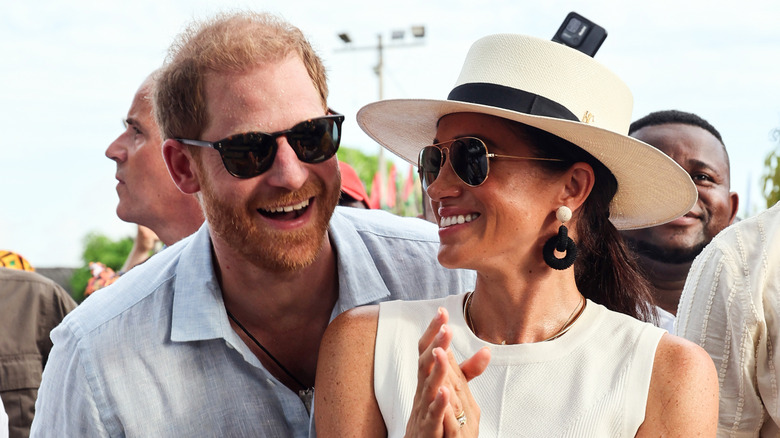
Prior to their announcement of their anti-phone agenda, the Sussexes had been transparent about their mental health and the importance of children's mental health. It's no secret that the rise of personal devices and social media has been linked to a decrease in young people's mental health, and the duke and duchess have taken to leading the fight against the media machine to protect the most vulnerable in our community. Meghan Markle spoke plainly about the dangers of phones in the hands of children while unveiling a memorial in New York, saying, "It is a universal truth that our children are in harm's way by what's happening online" (via CBS).
Prince Harry echoed a similar sentiment on World Mental Health Day: "I've said in the past that at least to a certain extent, families and parents used to know that your kids were safe under your own roof. We can't say that anymore" (via Vanity Fair). Digital safety is hard to manage, especially with young kids, a concept that the prince also touched on in his podcast interview (via People). "Because in no logical, fair, ethical, moral world, should a parent have to consider this app, that sits on the phone — which by the way, having a phone for your kid is a really important thing — but the moment that you give them the gateway to everything else, kids will be kids," he said.
What do the experts say about children's phone usage?
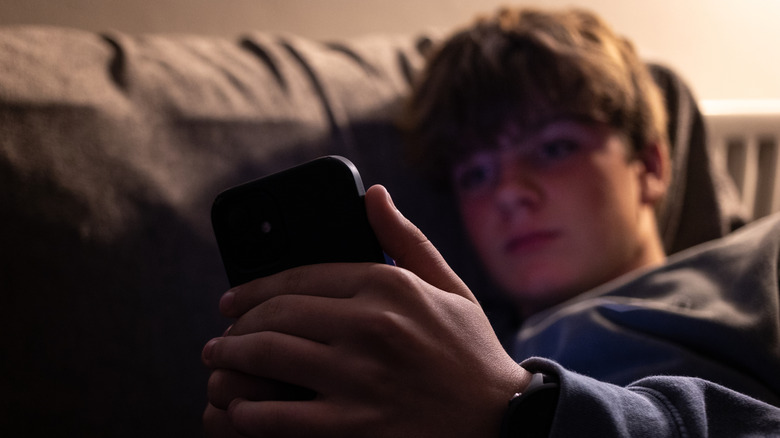
The royals haven't invented this line of questioning toward children's connections to phones. In fact, medical experts have long encouraged parents to postpone their children's access to personal devices since the boom of cell phones. And, in recent years, as social media has seeped into society by creating society itself, the power phones hold in young people's lives has become astronomical. Prince Harry said it himself: "The easiest thing to say is to keep your kids away from social media. The sad reality is the kids who aren't on social media normally get bullied at school because they can't be part of the same conversation as everybody else" (via BBC).
Dr. Ran Barzilay spoke of a parent's role in managing the connection of their child to their phone: "When you give your kid a phone, you need to think of it as something that is significant for the kid's health — and behave accordingly" (via The New York Times). And his concern was further voiced by Dr. Sandra Fritscher, who also offered a small tip: "Most kids already have access to digital technology, either through iPads or laptops, and things like that. Assess what's going on in that landscape and their ability to do things without technology. When they're being told it's time to put away their devices, it's a good sign if they do that with no protest and no difficulties" (via Children's Hospital of Colorado).