
Reese Witherspoon Took An Outside-The-Box Approach To Dealing With Her Anxiety
More than 19% of people in the United States live with an anxiety disorder, per the National Alliance on Mental Illness. Fortunately, numerous types of treatments — including medications and psychotherapy — are available to help people better cope with the overwhelming feelings associated with anxiety.
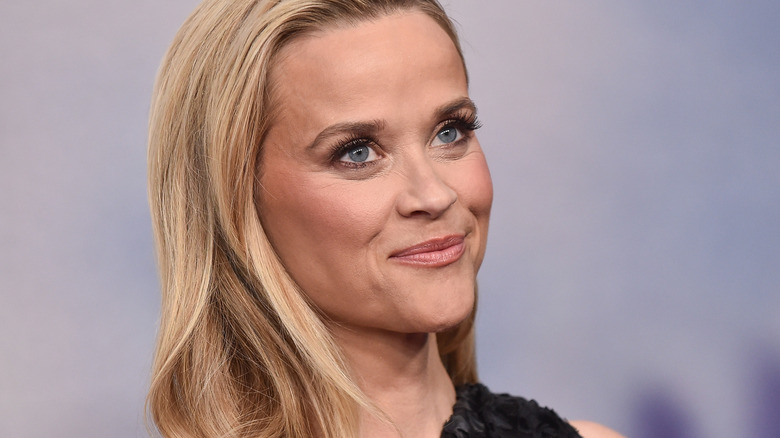
But not everyone responds in the same way to treatment, which is why Reese Witherspoon turned to a less orthodox way to ease her anxiety. For Witherspoon, the right answer turned out to be hypnotherapy. In a 2024 article in the National Enquirer, a source close to Witherspoon explained that "the experience [hypnotherapy] changed her life." The source added that Witherspoon has at least one appointment a week with her hypnotherapist.
Witherspoon confirmed this information on the "Las Culturistas" podcast, noting that she tried Ativan, a drug that is commonly prescribed for the treatment of anxiety. However, she said the drug made her feel "like a zombie," although she was quick to add that people with anxiety should feel comfortable doing whatever they needed to do to help themselves and not simply do what she did. (A popular anxiety medication, Ativan, can have harmful effects.)
If you or someone you know needs help with mental health, please contact the Crisis Text Line by texting HOME to 741741, call the National Alliance on Mental Illness helpline at 1-800-950-NAMI (6264), or visit the National Institute of Mental Health website.
Alternative therapies to prescription drugs
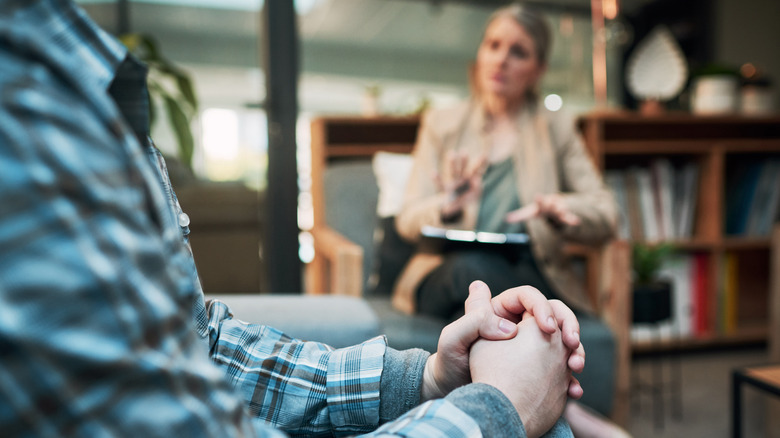
In the podcast episode, Witherspoon mentioned that her hypnotherapist relied on a practice called neuro-linguistic programming (NLP) during their sessions. NLP is thought to create a stronger sense of self-awareness by assisting people in reframing situations and creating different associations to produce more positive emotional responses. While NLP can be practiced in any therapeutic setting, Witherspoon has said that she uses it in tandem with hypnosis. Hypnosis induces a meditative state; once a person is in that state, the individual may be better guided to adopt NLP strategies (per NLP-Techniques).
Witherspoon appears to have found success by using NLP and hypnotherapy. Yet neither solution is a surefire winner for everyone. A 2022 study in the Journal of Nursing Management found that NLP could help nurses work toward a professional goal. That said, a 2014 report from the Canadian Agency for Drugs and Technologies in Health concluded that there was no supporting proof that NLP could effectively resolve cases of generalized anxiety disorder (GAD).
Support for the application of hypnosis
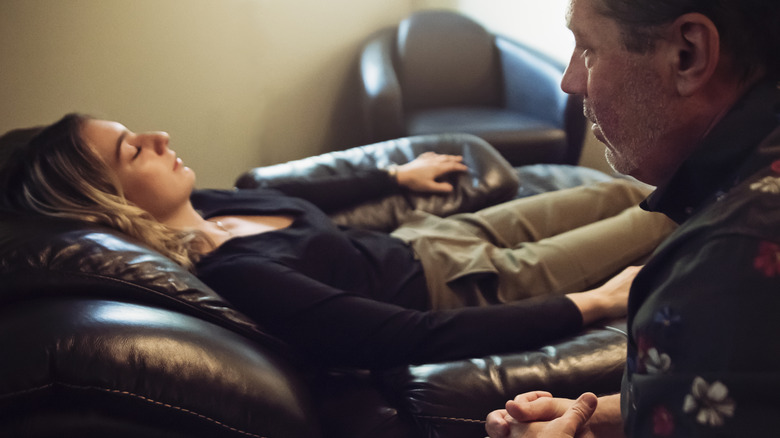
Although NLP hasn't been given a green light by every review, hypnotherapy seems to be a much more proven way to address mental health issues. A 2019 review in the International Journal of Clinical and Experimental Hypnosis showed that people who underwent hypnotherapy for anxiety experienced improvements that were 79% more significant than their peers who didn't undergo hypnotherapy as part of their treatment.
Likewise, a 2025 review in the Journal of Psychosomatic Research concluded that hypnosis lessened both anxiety and pain. Additionally, the review discovered that few unwanted effects occurred among those who went through with hypnosis.
Witherspoon isn't the only celebrity who has turned to hypnosis as a way to improve her health. Singer Adele leveraged hypnotherapy to address her stage fright, actor Matt Damon reportedly quit smoking through the application of hypnosis, and pop star Fergie said she used hypnotherapy to stick with a nutritious eating plan.