

Why Won't Prince Harry Embrace His Hair Loss? Research Explains Why He's Not Alone
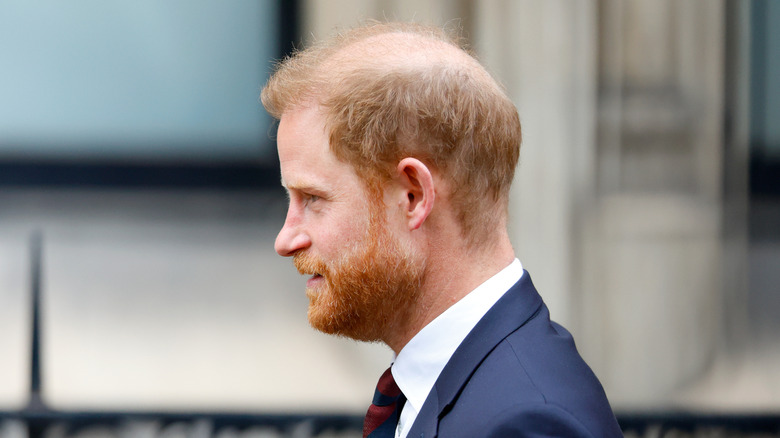
Royal brothers Prince William and Prince Harry share a history of male pattern baldness, a condition that can affect up to half of men and often has a genetic link. However, while the former has seemed to embrace his hair loss (he shaved his head in 2018), the latter hasn't been as willing to say goodbye to his locks. Case in point was Harry's head-scratching tress transformation at the Sundance Film Festival in 2026.
A couple of days before the event, Harry was photographed with plenty of scalp showing on the top of his head. Yet at the event, his hair seemed much fuller, leading at least some people on social media to speculate that he may have used hair dye (which could have dyed his scalp as well), hair fiber spray, or a combination of both strategies (via OK!).
Harry's decisions make top headlines because of his status. Plus, he once criticized his brother's baldness quite bluntly, describing the hair loss as "alarming" in his 2023 memoir (via Page Six). Still, he's hardly the first or last man on earth to want to have (or appear to have) more scalp hair. In fact, research shows that losing hair and the outward symptoms it causes, although not unusual, can still be quite emotional for men.
Excessive hair loss, higher risk of declining mental health
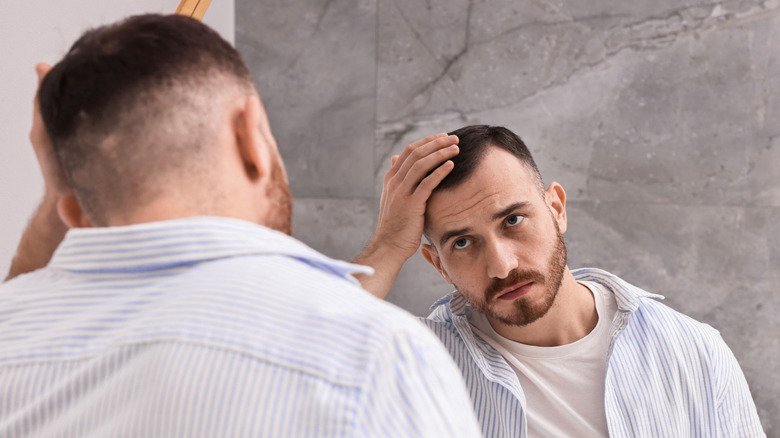
For example, a 2022 review of 13 studies that was published in the Journal of Dermatology revealed a strong correlation between psychological distress and hair loss. In one study, nearly a third of men said they were preoccupied by their hair loss and coped by trying to cover up their baldness with hats or merely dressing particularly nicely, among other adaptive solutions. The overall consensus of the review team was that hair loss had the propensity to negatively affect quality of life.
Similar results came from a 2021 review of 41 studies available in JAMA Dermatology. The review concluded that there was a connection between baldness and deficits in emotional and physical health. The review recommended mental health support as a potential therapy. Likewise, a 2025 review in SSRN showed a decline in self-esteem (up to 35%) and increased rate of depression (up to 25%) in men with hair loss.
The tangled relationship between stress and continuing hair loss
These and other studies reveal what many people know at some deeper level: We place a huge importance on hair. What's worse is that as our mental health is affected by our feelings, our physical health can wane. According to the United States Centers for Disease Control and Prevention, lasting depression can have unwanted health effects on the cardiovascular and other human systems. And Prince Harry has candidly said that he has both anxiety and depression anyway.
What's especially ironic about the association between hair loss and stress is that the experience doesn't just have the potential to harm someone on the inside. It can produce visible expressions, as well — including additional hair loss. The U.S. National Institutes of Health notes that hair can start falling out when stress goes up, a disorder called telogen effluvium. Therefore, the higher the stress someone feels about their hair loss, the worse the issue might become. Although, the outward effects (e.g., hair thinning) of telogen effluvium can be reversed whereas genetically related hair loss (like William and Harry seem to have) typically continues.