

Side-By-Side Pics Of Celebrities Who Got Transplants To Compensate For Hair Loss

Going bald might be inevitable depending on your genetics and other factors, but living with a sleek scalp or patchwork of thin spots doesn't have to be. Plenty of men (and women) have taken steps to permanently restore the lushness of their tresses by combatting their receding hairlines with hair transplants. In fact, some well-known celebs have taken the plunge to restore their manes.
Before you assume that they're taking a chance, you should know that when hair restoration is handled by a pro, the treatment is statistically safe. As the American Society of Plastic Surgeons attests, hair transplantation carries minimal risks. But it's not always effective forever. A 2020 study in the Journal of Cutaneous and Aesthetic Surgery showed that after four years, only 9% of hair restorations looked as good as they had one year post-surgery. However, the study was only conducted on those who underwent a follicular unit transplant (FUT), which is only one type of procedure. (Follicular unit extraction, or FUE, is gaining popularity because it's less invasive, but it's not right for every individual.)
Even if the long-term odds may be a little on the lower side, the stars who've lined up for hair transplants don't seem to be having a bad (hair) day. On the contrary, they seem to be pleased by their new 'dos.
Joel McHale
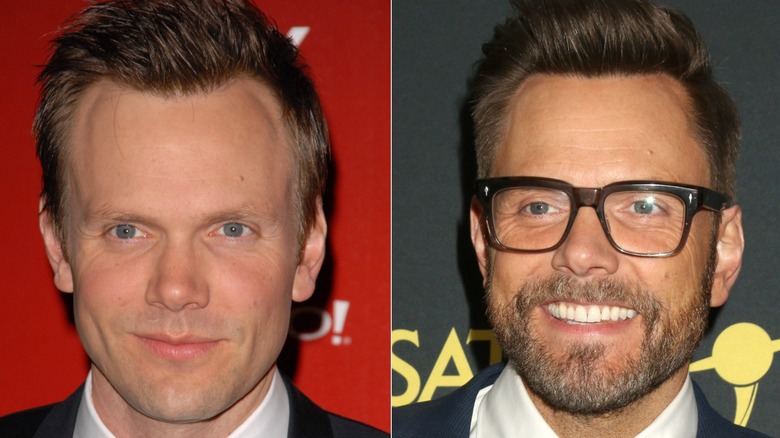
It's always nice to hear the honest-to-goodness scoop about a hair transplant from the transplantee rather than the rumor mill. And Joel McHale has been an open book about how he dealt with male-pattern baldness.
In a 2025 episode of the We Might Be Drunk podcast, McHale talked about the four transplants he's had. The first three were all FUTs, a process that involves relocating a thin strip of hair from the back of the head to above the forehead. McHale said he didn't recommend FUT due to the pain; instead, he suggested that listeners consider FUE, which he referred to as "plucking" on the show. FUE is a process that transplants individual hair follicles from thick areas to thin areas. (Yes, it takes a long time — but most patients are under sedation, so the time flies faster, according to at least one GQ writer's account.)
During the podcast, McHale explained, "Now they pluck it from the whole back section, and it's a miracle." He also said the price tag for his hair treatments was roughly $10,000. Since it's cosmetic in nature, hair transplantation isn't usually covered by insurance. That said, McHale warned against going with the lowest bidder, noting that "if somebody is like, 'I'll do it for $3,000,' then you don't."
John Cena
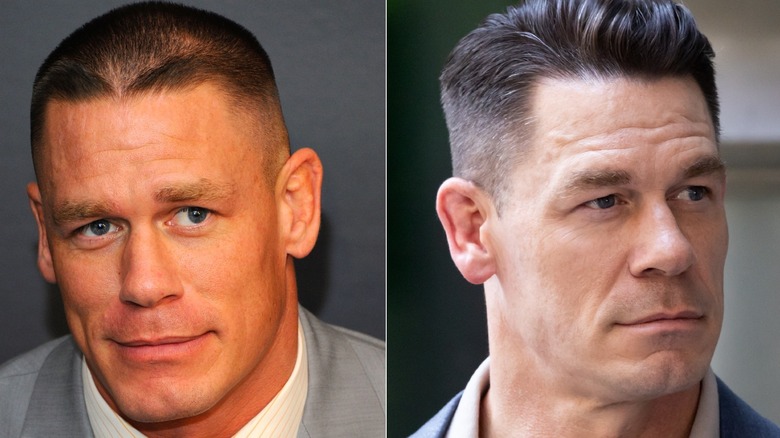
Bullying can be hurtful, even to a tough guy like professional wrestler John Cena. He admitted to People that taunting from the crowd affected him enough to take bold action. "I saw their signs that said 'The bald John Cena,'" explained Cena. "They pushed me into going to see what my options were."
In addition to a hair transplant, Cena began using minoxidil, a well-known hair loss prevention medication, and taking vitamins. He also mentioned the use of red light therapy. In a 2014 study on women in Lasers in Surgery and Medicine, regular red light therapy improved their hair growth by 37%.
Why would Cena need such an involved regimen after a hair transplant? Individuals who are losing their hair will continue to lose more hair after a transplant. As such, the transplant area may begin to look thicker than the rest of the hair on their head, which can eventually lead to odd-looking clumps of hair amid balder areas.
Cena is happy with the results, but he's not letting haters off the hook for their insensitivity. As a guest on the Pat McAfee Show, he showed no mercy for those who sought to bring him down: "You guys ripped me to shreds for a genetic problem that I can't control" and "This isn't cool." It was the perfect clapback to put some perspective on his story. (To be honest, many other celebrity social media breaks were due to bullying.)
Joey Fatone
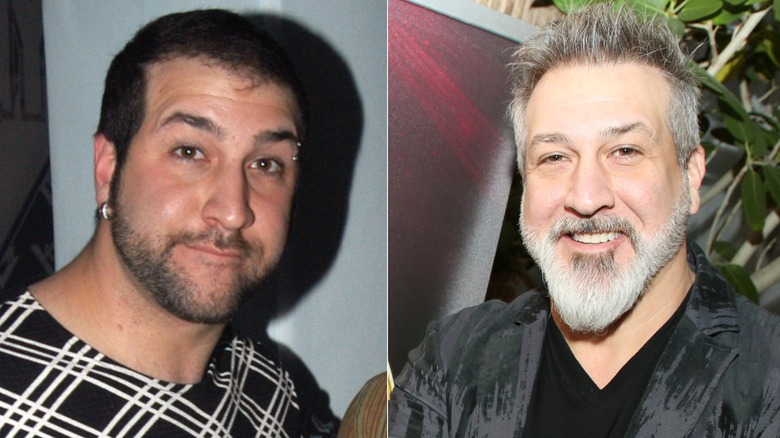
As one of the original NSYNC members, Joey Fatone has been in the public eye for decades. And throughout the years, a bald area along the right side of his crown became more obvious, along with general hair thinness.
Fatone sought help from a popular American-based treatment center to address his hair loss in the early 2010s. He's been very candid about opting for "hair plugs," although the term appears to be outdated. Hair plugging required removing larger amounts of hair from the back of the head and grafting them somewhere else. Now, hair transplant technology has advanced to allow for more subtle hair graft relocation with FUT and FUE.
Semantics aside, Fatone is clearly thrilled with his physical transformation and is pleased to bare all. "I'm never afraid to tell people about this stuff. Who cares?" he told People, adding that "a lot of men are very shy or embarrassed about it, but there's nothing to be embarrassed about." In fact, Fatone is such a supporter of cosmetic surgery that he also underwent fat reduction to minimize the fatty deposits under his chin and around his abdomen. (For the record, always learn the potential side effects of plastic surgery before following in your fave stars' footsteps.)
Boy George
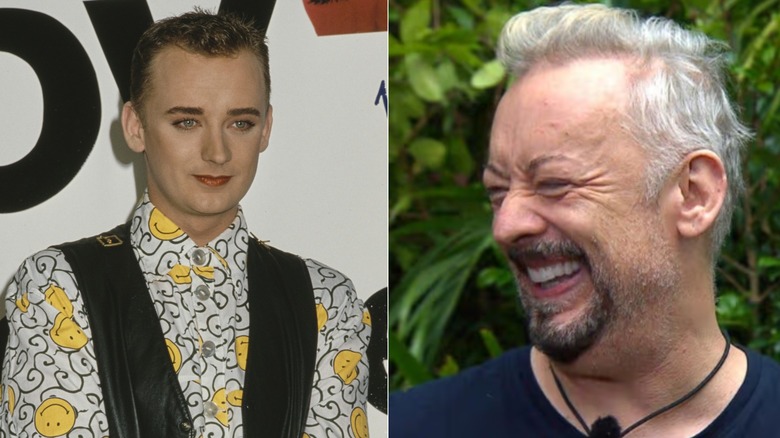
Stardom couldn't keep Boy George from losing his hair at an early age. Like many celebs, he decided to take cosmetic action and try hair restoration.
It turns out that he required multiple procedures to get the look he wanted. Per Mirror, George explained during a reality TV appearance, "I had three hair transplants around 2015–2018 — two in Ireland and a final one in LA — and the weird thing is no one remembers I was bald as a shaved badger."
In a YouTube clip from the reality show, George admitted that he took the plunge due to athletic team manager Wayne Rooney. When George saw the great results that Rooney experienced, he decided to do likewise.
George hasn't specified which type of hair restoration technique he used to regain his mane. However, at least one hair clinic has speculated that it was probably FUE, the kind that transplants hair follicles rather than strips of skin.