

Kyle Richards' Daughter Blamed Her Hair Loss On A GLP-1. Sadly, She's Not Alone
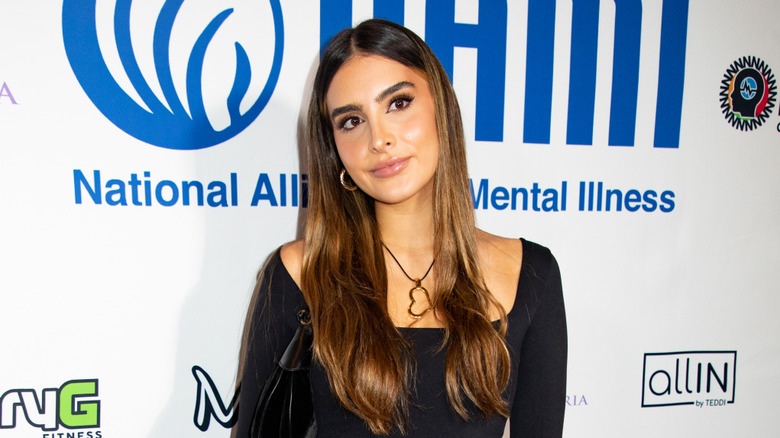
You could lose more than pounds if you try a GLP-1 like Ozempic or Wegovy. In addition to other unwelcome side effects, some GLP-1 users are coming forward to tell stories of sudden hair shedding – including reality TV celeb Kyle Richards' daughter, Sophia Umansky.
In a 2025 TikTok video, the 25-year-old Umansky shared that she started finding clumps of hair in her drains and brush after taking the GLP-1 drug Mounjaro for a few months. In the video, she gave followers a visual tour of her shower wall and bathroom sink, both containing clumps of long, dark hair. I'm gonna be bald in about a week," she claimed.
To be fair, a TikTok makeup tutorial from February 2026 shows Umansky with what looks like plenty of hair, so her prediction didn't happen. (Unless she's wearing a lookalike wig.) Of course, that doesn't diminish her shocking realization that Mounjaro seemed to be causing her hair to come out in higher-than-normal quantities.
Potential reasons behind GLP-1-related hair loss
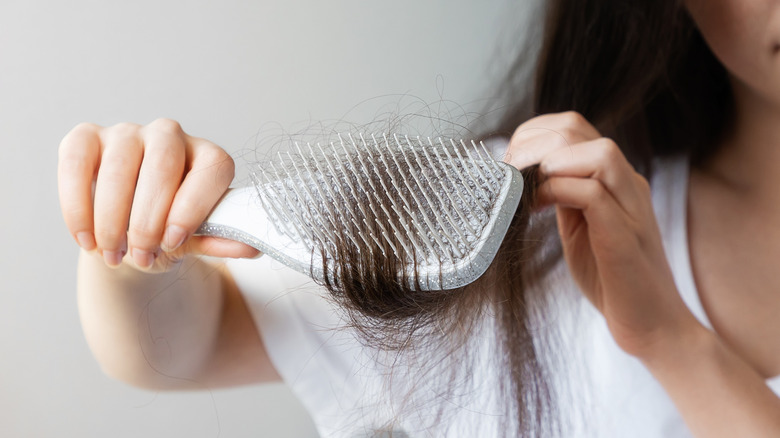
Umansky isn't alone in her experience, but the reason for this type of hair loss doesn't seem to be the drug itself. Additionally, hair loss isn't a listed side effect for the key ingredient in Mounjaro, tirzepatide. Instead, the problem seems to lie with either the foods that some GLP-1 users eat or the rapidness of the weight loss they undergo.
For instance, GLP-1s are designed to suppress appetite. They may also cause symptoms like nausea. Therefore, many people who use GLP-1s end up eating up to 700 calories less per day, according to a 2025 study in Food Quality and Preference. Plus, they don't always focus on the nutritional impact of the foods they choose. Even Umansky noted that she thought that her hair loss might be related to her picking non-nutrient-dense foods, which is why she had "really been putting in effort" to eat more mindfully.
Then there's the stress that quick weight loss has on the body. It's not unusual for individuals on GLP-1s to lose a few pounds each week. As a result, they may find themselves with telogen effluvium, which causes hair to shed faster than it typically would, but not grow at the same rate.
Ways to avoid unexpected hair loss while on a GLP-1

Fortunately, telogen effluvium generally is a reversible condition. When the stress goes away (like when you stop losing a high percentage of your body weight), the body readjusts and regular hair density returns. It may take up to six months to get a thick head of hair, but it should return.
Currently, you won't find "hair loss" as a GLP-1 side effect listed for the drug Mounjaro. Per a 2025 review in Cureus, further research is needed to prove the GLP-1-hair loss connection. Still, dermatologist Dr. Jeffrey Berti advises that users taking GLP-1s should "avoid aggressive caloric restriction, and be aware to ensure adequate daily protein intake, in addition to adding any micronutrients, especially iron, zinc, vitamin D, and B12" (via Nashville Dermatology Physicians).
However, it's always a good idea to speak with your doctor before determining if any weight loss treatment is right for you. That way, you'll be less likely to find yourself in the same unenviable position as Umansky was when she realized she was losing her locks.
(Read about millennial stars who have admitted to using Ozempic and other GLP-1s.)