

Outdated Boomer Diet Trends That Actually Deserve A Comeback
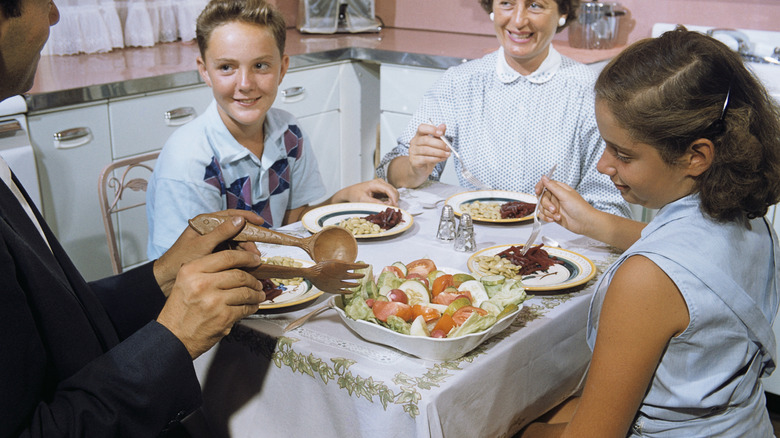
When you think of boomer weight-management strategies, your mind might automatically picture smack-my-head fads like the grapefruit or cabbage soup diets. Yet not all boomer dieting trends were off-base, offbeat, or just plain awful. In fact, some eating behaviors probably deserve a second chance among modern audiences.
This doesn't mean you should run out, buy a cookbook from the '50s, '60s, or '70s, and go full vintage with your kitchen activities. A 2015 study in The Milbank Quarterly found that boomers aren't necessarily healthier than later generations due to a general rise in obesity, among other factors. According to a 2024 study in the International Journal of Environmental Research and Public Health, obesity levels have consistently risen since 1959 (1946 marked the start of the boomer generation).
With that said, you might want to rethink the way you eat or exercise when you hear about the way that most boomers were taught to address their food and health. Certain boomer diet trends might make it easier for you to stay fit, especially if you're avoiding medications like GLP-1s (and the potential side effects of using GLP-1s).
Eating more home-cooked meals than fast food fare

Fast food culture hasn't done much good for contemporary consumers. From oversized portions to sodium- and fat-laden menu items, fast food can have a negative effect on your waistline and overall health.
Fast food was starting to find its way into communities across the United States just when the first boomers were coming of age. Yet rather than chowing on fast food items (which often have way more calories than you expect), most families at the time ate the bulk of their meals at home. In fact, research from the United States Department of Agriculture (USDA) shows that people got approximately 6% of their calories from fast food in the late '70s; 40 years later, the percentage had nearly tripled to 16%.
Though this doesn't mean that every boomer entree, side dish, or dessert was healthier, it does mean that the food was generally made with fewer preservatives and chemicals. Preparing a meal at home gives the cook more control over the quality of a meal's ingredients, enabling them to include nutrient-rich foods that aren't ultraprocessed.
Snacking as an exception rather than a rule

Today's snacking culture is a far cry from what boomers experienced. It wasn't unusual for people to wait until standard meals like breakfast, lunch, and dinner to eat instead of having snacks all day. According to National Health and Nutrition Examinations Surveys data (via FoodNavigator-USA), in the late '70s, 40% of people in the U.S. said they hadn't snacked in the past 24 hours; three decades later, that only held true for 4% of respondents. Furthermore, more than half of the respondents admitted to having at least three snacks daily.
This doesn't mean that snacking can't be good for you, but many people who snack between meals end up increasing their daily caloric intake more than they realize. A USDA chart from 2007-2008 indicates that the daily calorie value for snacks range from around 325 to 652 depending on a person's gender and age. By not snacking, you might be able to better maintain your weight without having to take any other steps. With that said, if you're on the road and absolutely have to have a snack, these are best snacks to munch on when you're on the go, according to a registered dietitian.
Keeping portion sizes modest

Mixed with eating at home and only snacking sometimes, smaller portion sizes kept a lot of people leaner several decades ago. The portions that seem standard now weren't standard for boomers during their formative years. In fact, portion sizes have expanded between two- and five-fold since the mid-twentieth century, according to a 2021 editorial in the American Journal of Public Health.
Research shows a correlation between increased portion sizes (sometimes referred to as "portion distortion") and health problems. Obesity research director Dr. Marlene Schwartz told WebMD that one reason we can't physically handle the upsurge in food volume and calories is that we're not built for supersized portions. "We are biologically ill-equipped to handle it," Dr. Schwartz said.
What can you do if you're in a "bigger portion" mindset? Mayo Clinic offers a visual list of accurate food portion sizes to help you understand what portion sizes should actually look like.
Starting off with breakfast

The rise of intermittent fasting has made breakfast less common for many people, although statistics from the USDA indicate that 85% of people eat something in the morning. Yet boomers eat breakfast far more frequently than individuals from younger generations, a spillover from their upbringing. In the 1970s, breakfast was a staple of the day. A 2023 study in the Journal of Clinical and Diagnostic Research notes that 89% of people in the United States ate breakfast in 1971.
What's the benefit of breakfast? Dietitian Regina Shvets explained to Johns Hopkins Medicine that eating right away offers the body a huge kickstart. Said Shvets, "Breakfast offers numerous benefits to people in all life stages, and it can also help with meeting certain health goals." That said, she advised that breakfast should feature a nutritious protein like eggs to get the biggest health advantage.
Making exercise and physical activity part of one's everyday routine

Exercising was more than just an add-on activity for many boomers. They didn't need to head to a gym and lift weights, run on a treadmill, or engage in a high-intensity interval training (HIIT) class. Instead, they got their movement in a more natural way because they were more active. This was especially true for moms, as shown in a 2013 study from Mayo Clinic Proceedings. The study revealed that modern mothers generally spend less time being active than their counterparts in the 1960s.
Moreover, workers expended around 100 calories more each day in the 1960s than they do now, according to a 2011 study in PLOS One. Since 100 calories daily can add up to more than 10 pounds in a year, it may be another reason why people tended to be leaner decades ago.